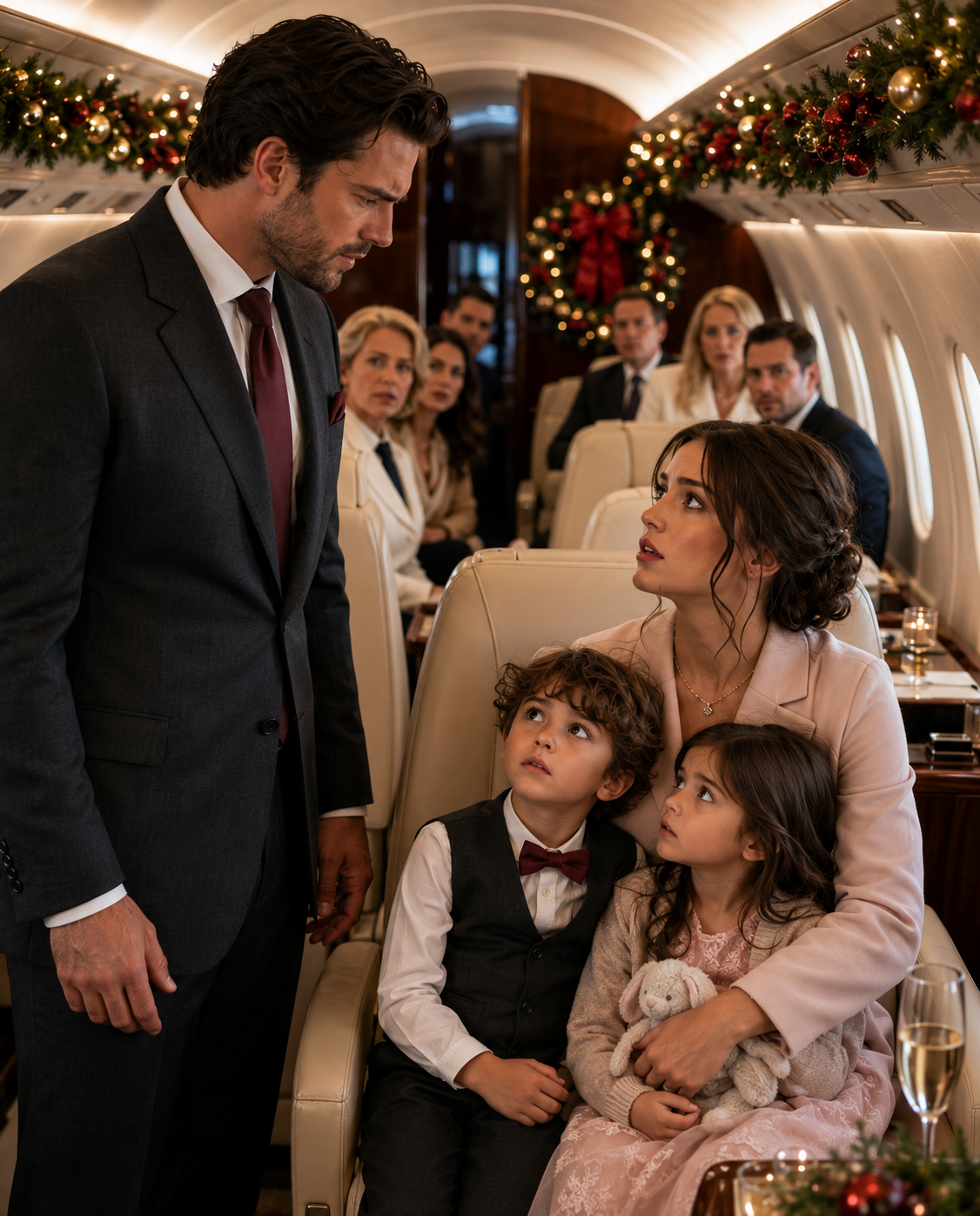

I boarded a Christmas Eve flight furious about a $780 million deal, convinced nothing mattered more than getting to Denver before midnight.The whole airport felt like it had been designed to test my patience.
Families moved too slowly. Children cried too loudly.A man in a Santa hat blocked the first-class line while trying to balance three coffees and a stroller.I stood behind him with my phone pressed to my ear, telling my acquisition team for the fourth time that I did not care about weather delays, holiday staffing, or Calder Industries making another offer.
“Get Merritt Systems in the room,” I snapped. “I’ll sign when I land.”
To me, the deal was everything.
Prescott Technologies had chased Merritt for nine months. Their medical platform could change neonatal care across the country, and I wanted it badly enough to miss Christmas, ignore exhaustion, and turn my life into one long negotiation.
My name is Damon Prescott, and until that moment, I thought I understood the cost of ambition.
Then a red crayon rolled against my shoe.
I looked down.
A little boy with sandy-brown curls and bright green eyes reached toward it.
“Sorry,” he said. “It escaped.”
He couldn’t have been more than two or three.
When he smiled, a small dimple appeared in his left cheek.
I had the same dimple.
I bent down and picked up the crayon.
“What’s your name?”
“Luke,” he said proudly.
Before I could ask another question, a woman’s voice came from three rows behind him.
“Luke, sweetheart, come back here.”
My chest tightened before I even turned around.
I knew that voice.
Cassandra Hayes stood in row twenty-eight with a little girl balanced against her hip.
Her hair was shorter now, her face more tired, but I would have recognized her anywhere.
I had once planned to marry her.
I had once believed there would never be anyone else.
The little girl in her arms had my eyes too.
“Damon,” Cassandra whispered.
I stared from Luke to the child she held and started calculating dates automatically.
Three years since Cassandra and I had broken up.
The twins looked about two and a half.
Our last night together had been almost exactly nine months before they would have been born.
The truth struck so hard I gripped the seat beside me.
“Who are these children?”
Cassandra went pale.
Before she could answer, a flight attendant touched my arm.
“Sir, please return to your seat. We’re preparing for departure.”
“We’re going to talk,” I told Cassandra.
“Not in front of them,” she said quietly.
Luke looked between us.
“Mama, do you know the angry man?”
Her answer cut deeper than I expected.
“I used to.”
I returned to first class only because aviation regulations managed to accomplish what executives, investors, and employees rarely could.
They made me sit down.
My phone vibrated before airplane mode.
The acquisition team is waiting in Denver. We need your signature before midnight or Merritt Systems may accept Calder’s offer.
Three hours earlier, that message would have consumed me.
Now two children with my eyes were sitting twenty rows behind me.
As the plane climbed into the dark Oregon sky, I looked through the gap between seats.
Luke had both palms against the window.
The little girl—Violet, I heard Cassandra call her—held a gray stuffed elephant against her chest.
Then turbulence struck.
The plane dropped suddenly, and Violet began crying.
“It’s okay, baby,” Cassandra soothed. “The clouds are just dancing with us.”
My throat tightened.
She had always done that.
When thunder scared us, she called it clouds moving furniture.
When we couldn’t afford electricity in our first apartment, she lit candles and called it indoor camping.
I unbuckled my seat belt.
The flight attendant appeared immediately.
“Sir, sit down.”
“There are children back there.”
“There are many children on this flight.”
“My children may be back there.”
For the first time, her expression softened.
“Then stay seated until the captain turns off the sign.”
Those twelve minutes felt longer than any board meeting of my life.
The moment the light disappeared, I stood and walked to row twenty-eight.
Cassandra watched me approach with one arm protectively around the twins.
An elderly woman across the aisle stopped pretending not to listen.
“May I sit?” I asked.
Cassandra’s jaw tightened.
Then she shifted just enough to let me into the empty seat beside her.
Luke stared at me curiously.
Violet hid behind her stuffed elephant.
I lowered my voice.
“Cassandra, I need the truth.”
She looked down at the children, then back at me.
“They’re yours.”
For several seconds, the entire plane seemed to vanish around me.
I had missed their births.
Their first steps.
Their first words.
Christmas mornings I never knew existed.
My voice barely worked.
“Why didn’t you tell me?”
Cassandra’s eyes filled with tears.
“I tried.”
Then she reached into her bag and pulled out a thick envelope that made my blood run cold.
Inside were letters.
Returned letters.
Certified receipts.
Copies of emails.
Hospital bracelets.
A photograph of two newborn babies lying beneath warming lights.
The first letter was dated three years earlier.
Damon, I’m pregnant. I know things ended badly, but you deserve to know.
The second letter held an ultrasound picture.
Twins.
The third was written in shaky handwriting.
Luke and Violet were born early. Violet had trouble breathing, but she’s fighting.
The fourth letter was shorter.
I won’t keep begging your office to let me reach you. If you choose silence, I’ll raise them alone.
Every letter had been sent to my company headquarters.
Every letter had been returned.
Some were stamped undeliverable.
Others were marked refused.
One email printout showed my assistant’s response:
Mr. Prescott has no personal relationship with Ms. Hayes and requests no further contact.
I stared at the name at the bottom.
Elise Warren.
My executive assistant.
The woman who controlled my calendar, calls, mail, and travel.
The woman who had told me Cassandra wanted “nothing to do with the life you’re building.”
I felt sick.
“I never saw these,” I whispered.
Cassandra’s face hardened, but her tears slipped anyway.
“I went to your office when I was five months pregnant. Security escorted me out. Elise told me you were in Singapore and that you had moved on. She said if I cared about my dignity, I would stop embarrassing myself.”
“Cassandra—”
“No.” Her voice shook. “Do you know what it feels like to sit in a hospital NICU alone, watching your daughter fight to breathe, wondering if the man who helped create her even cared if she lived?”
I had no defense.
Nothing I could say would give back those nights.
“I didn’t know,” I said.
“And that makes it better?”
“No,” I admitted. “It makes it worse. Because I built a company where someone could erase my children from my life, and I never noticed.”
Luke tugged my sleeve.
“Are you sad?”
I looked at him, and something in my chest broke open.
“Yes,” I said softly. “A little.”
He handed me the red crayon.
“You can use my happy color.”
Cassandra looked away.
I held that crayon like it was something sacred.
For the rest of the flight, we spoke in fragments.
She told me Luke loved airplanes, dinosaurs, and asking questions until adults surrendered.
Violet was quieter, stubborn, and sang herself to sleep when she was nervous.
They had been born seven weeks early.
Violet had spent twenty-six days in the NICU.
Cassandra had worked two jobs after maternity leave ended, then moved in with her aunt when rent became impossible.
“Where are you going now?” I asked.
“Denver,” she said. “My aunt passed away. Her house is being sold. I have an interview after Christmas.”
“You’re flying with two toddlers on Christmas Eve for a job interview?”
“I do what I have to do.”
The words were not bitter.
That made them worse.
My phone stayed dark in airplane mode, but my mind kept returning to the deal.
Merritt Systems.
Neonatal medicine.
The technology that could help babies like Violet.
The company I had chased because I told myself saving future children would make up for the sister I lost as an infant.
But while I was chasing medicine to save children, I had failed to find my own.
When we landed in Denver, my acquisition team flooded my phone before the plane even reached the gate.
Seven missed calls.
Twelve messages.
Final documents ready.
Board waiting.
Calder increasing offer.
Must sign before midnight.
I stood in the aisle while Cassandra struggled with a diaper bag, two coats, Violet’s elephant, and Luke’s backpack.
No one offered to help.
Businessmen pushed past her because holiday kindness apparently ended at boarding group priority.
I reached for the bag.
Cassandra flinched.
“I’m not trying to take over,” I said. “I’m just carrying a bag.”
After a moment, she let me.
At the gate, my company driver stood holding a sign with my name.
Beyond him, a black SUV waited to take me to a conference room where men in expensive suits would decide whether $780 million changed hands before midnight.
Cassandra shifted Violet on her hip and reached for Luke.
“Goodbye, Damon.”
“No,” I said.
She stopped.
“No?”
“Not goodbye. Not like this.”
My phone rang again.
My chief financial officer, Grant Bell.
I answered without looking away from Cassandra.
“Damon, where are you? Merritt’s people are already at the hotel.”
I watched Luke press his little hand against the airport window, looking at falling snow.
“I’m not coming yet.”
Silence.
Then Grant said, “Excuse me?”
“Delay the signing.”
“We can’t delay. Calder will take it.”
“Then let them try.”
“This is a $780 million acquisition.”
I looked at my children.
“I know.”
“Damon, don’t do something emotional.”
That almost made me laugh.
For years, people praised me because I was never emotional.
Now my life was collapsing because I had been too easy to separate from my own heart.
“Find out why Elise Warren blocked personal correspondence from Cassandra Hayes,” I said. “Pull mailroom records, security logs, email archives, everything.”
Grant went quiet.
“Damon, this is not the time.”
“It is exactly the time.”
I hung up.
Cassandra stared at me.
“What are you doing?”
“For once,” I said, “choosing the right emergency.”
I took them to a small airport hotel because Cassandra’s connecting shuttle had been canceled in the storm.
I paid for two adjoining rooms, ordered food, and sat on the floor while Luke drew red airplanes on hotel stationery.
Violet watched me cautiously from behind the couch.
Every time I moved too quickly, she hid.
I deserved that.
Trust had to be earned by people who showed up late.
Around ten o’clock, Cassandra put the twins to bed.
Luke fell asleep with one hand still holding the crayon.
Violet slept curled around her elephant.
Cassandra and I sat in the next room under yellow lamplight while snow tapped against the window.
“I loved you,” she said quietly.
“I know.”
“No, Damon. I don’t think you do. I loved you when you were eating ramen at midnight and fixing code with duct tape holding your desk together. I loved you before Prescott Technologies had investors, before your name meant anything. But the more successful you became, the more you treated love like an appointment you could reschedule.”
I looked down.
“You’re right.”
She seemed startled.
Maybe she had expected denial.
The old Damon would have defended himself.
The old Damon would have explained pressure, responsibility, market timing, board expectations.
But explanations were not apologies.
“I became someone I thought I needed to be,” I said. “Then I let that person run my life.”
Cassandra’s eyes softened for half a second, then guarded again.
“I’m not asking you to come back.”
“I know.”
“And I won’t let you appear suddenly and confuse them because you feel guilty.”
“I know that too.”
“Do you?”
“I want a DNA test if you want one,” I said. “I want lawyers involved, not to threaten you, but to protect you. I want to provide for them. I want to know them slowly, in whatever way you decide is safest. And I want to prove that I didn’t ignore you.”
Cassandra stared at me for a long time.
“Proof won’t change the last three years.”
“No,” I said. “But it might help me understand who stole them.”
At 11:42 p.m., Grant called again.
This time his voice was different.
“Damon, we found something.”
My grip tightened.
“Say it.”
“Elise flagged Cassandra Hayes as a security risk three years ago. There are notes in the internal system saying all mail and calls from her should be diverted. Security logs show Cassandra came to the building twice. Elise personally signed the removal order.”
Cassandra covered her mouth.
“Why?” I asked.
Grant hesitated.
“Because of Helena Voss.”
Helena was the board chair’s daughter.
The woman my investors had wanted me to marry for optics, access, and clean headlines.
I had never loved her, but I had attended events with her, allowed the press to speculate, and let my company benefit from the illusion.
“There’s more,” Grant said. “Elise forwarded copies of Cassandra’s first two letters to Helena. Helena replied, ‘Handle this before Damon ruins everything.’”
The room went silent.
I closed my eyes.
My ambition had not only cost me Cassandra.
It had surrounded me with people who believed a pregnant woman could be treated as a business risk.
“Fire Elise,” I said. “Preserve all evidence. Inform legal. And tell the board I won’t sign anything tonight.”
“Damon—”
“No deal tonight.”
“Merritt will walk.”
“Then Merritt walks.”
I ended the call.
Cassandra was crying silently.
“I thought you chose not to answer,” she whispered. “I thought I meant so little.”
“You meant everything,” I said. “But I built my life so badly that everything important could be kept from me.”
At midnight, while my acquisition deadline passed in a Denver conference room, I sat on a hotel carpet outside a bedroom door, listening to my children sleep.
It was the first Christmas Eve in my adult life that I did not close a deal.
It was the first one that mattered.
The next morning, Luke woke me by placing the red crayon on my chest.
“Santa came?” he asked.
I looked at the tiny hotel coffee maker, the vending-machine snacks, and the snow-covered parking lot outside.
“Not yet,” I said. “But I think he’s running late.”
Cassandra tried not to smile.
We found a pharmacy open three miles away and bought coloring books, mittens, toy cars, a stuffed bunny for Violet, and a cheap plastic Christmas tree barely taller than Luke.
Back at the hotel, we decorated it with paper snowflakes cut from airline napkins.
Violet finally spoke to me after breakfast.
She pointed at my face and said, “You have Luke’s smile.”
Cassandra froze.
I smiled carefully.
“Maybe Luke has mine.”
Violet considered that, then handed me her stuffed elephant.
“He likes nice people.”
It was not forgiveness.
It was not family yet.
But it was a beginning.
In the weeks that followed, the truth became public in ways I could not control.
Elise was fired and later sued.
Helena resigned from two charity boards when the emails leaked.
My board demanded damage control.
I gave them something else: my resignation as chairman, effective after a governance review.
I stayed CEO only under conditions I should have created years earlier—independent oversight, whistleblower protections, and no executive office powerful enough to erase a human being from someone’s life.
Calder did make another offer for Merritt Systems.
For a while, I thought I had lost the acquisition forever.
Then Merritt’s founder, Dr. Alan Merritt, requested a private meeting.
He was seventy-eight, sharp-eyed, and unimpressed by wealth.
“You missed the signing,” he said.
“Yes.”
“For personal reasons.”
“For my children.”
He studied me.
“Our platform exists because my grandson died in a NICU while three specialists argued over data they couldn’t access fast enough. I don’t trust men who claim to care about babies only when cameras are present.”
I said nothing.
“But I read what happened,” he continued. “And I read your proposed changes to Prescott governance. Calder wants our patents. You want redemption.”
“Redemption isn’t enough,” I said.
“No,” he replied. “But it’s better than greed.”
The deal closed three months later for less than the original offer, with stronger patient-access protections and a foundation funded in Violet’s name to support families with premature infants.
Cassandra cried when I told her.
“Don’t use her for publicity,” she warned.
“Never,” I said.
And I meant it.
The DNA test came back as expected.
Luke and Violet were mine.
But biology was the easiest part.
Fatherhood was not a signature, a wire transfer, or a press release.
It was showing up every Tuesday for dinner even when Violet refused to speak to me.
It was learning that Luke hated peas but would eat them if they were called green moon rocks.
It was sitting beside Cassandra in a pediatric waiting room without trying to control the schedule.
It was apologizing without asking forgiveness to arrive on my timeline.
Over time, Cassandra let me into more of their lives.
Not as a hero.
Not as the man who had finally discovered the truth and deserved applause.
As a father who had missed too much and had no right to waste what remained.
One year later, on Christmas Eve, we took the same route again—not because we had to, but because Luke wanted to see airplanes in the snow.
This time, we sat together.
Cassandra by the window.
Luke beside her.
Violet on my lap, holding the same gray elephant.
Halfway through the flight, a red crayon rolled under the seat and touched my shoe.
Luke gasped.
“It escaped again!”
I picked it up and handed it back.
Cassandra looked at me, and for the first time in years, there was no anger in her eyes.
Only caution, memory, and something softer beginning underneath.
“Do you ever think about that night?” she asked.
I looked at our children.
“Every day.”
“Do you regret losing the deal deadline?”
I smiled faintly.
“No.”
Violet leaned against my chest, sleepy and warm.
Luke began drawing four stick figures beneath a crooked Christmas tree.
He gave all of us green eyes.
Outside the window, clouds moved beneath us like a quiet white ocean.
Years earlier, I thought ambition meant never missing a chance.
But I had missed births, letters, tiny hospital bracelets, first words, and a woman who had loved me before the world knew my name.
I could never recover those years.
I could only honor them by never choosing the wrong thing again.
That Christmas Eve, somewhere above the snow, I finally understood the real cost of ambition.
It was not the deals you lost.
It was the people who stopped waiting for you to come home.
And by some grace I did not deserve, mine were still there, three rows behind me at first, then slowly, carefully, right beside me where they belonged.
THE END! THANKS FOR READING!