

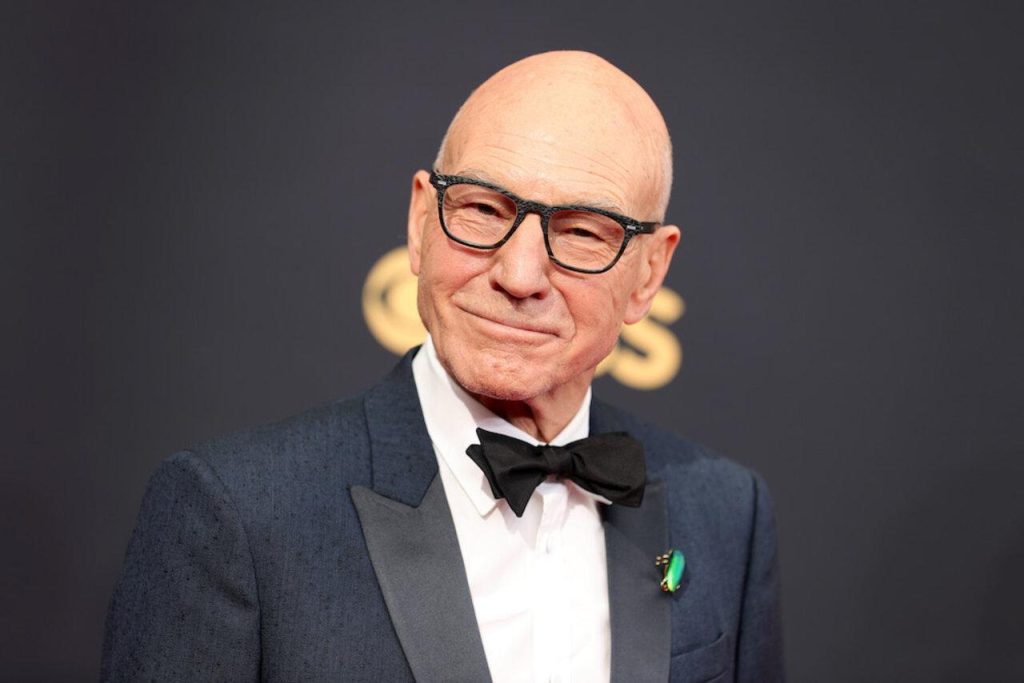
Sir Patrick Stewart, the commanding British actor whose remarkable career stretched from the stages of Shakespeare to the bridge of the USS Enterprise and the halls of Marvel’s X-Mansion, has died at the age of 86.
Stewart died at his Los Angeles home on Wednesday, October 28, 2026, following what his longtime spokesperson described as a “brief and poignant journey” with Alzheimer’s disease and Lewy body dementia. His family and close friends were with him, with music, prayer, laughter and tears surrounding his final hours.
The announcement immediately prompted tributes from across the entertainment world.
For millions of viewers, Stewart will forever be Captain Jean-Luc Picard, the thoughtful, disciplined and deeply humane commander who helped redefine Star Trek for a new generation.
For another generation, he was Professor Charles Xavier, the calm and principled leader of the X-Men whose belief in coexistence gave emotional weight to one of cinema’s biggest superhero franchises.
Yet those two roles, iconic as they became, represented only part of an extraordinary acting life.
Long before Hollywood made him globally famous, Stewart had already spent years establishing himself as one of Britain’s most accomplished classical actors.
And long after fame arrived, he repeatedly returned to the theater that had shaped him.
His death closes a career spanning roughly six decades and leaves behind a body of work stretching across Shakespeare, science fiction, superhero films, television, comedy, animation, voice acting and memoir.
From Yorkshire to Shakespeare
Patrick Stewart was born on July 13, 1940, in Mirfield, West Yorkshire, England.
He grew up in a working-class household during and after the Second World War.
His father, Alfred Stewart, had served in the British military and later worked as a laborer and postman. His mother, Gladys, worked in textiles.
But Stewart’s childhood was not peaceful.
He later spoke publicly about witnessing his father physically abuse his mother, an experience that deeply affected him and that he carried for decades before discussing it openly.
The future actor did not grow up surrounded by wealth, theatrical connections or celebrity.
His path began much more modestly.
Acting offered him something different—a place where language, imagination and discipline could create another world.
That passion eventually led him into professional theater.
In 1966, Stewart joined the Royal Shakespeare Company.
It became one of the defining institutions of his life.
The RSC says Stewart appeared in more than 40 of its productions over a 27-year association, performing a broad range of classical roles and developing the vocal authority and stage discipline that later became unmistakable features of his screen performances.
He performed works by Shakespeare and other major playwrights, appearing in productions connected with Hamlet, Macbeth, Henry IV, Antony and Cleopatra, The Winter’s Tale and many others.
His Broadway debut came in 1971 in Peter Brook’s celebrated production of A Midsummer Night’s Dream.
At that point, Stewart was a respected classical actor.
International superstardom still seemed unlikely.
Then came Captain Jean-Luc Picard.
The Role That Changed Everything
When Stewart was cast as Captain Jean-Luc Picard in Star Trek: The Next Generation in the late 1980s, he was already in his forties and primarily known for stage work.
The casting proved transformative.
Star Trek: The Next Generation premiered in 1987 and faced an enormous challenge.
The original Star Trek had become a cultural institution.
Any successor would inevitably be compared with Captain James T. Kirk, Leonard Nimoy’s Spock and the original Enterprise crew.
Picard could not simply be another Kirk.
Stewart made sure he wasn’t.
Where Kirk was often impulsive and physical, Picard was measured.
He listened.
He reasoned.
He negotiated.
His authority rarely depended on shouting.
Stewart’s classical training gave even technical dialogue a sense of weight, and his powerful baritone turned phrases such as “Make it so” and “Engage” into some of television’s most recognizable commands.
But Picard’s greatest strength was not his voice.
It was his moral seriousness.
The character believed diplomacy should precede violence.
He wrestled with ethical questions.
He respected knowledge.
He believed humanity could improve.
Stewart played Picard across seven seasons of The Next Generation, and the role turned him into an international star.
He later reprised the character in the films Star Trek Generations, Star Trek: First Contact, Star Trek: Insurrection and Star Trek: Nemesis. Decades later, he returned once again for Star Trek: Picard, which ran from 2020 through 2023.
That return carried particular emotional significance.
Picard was no longer simply a captain in command of a starship.
He was an older man confronting regret, mortality, memory, friendship and unfinished business.
Stewart brought his own age and experience to the role.
Fans who had grown older with him saw something rare: a fictional hero allowed to age visibly without losing his importance.
Professor Charles Xavier and a Second Global Franchise
Just as one generation knew Stewart as Picard, another came to know him as Professor Charles Xavier.
In 2000, Stewart appeared in the first X-Men film as the powerful telepath and founder of Xavier’s School for Gifted Youngsters.
The casting seemed almost inevitable.
Professor X required intelligence, authority, patience and moral conviction.
Stewart already embodied all four.
His Xavier believed mutants and humans could coexist even while his old friend and ideological rival Magneto—played memorably by Ian McKellen—believed conflict was inevitable.
That philosophical relationship gave the films emotional depth beyond their action sequences.
Stewart continued playing Xavier across multiple entries in the franchise through 2017, including the acclaimed Logan, and later returned to a version of the character in the Marvel Cinematic Universe.
The X-Men films also deepened one of Stewart’s most beloved real-life friendships.
He and Ian McKellen had known one another through theater, but their later work together turned them into one of entertainment’s most adored friendships.
Their playful interviews, photographs and public appearances showed audiences another side of Stewart.
Away from Picard’s seriousness and Xavier’s calm dignity, Stewart could be mischievous, silly and delightfully unserious.
His Friendship With Ian McKellen
After Stewart’s death, McKellen remembered his friend as one of the most respected and beloved actors of his generation and emphasized the Yorkshire identity that remained central to Stewart throughout his life.
Their friendship extended far beyond the X-Men franchise.
The pair also returned to the stage together.
They performed in Waiting for Godot and later appeared on Broadway in productions that paired Samuel Beckett’s play with Harold Pinter’s No Man’s Land.
The sight of two internationally famous movie stars returning to demanding theater roles delighted audiences and reinforced something Stewart never seemed to forget:
Before Picard and Professor X, he was a stage actor.
And fundamentally, he remained one.
The Stage Was Never Left Behind
Hollywood success could easily have pulled Stewart permanently away from classical theater.
It did not.
He repeatedly returned to Shakespeare and major dramatic roles.
His later stage work included a celebrated Macbeth, as well as performances in Waiting for Godot, No Man’s Land, A Life in the Theatre and other productions.
His career accumulated major honors and nominations across theater, television and recorded performance, including Olivier recognition, Emmy nominations, a Tony nomination and a Grammy Award. He was also made an Officer of the Order of the British Empire and was knighted in 2010 for services to drama.
Yet awards alone do not explain Stewart’s reputation among actors.
His technique did.
He understood stillness.
He knew how to make silence feel active.
His voice could command a room, but he also knew when not to use its full force.
Decades of Shakespeare taught him that authority onstage was not created simply by volume.
That lesson carried directly into Picard.
When Stewart stood on the Enterprise bridge and quietly gave an order, audiences believed people would obey him.
An Actor Who Could Also Laugh at Himself
One reason Stewart remained culturally relevant for so long was his willingness to make fun of the solemn image audiences associated with him.
He appeared in comedies and animated programs.
He lent his unmistakable voice to projects far removed from Shakespeare.
His appearances in shows such as Extras and Frasier demonstrated a willingness to parody his own gravitas.
He became a prolific voice performer as well, appearing in animated television, films, video games and commercials.
Younger audiences who had never watched The Next Generation sometimes encountered Stewart first through comedy or animation.
Social media brought another transformation.
Images of Stewart alongside McKellen—wearing matching hats, wandering around New York or joking with each other—made the distinguished Shakespearean actor seem unexpectedly approachable.
The stern captain, it turned out, loved being ridiculous.
Colleagues remembered that quality after his death.
Recent tributes emphasized not only his talent but his humor, generosity and warmth. Hugh Jackman remembered Stewart as a friend and mentor, while other colleagues including William Shatner, George Takei and performers from across film and television praised his intelligence, humanity and influence.
The Childhood Pain He Eventually Spoke About
Perhaps the most important work Stewart did outside acting came from something he had once struggled even to discuss.
His childhood home was marked by domestic violence.
Stewart witnessed his father abuse his mother.
For many years, he rarely spoke publicly about that part of his life.
Eventually, he decided silence was no longer useful.
He began discussing the experience openly and became a prominent supporter of organizations assisting women and children affected by domestic abuse.
In his own writing, Stewart described growing up in a home “darkened by domestic violence” and explained that his father was unable to control his anger or his hands.
This was not celebrity advocacy attached casually to a cause.
It was personal.
Stewart became closely associated with Refuge, the British domestic-abuse charity.
Following his death, Refuge remembered him as an ambassador whose willingness to speak openly about witnessing violence as a child helped break silence around domestic abuse.
Cherie Blair, also an ambassador for Refuge, recalled how unusual and powerful it was to hear a famous man speak publicly about such experiences, noting that Stewart helped show that children who witness abuse carry consequences of their own.
His advocacy also challenged another damaging assumption:
That experiencing violence in childhood inevitably means repeating it.
Stewart used his experience to argue the opposite.
Cycles can be broken.
Pain can become empathy instead of repetition.
Looking Back Through ‘Making It So’
In 2023, Stewart published his memoir, Making It So.
The title, of course, borrowed Picard’s famous command.
But the book reached far beyond Star Trek.
It reflected on poverty, family, acting, relationships, fame and the childhood experiences Stewart had once tried to distance himself from.
In discussing the memoir, Stewart admitted that for years he had been embarrassed by parts of his background and had wanted “Patrick Stewart” the successful actor to feel separate from the frightened boy he once was.
Eventually, he came to understand that separating those identities was impossible.
The childhood helped shape the adult.
The pain helped shape the empathy.
The working-class Yorkshire boy and the celebrated Shakespearean knight were always the same person.
That recognition seemed to bring him a kind of peace later in life.
A Career He Never Intended to Abandon
One of the most poignant details following Stewart’s death came from one of his final interviews.
Earlier in 2026, while discussing Star Trek and his continuing work, Stewart said he had no intention of retiring.
“I’ll always and forever be an actor,” he said.
The remark now carries added weight.
For Stewart, acting was apparently never simply a profession he expected to leave behind.
It was the organizing force of his life.
He had begun performing professionally long before Star Trek.
He continued long after he could easily have retired.
Even in his eighties, he remained connected to Shakespeare, voice work and the characters that had defined different eras of his career.
That continuity may explain why his death feels unusually significant.
He belonged to several artistic worlds at once.
Classical theater audiences knew him.
Science-fiction fans knew him.
Superhero audiences knew him.
Comedy fans knew him.
Children heard his voice without necessarily knowing his face.
Few actors build that kind of cross-generational recognition.
Captain Picard’s Unusual Legacy
Among Stewart’s many performances, Jean-Luc Picard may remain the most culturally enduring.
Picard offered television a particular model of leadership.
He was authoritative without needing to be cruel.
Intellectual without being emotionally empty.
Strong without constantly demonstrating physical dominance.
He listened to experts.
He admitted uncertainty.
He changed his mind when evidence required it.
And he treated diplomacy as courage rather than weakness.
Those qualities mattered to viewers.
StarTrek.com, in its official tribute, remembered Stewart for presenting Picard as a “reasoned, curious, thoughtful leader” whose convictions and quiet strength helped reimagine the franchise.
That may be Stewart’s most important contribution to Star Trek.
He did not simply play a captain.
He made reflection dramatic.
Professor X and the Idea of Hope
Professor Xavier carried some of the same qualities.
Xavier’s central argument was that people who feared one another did not inevitably have to destroy one another.
His methods were sometimes flawed.
The X-Men stories intentionally complicated his idealism.
But Stewart gave the character sincerity.
When Xavier spoke about tolerance, coexistence and the responsibility that accompanies power, Stewart made those ideas sound like convictions rather than superhero dialogue.
The role also allowed him to perform opposite McKellen’s Magneto, turning an ideological conflict into something deeply personal.
Two old friends.
Two visions of survival.
Two men who understood each other and still disagreed.
The emotional credibility of those scenes owed much to the performers.
A Life Beyond the Roles
Away from acting, Stewart had interests that ranged widely.
He remained attached to his Yorkshire roots and was a longtime supporter of Huddersfield Town football club.
He enjoyed motorsports, puzzles and beekeeping.
He maintained academic and cultural connections, including serving as chancellor of the University of Huddersfield for years.
His personal life included three marriages.
His first marriage, to choreographer Sheila Falconer, produced his two children, Daniel and Sophie.
He later married television producer Wendy Neuss.
In 2013, Stewart married singer-songwriter Sunny Ozell, with Ian McKellen famously involved in the wedding ceremony. Stewart is survived by Ozell and his children.
Tributes From Across Generations
The response to Stewart’s death illustrated the extraordinary range of people whose careers had intersected with his.
Hugh Jackman remembered a friend and mentor.
Ian McKellen remembered a deeply admired fellow actor.
William Shatner praised his intelligence and grace.
George Takei reflected on the way Picard represented an optimistic vision of humanity.
Marvel Studios honored the actor whose Professor Xavier became one of the defining performances of the X-Men franchise.
Actors who worked with Stewart in theater remembered the seriousness he brought to the craft.
Others remembered his humor.
Fans shared stories of seeing him at conventions, hearing him perform Shakespeare or simply encountering Picard at a moment in their lives when the character’s compassion mattered.
That breadth is unusual.
Some actors are identified permanently with one character.
Stewart somehow became inseparable from at least two.
And neither diminished the rest of his career.
The Voice That Could Fill a Theater
It is impossible to discuss Patrick Stewart without mentioning his voice.
Rich.
Controlled.
Immediately recognizable.
It was a voice shaped for Shakespeare before microphones made it famous.
He could make technical science-fiction dialogue sound almost poetic.
He could deliver a Shakespearean monologue with precision and then use the same instrument for an animated comedy.
But the voice mattered because Stewart understood what to do behind it.
He knew language.
Rhythm.
Pauses.
Emphasis.
Listening.
His performances rarely felt like a man simply waiting to deliver the next line.
He appeared to think.
That quality made audiences lean toward him.
His Final Chapter
The announcement that Stewart had experienced Alzheimer’s disease and Lewy body dementia was especially poignant because the diagnoses had not been widely disclosed before his death.
His spokesperson said his final period was brief and that he died peacefully, surrounded by people close to him.
There is something particularly moving about that ending for an actor whose work depended so heavily on memory, language and presence.
But it would be unfair to allow illness to define his final chapter.
Only months before his death, he was still speaking about acting as something permanent in his identity.
He remained connected to Shakespeare.
To Star Trek.
To audiences.
To the craft he had entered as a young man from Yorkshire with no idea where it would lead.
An Extraordinary Journey
Patrick Stewart’s life contained contrasts that almost seem fictional.
A frightened boy in a troubled working-class home became a knight.
A Shakespearean stage actor became a science-fiction icon.
A man initially uncertain about accepting Star Trek became one of the franchise’s most beloved figures.
A performer associated with intense seriousness became famous for making people laugh at his own expense.
A child who witnessed domestic violence became an advocate for survivors.
An actor who had already achieved more than most performers could imagine continued working into his eighties because acting was not simply something he did.
It was part of who he was.
A Legacy Far Beyond Hollywood
It is tempting to reduce Stewart’s legacy to Picard and Professor X.
Those characters will undoubtedly introduce him to audiences long after his death.
But his influence extends further.
It lives in generations of actors who watched how he treated Shakespeare.
In fans who saw Picard as a model of thoughtful leadership.
In children who discovered Professor Xavier through superhero films.
In survivors who heard Stewart speak openly about domestic violence and realized that silence was not compulsory.
In audiences who saw that an actor could move between Shakespeare and science fiction without treating either as beneath him.
And in colleagues who remembered not merely a commanding performer but a friend capable of enormous humor and affection.
Patrick Stewart once built a career around characters who believed humanity could become better than it was.
Perhaps that is why his performances lasted.
They carried hope without naïveté.
Picard knew humanity had flaws.
Xavier knew fear could turn people against one another.
Stewart himself knew cruelty from childhood.
None of those experiences required surrendering the belief that people could choose differently.
That belief seems woven through his work and his advocacy.
The Final Curtain
Sir Patrick Stewart died on October 28, 2026, at 86.
The Royal Shakespeare Company lost one of its distinguished longtime artists.
Star Trek lost one of the central figures in its history.
The X-Men franchise lost the actor who helped give Professor Xavier his cinematic identity.
His family lost a husband and father.
His friends lost a man they described with extraordinary affection.
And millions of viewers lost a performer whose face and voice had accompanied them across decades.
But the strange gift of acting is that disappearance is never complete.
Press play, and Picard walks onto the bridge again.
Return to X-Men, and Xavier is waiting in his wheelchair.
Listen to Shakespeare, and Stewart’s voice is there.
Watch an old interview with Ian McKellen, and suddenly he is laughing again.
A career lasting six decades leaves behind an enormous archive of moments.
Some powerful.
Some heartbreaking.
Some very funny.
Together they form the legacy of a performer who traveled further than the boy from Mirfield could possibly have imagined.
From Yorkshire to Stratford.
From Shakespeare to the stars.
From Captain Jean-Luc Picard to Professor Charles Xavier.
From private childhood pain to public advocacy.
Patrick Stewart spent his life showing audiences what dignity, intelligence, vulnerability and authority could look like onstage and onscreen.
The final curtain has fallen.
But the work remains.
And generations of audiences will continue hearing that unmistakable voice whenever Captain Picard gives the order that became inseparable from the man who played him:
“Make it so.”
THE END! THANKS FOR READING!