
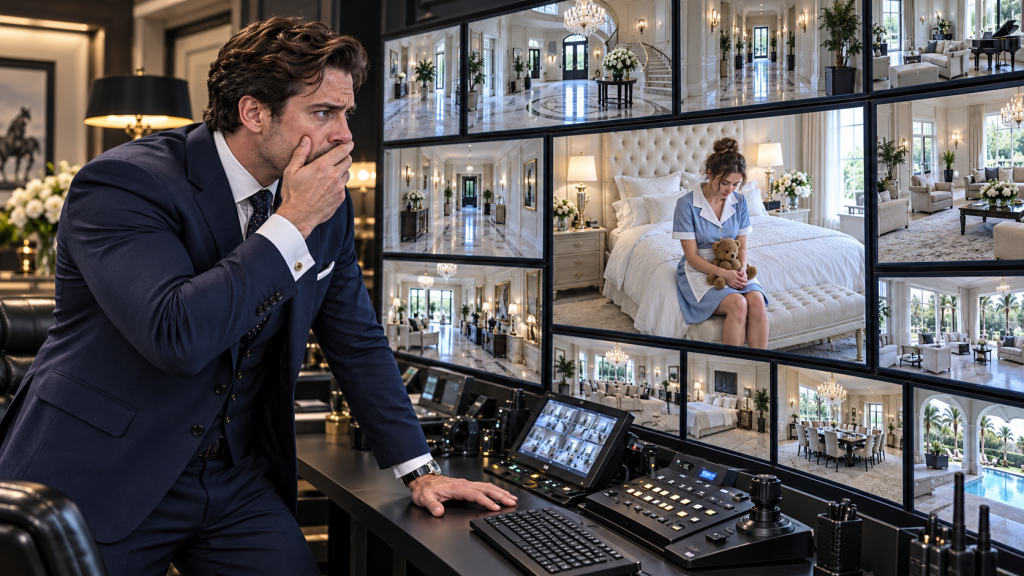
PART 2 “Hector,” I said, already moving toward the door. “Unlock it.” He did not move. “Mr. Vance—” “Now.” His expression remained professional, but his voice hardened. “We should preserve the footage first.”
I stopped.
Every instinct in me wanted to storm into the living room, pull Chloe away from my daughters, and make her answer for every second I had just watched.
But Hector was right.
If I went charging in without thinking, Chloe could lie.
Minimize.
Claim it happened once.
Say the girls provoked her.
Accuse Marisol of manipulating the recording.
I had spent twenty years in business learning that people rarely confess when cornered.
They rewrite.
I looked back at the monitor.
Marisol had released Chloe’s arm but remained between her and Sofia.
Chloe’s face was twisted with rage.
“You put your hands on me again,” Chloe hissed, “and I’ll have you deported so fast you won’t even have time to pack.”
My stomach turned.
Marisol’s expression changed.
Not fear.
Something sadder.
Recognition.
As if she had heard that threat before.
She lowered her voice.
“I am a permanent resident, Miss Chloe.”
“I don’t care what you are.”
Valeria whispered:
“Please stop.”
Chloe snapped toward her.
“You don’t speak unless I ask you a question.”
My daughter flinched.
That was enough.
“Hector.”
He nodded.
“Footage is duplicating to secure storage now.”
“How long?”
“Thirty seconds.”
I watched the progress bar.
It felt like thirty minutes.
Then Hector said:
“Done.”
I walked out.
Not ran.
Walked.
That surprised even me.
My whole body felt cold.
By the time I reached the living room, Chloe had retrieved Sofia’s rabbit from the shelf.
She was holding it above her head.
Sofia was crying.
Marisol stood beside the girls.
Then Chloe heard my footsteps.
She turned.
The rabbit slipped from her hand.
For one second, nobody moved.
“Alexander?”
I looked at my daughters first.
Sofia’s face was wet.
Valeria looked terrified.
Then relief spread across both of them.
“Daddy!”
They ran to me.
I dropped to my knees and pulled them against my chest.
Sofia buried her face in my shoulder.
Valeria gripped the back of my jacket.
I could feel both of them shaking.
That nearly destroyed me.
Not the video.
Not Chloe’s face.
The fact that my children felt safer the second they saw me, yet had been too afraid to tell me what was happening.
I looked at Marisol.
“Are you all right?”
“Yes, sir.”
Then I saw faint red marks on Sofia’s wrist.
Everything inside me went still.
Chloe took a step toward us.
“Alexander, I can explain.”
I stood.
“No.”
She blinked.
“What?”
“You’re going to leave the house.”
Her face changed.
“What are you talking about?”
“You’re leaving now.”
“Because of her?”
She pointed at Marisol.
That told me she still did not understand.
I said:
“Because I watched you.”
Silence.
Her face drained.
“The cameras.”
I watched realization arrive.
Not guilt.
Fear.
“You were spying on me?”
“It’s my home.”
“You told me you were in Canada.”
“I lied.”
Her eyes widened.
“You set me up?”
“No.”
I shook my head.
“I gave you privacy.”
“You tricked me.”
“I gave you forty-five minutes in a house where you believed no one was watching.”
She stared at me.
“And you chose to terrorize two children.”
“That is not what happened.”
Of course.
Rewrite.
I almost admired how quickly it started.
“They were being disrespectful.”
“They were reading.”
“They have become spoiled.”
“They are nine and six.”
“You don’t understand what they’re like when you’re gone.”
I looked toward Valeria.
She pressed herself closer to me.
“I understand more now than I did an hour ago.”
Chloe glanced toward Hector, who had entered behind me.
Her voice changed immediately.
Softer.
Controlled.
“Alexander, this should be private.”
“No.”
She looked around.
“Not in front of staff.”
Marisol flinched slightly.
Staff.
Not people.
Not someone who had protected my daughters.
Staff.
I turned to Hector.
“Please have security collect Ms. Bennett’s personal belongings from the guest suite.”
Chloe stared.
“Excuse me?”
“She is not to return to the property without arranging it through counsel or security.”
Her face hardened.
“You can’t throw me out. I live here.”
“You maintain another residence.”
“That’s not the point.”
“You are not staying in this house tonight.”
She stepped closer.
“What about the wedding?”
That almost made me laugh.
“The wedding is canceled.”
Sofia looked up at me.
“Really?”
The hope in her voice made me feel sick.
I crouched again.
“Yes, sweetheart.”
She began crying harder.
But these tears were different.
Relief.
Valeria wrapped both arms around her.
Chloe saw it.
Her face twisted.
“You see? This is Marisol. She has turned them against me.”
“No.”
Valeria spoke before I could.
Her voice shook.
“Marisol told us not to hate you.”
The room froze.
Chloe stared at her.
“What?”
Valeria looked at me.
“Every time Chloe was mean, Marisol said we should tell you.”
I swallowed.
“Why didn’t you?”
Valeria’s eyes filled.
“Because Chloe said you would send Marisol away if we complained.”
I looked at Chloe.
She went pale.
Sofia whispered:
“She said you loved her more than us.”
That sentence hit me harder than anything on the recording.
I stood slowly.
Chloe opened her mouth.
I raised one hand.
“Do not.”
She stopped.
“Do not explain that.”
“Alexander—”
“Do not say my name like this is a misunderstanding.”
Hector stepped closer.
“Ms. Bennett, I’ll escort you upstairs.”
Chloe looked at me.
“You’re choosing the housekeeper over your fiancée?”
“No.”
I said it calmly.
“I am choosing my children over the woman who frightened them.”
Her face crumpled.
Then, finally, tears.
I had seen Chloe cry before.
At movies.
At charity galas.
When her dog died.
This time I felt nothing.
Because whatever pain she felt now had arrived after consequences.
My daughters’ fear had arrived before anyone was watching.
Chloe left the estate forty minutes later.
No scene.
No dramatic throwing of luggage.
Security carried two suitcases to her car.
She stood beside the front steps.
For a moment, she looked toward the house.
Then drove away.
I watched from the window.
Sofia held my hand.
Valeria stood on my other side.
Marisol remained near the kitchen.
Too far away.
As though she expected to be next.
I turned.
“Marisol.”
“Yes, Mr. Vance?”
“Come sit.”
She looked uncertain.
“Please.”
She came into the living room.
I gestured toward the sofa.
She sat on the edge.
I stayed across from her.
The girls sat beside me.
Then I asked the question I was afraid to ask.
“How long?”
Marisol looked down.
“Sir…”
“How long has Chloe treated them like that?”
Silence.
“Please.”
She exhaled.
“About four months.”
Four months.
I had proposed to Chloe seven months ago.
She moved into the estate five months ago.
I felt physically ill.
“Why didn’t you tell me?”
Marisol’s eyes filled.
“I tried.”
I stared.
“When?”
“Twice.”
I searched my memory.
She continued.
“The first time was after your trip to Tokyo. I asked if I could speak with you privately.”
I remembered.
Barely.
I had been late for a conference call.
“What did I say?”
“That we could talk later.”
I closed my eyes.
Later never came.
“The second time?”
“After Miss Chloe threw away the girls’ drawings.”
Valeria looked down.
I remembered coming home that week.
Chloe told me the playroom had been cluttered and Marisol resisted “basic organization.”
“What happened?”
Marisol spoke carefully.
“She told me if I interfered again, she would tell you I was stealing.”
Everything connected.
The earrings.
The cash.
The perfume.
I stared.
“Were those accusations true?”
“No, sir.”
“I believe you.”
She began crying.
Not dramatically.
Quietly.
“I thought if I lost this job, I would lose the girls too.”
Sofia immediately climbed off the sofa and hugged her.
Marisol closed her eyes.
I looked away.
I did not deserve the intimacy of that moment.
Not yet.
Because I had failed them all.
I had not abused my daughters.
But I had built the conditions where someone else could.
Distance.
Absence.
Automatic trust.
A house so large that fear could live in one room while I lived in another.
That night, nobody slept.
The girls stayed in my bed.
Marisol remained in the guest room because Sofia refused to let her leave.
Hector sent the video files to our family attorney and secured duplicates.
I canceled every meeting on my calendar.
Toronto.
New York.
Singapore.
Gone.
At three in the morning, Valeria whispered:
“Daddy?”
“Yes?”
“Are you mad at us?”
I turned toward her.
“What?”
“For not telling.”
My chest tightened.
“No.”
“But you look mad.”
“I’m mad at myself.”
“Why?”
I stared at the ceiling.
Because I had believed adult charm over childhood silence.
Because I had confused financial security with parenting.
Because I had thought hiring good people meant I could be absent without cost.
But she was nine.
So I said:
“Because I should have noticed sooner.”
Valeria thought about that.
Then:
“Chloe was nice when you were home.”
“I know.”
“That’s why we thought you wouldn’t believe us.”
I closed my eyes.
That was the part I would never forget.
Not that Chloe deceived me.
That my daughters believed the deception was stronger than their voices.
PART 3
The next morning, I called three people.
My attorney.
A child therapist.
And Chloe.
The first two were practical.
The third was necessary.
She answered immediately.
“Alexander.”
“I need answers.”
“I’ve been waiting.”
I ignored that.
“Did you take the earrings?”
Silence.
“No.”
“The cash?”
“No.”
“Perfume?”
“No.”
“Then why did you say they were missing?”
Another silence.
“I thought Marisol was getting too comfortable.”
“What does that mean?”
“She acted like she ran the house.”
“She cooked, cleaned, managed schedules, and cared for the girls.”
“Exactly.”
I stared out the office window.
“So you invented theft?”
“I wanted you to create boundaries.”
“That is not an answer.”
She exhaled sharply.
“Yes.”
There it was.
Not lost items.
A story.
Designed to make me distrust the person my daughters trusted most.
“Why?”
“Because you were supposed to build a life with me.”
“We were.”
“No.”
Her voice broke.
“You already had a family.”
I said nothing.
She continued.
“You had the girls. Marisol. The memory of Elena everywhere.”
My late wife.
That name stopped me.
“What does Elena have to do with this?”
“Everything.”
I felt cold.
“You still had her clothes boxed upstairs. Her photographs. The rabbit.”
I looked toward the living room.
Sofia’s rabbit.
The last gift from her mother.
“You resented a dead woman?”
“I resented living in her house.”
“It’s my house.”
“You know what I mean.”
“No.”
“I was supposed to become your wife. But every room told me I was replacing someone.”
“You were not replacing Elena.”
“That’s exactly the problem.”
I finally understood.
Chloe did not want to join my family.
She wanted to overwrite it.
The girls’ attachment to Marisol reminded her that she was not their mother.
The photographs reminded her Elena had existed.
The rabbit represented love she could not control.
Marisol’s presence represented loyalty she had not earned.
So she attacked each one.
Not with some elaborate master plan.
With small acts.
Removing drawings.
Restricting rooms.
Threatening Marisol.
Teaching my daughters that peace depended on obedience.
I asked:
“Did you ever physically hurt them?”
“No.”
“Sofia has marks on her wrist.”
“I grabbed her once.”
“Once?”
“Yesterday.”
“You expect me to believe yesterday was the first time?”
“Yes.”
I did not.
But I also did not need to interrogate her.
That would be handled appropriately.
I said:
“All communication goes through my attorney now.”
“Alexander, please.”
“No.”
“I love you.”
I closed my eyes.
“I believe you think you do.”
“That’s cruel.”
“No.”
I remembered something my therapist would later repeat:
Love is not measured only by intensity.
It is measured by what your presence does to other people.
I said:
“My daughters were afraid in their own home.”
She started crying.
I ended the call.
The child therapist, Dr. Lena Morris, began seeing Valeria and Sofia separately.
She also met with me.
That was humbling.
I expected guidance for the girls.
Instead, she asked about my schedule.
Travel.
Communication.
How I responded when they complained.
Whether I asked open-ended questions.
How much private time we spent together without staff.
I realized I had treated fatherhood like another executive function.
Systems.
Delegation.
Coverage.
Good schools.
Security.
Medical care.
Everything except enough presence.
One afternoon, Dr. Morris said:
“Your daughters learned that adults can look one way in front of you and another way when you’re gone.”
I nodded.
“They will need time to trust that telling you something difficult will not cost them a relationship they depend on.”
“Marisol.”
“Yes.”
That devastated me.
Chloe had threatened to get rid of Marisol.
But I had unintentionally given that threat power because I had never made clear to the girls that they could tell me anything without losing someone they loved.
So I changed things.
Not dramatically.
Consistently.
I stopped traveling every week.
Delegated more.
Worked from home two afternoons.
Started breakfast with the girls.
No phones.
No assistants.
No briefcases.
Just cereal.
Homework complaints.
Arguments over syrup.
I learned Valeria hated scrambled eggs.
I had not known that.
Sofia was afraid of thunderstorms.
I had not known that either.
She slept through them only because Marisol sat beside her.
I felt ashamed.
Marisol tried to quit.
That surprised me.
Two weeks after Chloe left, she asked to speak privately.
This time I turned off my laptop.
“Sit.”
She did.
“Mr. Vance, I think I should leave.”
“Why?”
“The girls need their father now.”
I stared.
“They need you too.”
She looked down.
“I do not want people to think I am trying to become their mother.”
“Who thinks that?”
She hesitated.
“Miss Chloe said—”
“Chloe no longer decides anything in this house.”
Marisol’s eyes filled.
I continued.
“You are not Elena.”
“No.”
“You are not replacing her.”
“No.”
“You are Marisol.”
She looked at me.
“And my daughters love you because you earned that.”
She began crying.
I hated making employees cry.
This was different.
“I would like you to stay,” I said. “But only if you want to.”
She nodded.
“I want to.”
“Then stay.”
Our attorneys eventually negotiated the return of Chloe’s remaining belongings.
No criminal case arose from the invented theft allegations because nothing had actually been reported to law enforcement.
The incident with Sofia was documented.
My attorney advised preserving all footage and records.
I did.
Chloe’s attorney sent a letter claiming I had violated her privacy through hidden cameras.
My counsel responded that the cameras were installed in common areas of my own residence as part of a disclosed security system and that there were no cameras in private spaces.
I stayed out of the legal argument.
That was what lawyers were for.
The engagement ended formally.
Deposits were lost.
Vendors canceled.
A society magazine called asking whether the wedding was postponed.
I said:
“Canceled.”
“May we ask why?”
“No.”
For once, I had no desire to control the story publicly.
My daughters’ pain was not content.
Chloe disappeared from my life.
Mostly.
Six months later, she sent a letter.
I almost threw it away.
Instead, I read it once.
She apologized.
Not perfectly.
There were still excuses.
Feeling insecure.
Feeling judged.
Feeling like an outsider.
But one line stood out:
I wanted to be chosen so badly that I started treating anyone who already had your love like competition.
That was probably the truest thing she ever said.
I did not reply.
Forgiveness did not require access.
The girls recovered slowly.
Valeria stopped positioning herself between adults and Sofia.
That took almost a year.
Sofia stopped asking permission to sit in the living room.
That took six months.
The rabbit remained with her constantly.
One day, she left it downstairs overnight.
Marisol found it the next morning.
She carried it upstairs.
Sofia said:
“It’s okay. Bunny can sleep on the couch.”
Marisol later told me she cried in the laundry room.
So did I when I heard.
That tiny forgotten toy meant my daughter finally believed the living room belonged to her again.
A year after the fake Canada trip, we returned to therapy for a family session.
Dr. Morris asked the girls what felt different.
Valeria said:
“Dad is home more.”
Sofia said:
“Chloe is gone.”
Fair.
Then Dr. Morris asked what made them feel safe.
Valeria answered:
“When people do the same thing when Dad is here and when he isn’t.”
I wrote that sentence down.
It became one of the most important leadership lessons of my life.
Character is not how someone behaves when authority is watching.
It is how they behave when they believe authority has left the building.
That lesson changed my company too.
I had spent years building compliance systems.
Audits.
Policies.
Security.
But I started asking different questions.
What happens when senior leadership is not present?
How do managers speak to assistants?
Drivers?
Cleaners?
Junior analysts?
Whose complaints are dismissed because the accused person is charming upward?
We expanded anonymous reporting.
Strengthened retaliation protections.
Started including household and executive-support staff in ethics training where appropriate.
People found it strange at first.
I did not.
Power behaves similarly everywhere.
Home.
Office.
Boardroom.
Kitchen.
Years passed.
Valeria became a teenager.
Sofia stopped carrying the rabbit everywhere but kept it on her bed.
Marisol stayed.
Her role changed over time.
Less housekeeper.
More household manager.
Eventually, family operations director, though she laughed at the title.
“What does that even mean?”
“It means you run everything.”
“I already did.”
Fair.
The girls never called her Mom.
I never asked them to.
They called her Mari.
That was enough.
When Valeria turned sixteen, she brought home her first boyfriend.
I hated him instantly.
Probably unfairly.
He was polite.
Nervous.
Too much hair.
After he left, Valeria asked:
“What did you think?”
“No.”
She laughed.
“That wasn’t the question.”
“It is my answer.”
Then she became serious.
“Dad?”
“Yes?”
“How do you know if someone is actually nice?”
The question stopped me.
I looked at her.
“Watch how they treat people they don’t need anything from.”
She nodded slowly.
“Like Mari?”
Exactly.
That was the legacy of that day.
Not fear.
Discernment.
Sofia eventually asked what happened with Chloe.
She remembered pieces.
The rabbit.
The rules.
The shouting.
At twelve, she wanted the full explanation.
I told her an age-appropriate version.
No exaggeration.
No demonizing.
Chloe had been insecure.
She treated them badly.
She lied about Marisol.
I should have seen it sooner.
Sofia asked:
“Did you still love her after?”
I thought about it.
“For a little while.”
She looked confused.
“How?”
“Feelings do not turn off because someone disappoints you.”
“Then why didn’t you marry her?”
“Because love is not the only requirement.”
“What else?”
I smiled.
“Safety. Respect. Trust. Kindness.”
She considered that.
Then:
“And bunny rights.”
I laughed so hard I had to sit down.
“Yes.”
“Bunny rights too.”
I never remarried quickly.
People expected I would.
Wealthy widower.
Young enough.
Society loved matching me with women.
I dated.
Carefully.
The girls met nobody for a long time.
Then, four years later, I met Dr. Claire Bennett.
No relation to Chloe.
Thank God.
She was a pediatric neurologist.
Sharp.
Funny.
Unimpressed by money.
The first time she came to the house, Marisol spilled coffee near her coat.
Claire immediately grabbed towels and helped clean.
Later, Valeria said:
“I like her.”
“Why?”
“She didn’t let Mari clean alone.”
Children notice.
Three years after that, Claire and I married.
Small ceremony.
At home.
Sofia carried her old rabbit tied with a ribbon around its neck.
Valeria gave the toast.
Marisol sat in the front row.
Not staff.
Family.
Claire never tried to become the girls’ mother.
That was probably why they eventually loved her.
She asked questions.
Listened.
Made room for Elena.
There were photographs of my late wife at important family events.
Not because we lived in the past.
Because love did not need erasure to survive.
On our wedding day, Claire gave Sofia a new shelf for her room.
Sofia laughed.
“What’s this?”
Claire said:
“For things nobody is allowed to take without asking.”
Sofia looked at me.
I looked away because I was already crying.
Years after the security-room incident, Hector retired.
At his farewell dinner, he gave me a small external hard drive.
I recognized the label.
ARCHIVE — DECEMBER 14.
My stomach tightened.
“The footage?”
“Yes.”
“I thought Legal had it.”
“They do. This is the last private duplicate.”
I held it.
“Why give it to me?”
“Because I didn’t know whether you wanted it destroyed.”
I thought for a long time.
Then said:
“Yes.”
He nodded.
We wiped it properly.
No ceremony.
No dramatic smashing.
Just deletion.
The footage had served its purpose.
My daughters did not need the worst morning of their childhood stored forever.
Neither did I.
I thought destroying it would feel like closing a chapter.
It did not.
The chapter had closed years earlier.
The cameras had shown me something terrible.
But the most important thing they revealed was not Chloe’s cruelty.
It was my absence.
I had spent years congratulating myself for providing everything.
The estate.
Security.
Schools.
Staff.
Travel.
Opportunity.
I thought those things made me a good father.
They made me a successful provider.
Different job.
Fatherhood required attention no security system could automate.
If I had simply asked better questions sooner, maybe the cameras would never have been needed.
If I had listened when Marisol tried to speak, maybe my daughters would have suffered for weeks instead of months.
That is the part I carry.
Not as guilt forever.
As responsibility.
The fake trip to Canada began because I suspected the wrong person.
I thought I was going to catch Marisol stealing.
Manipulating.
Turning my daughters against me.
Instead, the cameras showed a woman quietly protecting children she had no biological obligation to defend.
And they showed the woman I planned to marry using my absence as permission to become someone entirely different.
Forty-five minutes after I returned home in secret, I walked out of the security room pale because I had learned something terrifying.
Not that monsters always look frightening.
Sometimes they look elegant.
Soft-spoken.
Perfect beside you at dinner.
But I also learned something better.
Heroes do not always arrive dramatically either.
Sometimes they are already in your kitchen.
Packing lunches.
Reading stories.
Standing between a frightened child and someone more powerful.
And asking for nothing in return.
THE END! THANKS FOR READING!