
PART 1 “Please, sit down. The truth inside may be difficult to process.” Harrison’s attorney, Mr. Bennett, placed the cream-colored envelope in my hands. I stared at my name written across the front in Harrison’s shaky handwriting. EVELYN.
Just that.
No last name.
No formal title.
The way he always spoke to me.
For a few seconds, I could not move.
A week had passed since I watched them lower Harrison into the ground.
Seven days since I had stopped waking up beside him.
Seven days since I had reached across our shared bed at the nursing home and found only cold sheets.
And now his attorney was sitting across from me in the small reading room, staring as if he knew the contents of that envelope were about to change everything.
“Did Harrison write this?” I asked.
“Yes.”
“When?”
“About eight months ago.”
My throat tightened.
That was shortly after Harrison’s doctors told us his heart condition had progressed.
I broke the seal carefully.
Inside was a letter.
Several pages.
And beneath them, a legal document.
I began reading.
My dearest Evelyn,
If you are holding this, then I am gone, and my children are probably already pretending I lost my mind before I married you.
I actually laughed.
Not because it was funny.
Because that was exactly what they had done.
At the funeral, Harrison’s eldest son, Richard, had whispered loudly enough for me to hear:
“She manipulated an old man.”
His daughter, Caroline, called me “the nursing-home opportunist.”
And his youngest son, Stephen, barely looked at me except when discussing the estate with his siblings.
I kept reading.
They will tell you that I married you because I was frightened.
That is partly true.
I was frightened of losing control of my final days.
But that was not why I loved you.
My eyes blurred.
Harrison’s children had always believed our marriage was transactional.
A legal shield.
Nothing more.
They had never seen us in the courtyard.
Never heard us argue over chess.
Never watched him pretend not to enjoy the terrible old jazz records I loved.
Never saw the way he waited outside the state-funded dining hall so we could walk to the garden together.
Before Harrison, I had spent four years feeling invisible.
My husband, Peter, had died thirteen years earlier.
We had no children.
By seventy-four, I had outlived most of my close friends.
My pension barely covered medication and basic expenses.
When my arthritis worsened, I could no longer safely live alone.
That was how I ended up in Meadowbrook Nursing Center.
The state-funded wing.
Room 214.
Two residents.
One tiny closet.
A television that only worked when the weather was good.
Harrison lived on the fifth floor.
Private suite.
Living room.
Balcony.
A chef.
Round-the-clock private nursing.
The first time we met, neither of us knew anything about the other.
He was sitting beneath the oak tree studying a chessboard.
I stopped to watch.
Without looking up, he said:
“You’re standing where my rook needs to go.”
I replied:
“If your rook needs that much help, you’ve already lost.”
He finally looked at me.
Then smiled.
“Sit down.”
We played for two hours.
I beat him twice.
He denied both losses for the rest of his life.
That was how it started.
Not money.
Not loneliness.
Chess.
I returned to the letter.
I have spent much of my life confusing wealth with security.
You taught me that comfort without trust is still loneliness.
You were the first person in years who sat beside me without wondering what you would receive after I died.
I covered my mouth.
Mr. Bennett quietly pushed a tissue box toward me.
Harrison continued.
Now comes the part you will hate.
I looked down at the legal document.
It was a trust amendment.
My pulse quickened.
I turned back to the letter.
I changed my estate plan before we married.
Not after.
Before.
I stared at Mr. Bennett.
He nodded.
“Harrison did this independently.”
“What did he change?”
“Keep reading.”
I did.
I knew my children would accuse you of influencing me, so I made every decision before asking you to marry me.
I underwent two independent capacity evaluations.
I met with two separate estate lawyers.
I recorded a formal statement.
And I established an irrevocable trust.
My hands began shaking.
An irrevocable trust?
Why?
I reached the next paragraph.
My children believed my greatest asset was the family real-estate company.
They were wrong.
The company belongs largely to them already.
That was intentional.
What they do not know is that for almost thirty years I maintained a separate investment portfolio through a private holding trust.
They know it exists.
They do not know its value.
I looked at Mr. Bennett.
“How much?”
He didn’t answer immediately.
“Read the final page.”
I turned.
Harrison had written one final paragraph.
Evelyn, I am not leaving you my fortune because you married me.
I am leaving you control of the Harrison Cole Foundation Trust because you are the only person I trusted to use it the way I intended.
I stared.
Control?
Not inheritance?
Mr. Bennett leaned forward.
“Harrison’s private trust is worth approximately forty-two million dollars.”
I thought I had misunderstood him.
“Forty-two?”
“Million.”
I leaned back.
The room suddenly felt too small.
“No.”
“Yes.”
“I don’t want forty-two million dollars.”
“You are not receiving forty-two million dollars personally.”
That helped only slightly.
Mr. Bennett opened another folder.
“Harrison established a charitable foundation trust.”
“For what?”
“For long-term care reform.”
I stared at him.
He continued.
“Specifically, resident advocacy, elder legal aid, medical decision protection, and housing support for low-income seniors.”
My chest tightened.
Harrison and I had talked about those things constantly.
He hated the divide inside Meadowbrook.
One elevator to the private floors.
Another to the state wing.
One dining room serving salmon and fresh vegetables.
Another serving food that arrived lukewarm on plastic trays.
One class of residents with private aides.
Another waiting forty minutes for someone to help them into a wheelchair.
Harrison had seen all of it.
And once we married, he became impossible about it.
He funded new equipment anonymously.
Paid for additional overnight staff.
Created transportation vouchers.
He bought better mattresses for the state wing after discovering mine had springs pressing through the fabric.
I thought those were isolated acts.
They weren’t.
They were preparation.
“What exactly am I supposed to do?”
Mr. Bennett folded his hands.
“You are the foundation’s controlling trustee for life.”
I stared at him.
“No.”
“Harrison was very specific.”
“I’m seventy-eight.”
“He considered that.”
“I have arthritis.”
“He considered that too.”
“I have no experience managing millions of dollars.”
“You won’t manage investments directly.”
“Then what do I manage?”
“The mission.”
That sounded exactly like Harrison.
I laughed through my tears.
“Of course.”
“There is a professional investment board, an independent accountant, outside counsel, and a compliance committee.”
“And me?”
“You have final approval over grants above certain thresholds, appoint two board members, and hold veto authority over changes to the charitable mission.”
I stared down at Harrison’s letter.
Then noticed another page.
A personal bequest.
My heart sank.
“What is this?”
Mr. Bennett answered carefully.
“Harrison also left you some personal assets.”
“How much?”
“The condominium in Providence.”
I looked up sharply.
“He owned a condominium?”
“Yes.”
“Why?”
“He purchased it after you married.”
I had never heard about it.
“He hoped you might eventually leave Meadowbrook if your health allowed.”
My eyes filled again.
“What else?”
“A personal trust of $2.4 million for your living and medical expenses.”
I pushed the papers away.
“No.”
Mr. Bennett didn’t react.
“That’s too much.”
“Harrison disagreed.”
“I don’t need that.”
“He expected you to say that.”
Of course he did.
Mr. Bennett slid one smaller note across the table.
Harrison’s handwriting again.
Evelyn, stop arguing with my lawyer.
I laughed so suddenly that I began crying at the same time.
That was Harrison.
Absolutely Harrison.
Then the door opened.
Richard entered without knocking.
Behind him came Caroline and Stephen.
All three looked furious.
Richard pointed toward the documents.
“What is she signing?”
Mr. Bennett stood.
“Nothing.”
Caroline looked at me.
“What did he leave you?”
I wiped my face.
“That is none of your business.”
“It is absolutely our business.”
“No,” Mr. Bennett said calmly.
“It is not.”
Richard threw a folder onto the table.
“We’re contesting the will.”
Mr. Bennett nodded.
“I expected that.”
“You let an eighty-two-year-old man marry someone from a state-funded nursing wing.”
I flinched.
Mr. Bennett didn’t.
“Harrison married a competent adult.”
“He was dying.”
“He was not incapacitated.”
Caroline turned toward me.
“You planned this.”
I looked at her.
“No.”
“You expect us to believe you married our father for love?”
“Yes.”
She laughed.
“Please.”
That word angered me more than everything else.
Not because she doubted me.
Because she had not visited enough to know.
I stood slowly.
“Harrison knew your children’s birthdays.”
Caroline froze.
“He remembered Richard’s shellfish allergy.”
“He carried photographs of Stephen’s daughters.”
“He asked nurses to print every article mentioning your company because he wanted to know how you were doing.”
I looked at all three.
“He talked about you constantly.”
Nobody spoke.
“And you know what I never once heard him say?”
Richard’s face tightened.
“That he hated you.”
I swallowed.
“He didn’t.”
“He was hurt.”
“That’s different.”
Caroline’s eyes glistened.
“You don’t know anything about our family.”
“No.”
I nodded.
“But I know what it looked like when he watched the elevator doors every Sunday hoping one of you might arrive.”
That ended the conversation.
Not the legal fight.
Just the shouting.
The challenge came two weeks later.
They claimed undue influence.
Lack of capacity.
Emotional manipulation.
Exploitation of a vulnerable elderly man.
Everything Harrison had predicted.
And everything he had prepared for.
PART 2
Harrison had left behind more evidence than anyone expected.
First came the capacity evaluations.
Two independent geriatric psychiatrists had examined him before our engagement.
Both concluded he understood his finances, his family relationships, the nature of marriage, and the consequences of changing his estate plan.
Then came a video.
Mr. Bennett played it for us in his office.
Harrison sat behind a desk wearing the navy cardigan I hated because one elbow was worn nearly through.
He looked directly into the camera.
“My name is Harrison Cole.”
He stated the date.
Then:
“If my children are watching this, they are probably angry.”
Richard looked away.
Harrison continued.
“I love all three of you.”
Caroline started crying.
“I also know you.”
Nobody moved.
“You will assume Evelyn manipulated me because that explanation will be easier than admitting I stopped trusting you with decisions about my life.”
Stephen whispered:
“Dad.”
The recording continued.
Harrison explained everything.
The pressure to sign over medical control.
The meetings his children arranged with attorneys without consulting him.
Their attempts to move him to another facility closer to one of Richard’s businesses.
One especially painful incident happened months before Harrison proposed to me.
He had developed pneumonia.
His children held a family meeting about whether aggressive treatment was “worth it.”
Harrison overheard part of the conversation.
“I was lying in bed twenty feet away,” he said on the recording, “and they were discussing my future as if I had already left the room permanently.”
Richard’s face went pale.
Harrison did not accuse them of wanting him dead.
That mattered.
He acknowledged they may have believed they were being practical.
But he felt stripped of agency.
Then came the most important line.
“Evelyn never asked me how much money I had.”
I covered my mouth.
“She asked whether I wanted tea.”
Even Mr. Bennett looked emotional.
The legal challenge continued for almost a year.
But Harrison’s planning was exceptionally thorough.
The charitable trust had been created before our marriage.
My personal trust had been created later, but under independent counsel.
I had never attended a single estate-planning meeting.
Never recommended a lawyer.
Never saw a bank statement.
Never asked what Harrison owned.
There was little evidence supporting undue influence.
Eventually, his children withdrew most of their challenge.
Not because they suddenly accepted me.
Because continuing became expensive and increasingly difficult to justify.
They inherited substantial assets anyway.
Harrison had not disinherited them.
Richard received additional company shares.
Caroline received two commercial properties and investment accounts.
Stephen received a substantial trust.
Their combined inheritance exceeded mine personally by many times.
That was another fact nobody expected.
Harrison had not punished them financially.
He simply stopped giving them authority over everything else.
The foundation was different.
It became my responsibility.
At first, I was terrified.
The first board meeting nearly made me run back to Meadowbrook.
Twelve people sat around a polished table discussing endowment allocation, grant structures, compliance requirements, and actuarial projections.
I understood approximately half.
Finally, I raised my hand.
Everyone stopped.
“I’m sorry.”
The chairman smiled.
“You don’t need to raise your hand, Mrs. Cole.”
“I’m seventy-eight. Habits are deeply entrenched.”
A few people laughed.
Then I said:
“I don’t understand what half of you are saying.”
Silence.
One investment adviser started explaining.
I interrupted.
“No.”
He looked confused.
“Explain it as if you were explaining it to one of the residents at Meadowbrook who never finished high school.”
The room changed.
Not instantly.
But permanently.
That became my rule.
If the foundation existed to serve older people, then older people should be able to understand what we were doing.
No endless jargon.
No hiding decisions behind technical language.
We created resident advisory panels.
Not symbolic panels.
Voting panels.
People living in nursing facilities reviewed proposals.
We funded legal representation for residents fighting inappropriate guardianship arrangements.
We created grants for transportation, dental care, hearing aids, and family visitation programs.
One project funded private rooms for low-income residents approaching end of life.
That one was personal.
Nobody should spend their last night listening to a stranger’s television because poverty denied them privacy.
The foundation grew.
Not financially at first.
In reputation.
Within three years, we had funded programs in nine states.
I left Meadowbrook too.
Not immediately.
For almost six months after Harrison died, I could not leave.
Our balcony was there.
The courtyard.
The oak tree.
Leaving felt like abandoning him.
Then one morning, I realized something.
Harrison had not spent his final years protecting my choices so I could spend the rest of mine afraid to make one.
I moved into the Providence condominium.
It was beautiful.
Too beautiful.
Floor-to-ceiling windows.
A small terrace.
A guest bedroom I rarely used.
And in the living room, Harrison had installed one thing before he died.
A chess table.
On top sat our old wooden pieces from Meadowbrook.
One pawn was missing.
I laughed when I saw it.
He had lost that pawn during one of our courtyard games and blamed a squirrel.
I placed a photograph of him beside the board.
Then I sat down and cried for almost an hour.
His children remained mostly distant.
Then something unexpected happened.
Caroline called.
Four years after Harrison died.
“I found something.”
Her voice sounded different.
“What?”
“A box in Dad’s old storage unit.”
Inside were letters.
Hundreds.
Some addressed to me.
Some to his late first wife.
Some to his children.
Most were never sent.
Caroline asked:
“Can I bring them over?”
I hesitated.
Then said yes.
She arrived with two boxes.
No lawyers.
No accusations.
Just a tired woman in her sixties carrying pieces of her father.
We sat at my kitchen table.
She handed me one letter.
It was dated eight years before Harrison entered Meadowbrook.
He had written:
Richard thinks I’m controlling.
Caroline thinks I’m emotionally absent.
Stephen thinks I only call when I want something.
The tragedy is that they are all partly right.
I spent forty years believing providing money was the same as providing closeness.
Now I am wealthy enough to buy almost anything except the years when my children still wanted my attention.
Caroline began crying.
“I never knew he understood.”
I reached for her hand.
“He understood more than he admitted.”
She looked at me.
“I hated you.”
“I know.”
“I thought you took him.”
“I know.”
“But maybe…”
She struggled.
“Maybe he found something with you he couldn’t find with us anymore.”
I shook my head.
“You were his children.”
“That was different.”
“He loved you.”
“But he loved you too.”
I nodded.
“Yes.”
That was the first time any of them acknowledged it.
Stephen came next.
Not dramatically.
He attended a foundation event.
Then another.
Eventually, he began volunteering with a program helping families communicate about end-of-life decisions.
Richard took longer.
Much longer.
Seven years after Harrison’s death, he asked to meet me beneath the oak tree at Meadowbrook.
I was eighty-five by then.
Walked with a cane.
Complained constantly about my knees.
Richard looked older too.
We sat at the same chess table where Harrison and I first met.
For a while, neither of us spoke.
Then he said:
“I was angry at him.”
“I know.”
“I thought he embarrassed us.”
“How?”
“Marrying you.”
I smiled slightly.
“Because I was poor?”
He winced.
“Yes.”
At least he was honest.
“Now?”
“Now I’m ashamed I thought that mattered.”
I looked toward the courtyard.
Residents moved slowly along the paths.
Some accompanied by family.
Some alone.
Richard continued.
“When Dad got sick, I told myself I was making responsible decisions.”
“Maybe you were trying to.”
“I stopped asking him what he wanted.”
“Yes.”
His eyes filled.
“I thought being his son meant I knew better.”
I said nothing.
Then Richard whispered:
“I miss him.”
“So do I.”
He looked at the chessboard.
“Did he really cheat?”
“Constantly.”
Richard laughed.
A genuine laugh.
“Yeah.”
“He did that with us too.”
We played a game.
Richard beat me.
I accused him of inheriting dishonesty.
He said Harrison would have appreciated that.
Maybe he would have.
I never remarried.
Never wanted to.
Harrison was enough.
Not because our marriage was perfect.
It was brief.
Unusual.
Late.
We knew from the beginning that time was limited.
Perhaps that made us honest.
We never wasted months pretending we were not afraid.
He told me when death frightened him.
I told him when poverty frightened me.
He admitted he regretted how he raised his children.
I admitted I regretted spending years believing old age meant my meaningful life was finished.
Then we found each other.
At seventy-eight and eighty-two.
People sometimes described our marriage as tragic because it lasted only two years.
I never saw it that way.
Two good years are not tragic.
They are two good years.
The tragedy would have been refusing them because they came late.
When I turned eighty-eight, the foundation opened its largest project.
The Harrison Cole Center for Resident Choice.
It provided legal advocacy, family mediation, and medical-decision support for older adults in long-term care.
At the opening ceremony, all three of Harrison’s children attended.
So did five of his grandchildren.
Richard gave a short speech.
He said:
“My father spent his final years reminding us of something we should never have forgotten.”
Then he looked at me.
“Old age does not erase adulthood.”
I almost cried.
Afterward, I returned home.
The old envelope was still in my desk.
Harrison’s first letter remained inside.
The paper had yellowed slightly.
I read the final paragraph again.
Do not spend your remaining years trying to convince my children that you loved me.
Live in a way that makes the argument unnecessary.
I smiled.
He was right.
Again.
Annoyingly.
The truth inside that envelope had been difficult to process.
Not because Harrison left me money.
Not because the foundation was worth millions.
Not because his children challenged everything.
The difficult truth was simpler.
Harrison had planned for a future he knew he would never see.
A future where I would have choices.
Where residents like me would have advocates.
Where his children might eventually understand that protecting someone and controlling them are not the same thing.
And where the final years of a person’s life could still belong to that person.
The last evening Harrison was alive, we sat on the balcony.
Sunset turned the sky orange over Providence.
He was tired.
Very tired.
I read him three chapters from a mystery novel.
He interrupted constantly to criticize the detective.
Finally, I closed the book.
“You’re impossible.”
He smiled.
“You married me.”
“For legal reasons.”
“Obviously.”
I kissed his forehead.
He reached for my hand.
Then said:
“Thank you for not letting my last chapter belong to everybody else.”
At the time, I didn’t understand how deeply he meant it.
Now I do.
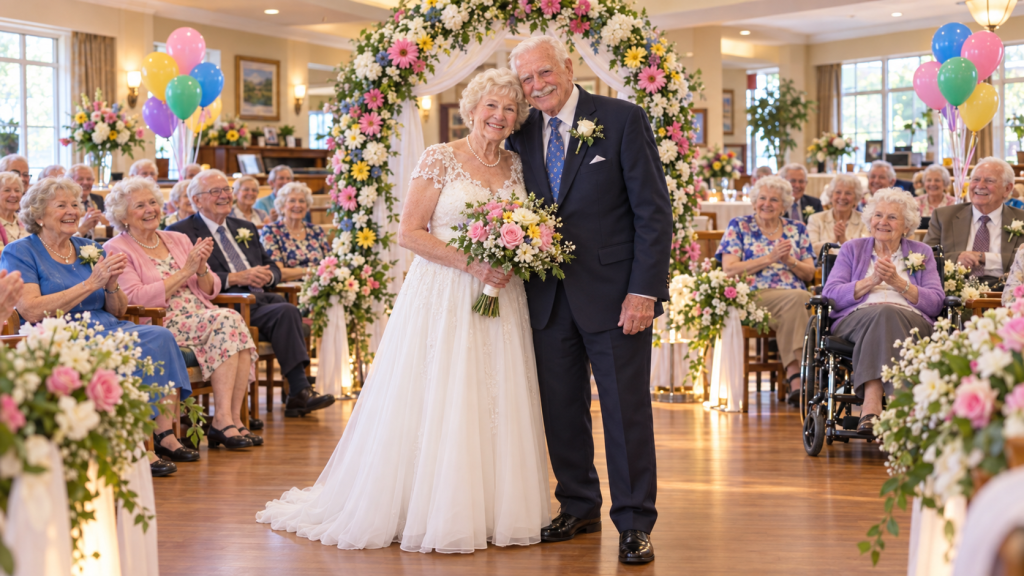
Harrison asked me to marry him because he wanted control over his final days.
But somewhere between the courthouse ceremony and the last sunset, the arrangement became something neither of us had planned.
Home.
And when his attorney handed me that envelope after the funeral, I thought I was about to discover what Harrison had left me.
I was wrong.
The most important thing he left was not money.
It was responsibility.
To protect choice.
To respect dignity.
To remember that growing old does not make someone less human, less capable of love, or less entitled to decide what happens next.
Harrison spent most of his life building wealth.
In the end, what mattered to him was something no account could measure.
Being heard.
Being loved.
And being allowed to remain the author of his own final chapter.
THE END! THANKS FOR READING!