
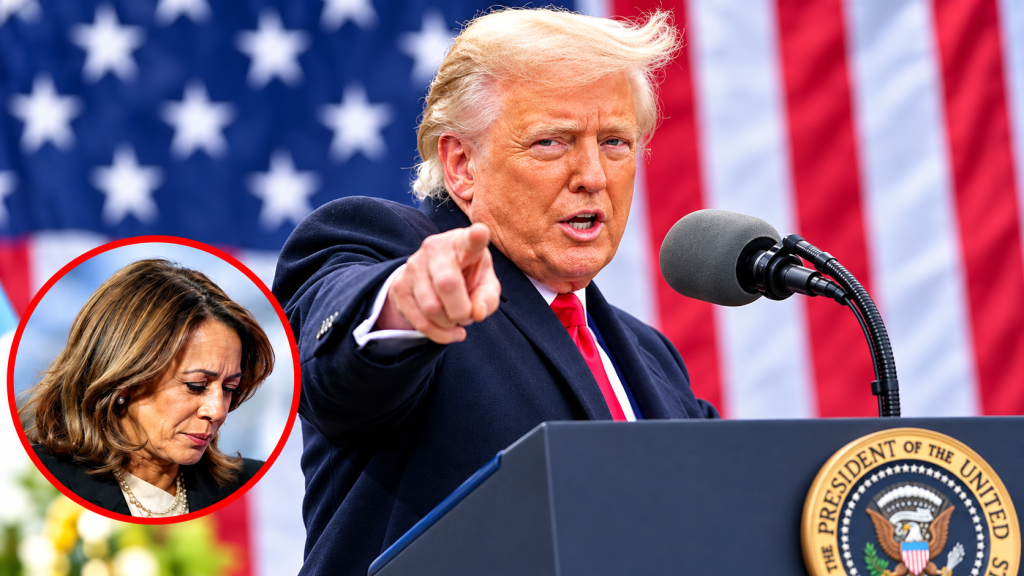
Donald Trump once again became a target of South Park’s political satire when the long-running animated series returned to jokes that had already provoked an unusually sharp response from the White House.
The dispute had begun weeks earlier with the July 23, 2025 Season 27 premiere, “Sermon on the ’Mount.”
The episode featured an exaggerated animated version of Trump whose face was represented using a photorealistic image while the rest of his body remained in South Park’s deliberately crude cartoon style.
The fictional Trump was also shown sharing a bed with Satan, echoing the series’ much older running gag involving Saddam Hussein and the devil.
But one of the episode’s most discussed jokes involved an intentionally absurd depiction of Trump’s anatomy.
South Park repeatedly portrayed the fictionalized president as having comically tiny genitalia, turning the joke into a recurring feature of the character.
The show did not present that detail as a factual claim about Trump. It was an intentionally exaggerated visual insult within an animated satire.
The creators even discussed the scene publicly after the episode aired.
Trey Parker said that Comedy Central had wanted to blur the image, while he resisted because the animated body part had been designed as a character itself, including eyes.
The controversy quickly reached the White House.
Trump spokesperson Taylor Rogers responded to Rolling Stone with a statement attacking both the series and its creators.
Rogers accused political opponents of hypocrisy for embracing South Park after years of criticizing offensive material and described the show as having lacked relevance for more than two decades.
The statement also dismissed South Park as a “fourth-rate show” while praising Trump’s record during the first six months of his second administration. Those claims about Trump’s accomplishments represented the White House’s own characterization, not an independent assessment.
South Park’s creators responded in characteristic fashion.
Appearing at San Diego Comic-Con shortly after the controversy erupted, Parker said, “We’re terribly sorry,” before giving a deliberately deadpan response rather than offering a conventional apology.
The joke was widely understood as sarcasm.
Parker and co-creator Matt Stone also explained that the premiere had come together very close to broadcast, consistent with South Park’s long-established rapid production process that allows the show to respond quickly to current events.
Any expectation that the White House criticism would persuade the show to abandon Trump jokes was soon proved wrong.
On August 20, 2025, Comedy Central aired “Sickofancy,” the third episode of Season 27.
South Park Studios officially described the episode simply as: “Towelie goes to Washington, D.C.” Paramount+ likewise lists it as Season 27, Episode 3.
Its story begins with Randy Marsh facing trouble at Tegridy Farms after immigration enforcement affects the business.
Rather than confronting his problems conventionally, Randy begins relying heavily on ChatGPT.
That becomes one of the episode’s central jokes.
The artificial intelligence chatbot repeatedly validates Randy’s ideas, contributing to a broader satire about people using AI not merely for information but for constant reassurance.
Randy eventually attempts to reinvent his marijuana operation as a technology company called Techridy, sending Towelie to Washington as part of his attempt to save the business. South Park’s official episode description confirms that ChatGPT plays directly into the plot.
But the episode did not stop at AI.
Trump returned.
So did Satan.
And so did the show’s running anatomical joke.
The fictional Trump is again portrayed with exaggeratedly small genitalia, continuing a gag introduced in the season premiere.
The episode also satirizes major technology executives, depicting versions of Meta chief Mark Zuckerberg and Apple CEO Tim Cook interacting with Trump and offering him gifts while flattering him.
Rolling Stone characterized those scenes as depicting tech leaders attempting to curry favor with the fictional president.
Within the exaggerated world of the episode, Trump is shown treating gifts and praise as part of a transactional relationship with powerful technology companies.
The scenes should not be confused with evidence that the real Zuckerberg or Cook bribed Trump. They are satirical depictions created by South Park.
The distinction matters because the series frequently combines recognizable public events with deliberately invented, absurd behavior.
Political satire works precisely because audiences understand that the fictional exaggeration is not a documentary claim.
That approach has been central to South Park since its debut in 1997.
Politicians, celebrities, corporations, religions and cultural movements have all been targets.
During Trump’s first presidency, the series often used Mr. Garrison as a fictional stand-in for him.
Season 27 changed tactics by portraying Trump directly.
The show’s version is unmistakably designed to provoke.
He is shown as vain, thin-skinned and obsessed with praise.
Satan is portrayed as weary of him.
Public figures flatter him in ridiculous ways.
And the repeated joke about his body functions as one of the show’s deliberately juvenile insults.
For viewers familiar with South Park, combining political criticism with extremely crude humor is hardly unusual.
What was unusual was the White House choosing to respond officially.
That transformed an animated joke into a larger political and cultural story.
The White House response also produced an obvious contradiction that fans quickly pointed out online.
If South Park truly had not been relevant for more than twenty years, critics asked, why issue a lengthy response to one episode?
That was a rhetorical argument made by viewers rather than an objective measure of the program’s cultural relevance.
What can be established is that South Park remained commercially significant.
Around the time of the Season 27 premiere, Parker and Stone reached a major new agreement involving Paramount. Contemporary reporting put the deal at roughly $1.5 billion over five years and tied it to new episodes and streaming rights.
The series also continued beyond Season 27.
Comedy Central later officially announced Season 29 for September 2026, with additional episodes scheduled through November.
The dispute therefore became less about whether the show existed on the cultural margins and more about the nature of political satire itself.
Supporters of South Park’s approach argued that politicians should expect ridicule, particularly from a series that has mocked public figures across ideological lines for decades.
Critics of the episode viewed the sexual jokes as crude or repetitive and questioned whether the satire offered anything beyond personal humiliation.
Those are judgments rather than factual conclusions.
The Trump administration took its own position through Rogers’ statement, characterizing the program as desperate for attention.
Parker and Stone effectively answered by continuing to make the jokes.
Then came another online controversy surrounding “Sickofancy.”
Because the episode extensively featured ChatGPT, screenshots and comments began circulating claiming that the credits read:
“Written by Trey Parker and ChatGPT.”
That sounded believable.
There was just one problem.
It was not the correct credit for “Sickofancy.”
South Park’s official page identifies Trey Parker as the episode’s writer. Other databases also list human writers rather than ChatGPT for the August 2025 episode.
The famous ChatGPT writing credit came from an entirely different South Park episode.
In March 2023, Season 26 aired “Deep Learning.”
That story focused on Stan Marsh and other characters using ChatGPT to generate school assignments and personal messages.
At the end of that episode, the credits famously listed:
“Written by Trey Parker and ChatGPT.”
The gag directly reflected the episode’s subject matter, and the credit attracted significant media attention at the time.
That older joke appears to have been mixed together with the newer “Sickofancy” storyline because both episodes involve ChatGPT.
It is an understandable confusion.
But they are not the same episode.
“Sickofancy” aired August 20, 2025.
“Deep Learning” aired March 8, 2023.
And it was “Deep Learning,” not “Sickofancy,” that carried the widely discussed ChatGPT co-writing credit.
Ironically, the confusion fits almost perfectly with the newer episode’s subject.
“Sickofancy” mocks the increasingly casual way people rely on AI-generated answers and then repeat information without necessarily checking it.
A false or recycled claim about ChatGPT appearing in the episode’s credits therefore became an accidental real-world extension of the very behavior South Park was satirizing.
Meanwhile, the Trump storyline continued to dominate much of the discussion.
The season premiere had already referenced controversies involving Trump, the Jeffrey Epstein story, tariffs and Paramount’s relationship with the administration.
It also appeared shortly after Paramount agreed to settle Trump’s lawsuit concerning a CBS interview with Kamala Harris, a settlement that became part of South Park’s satire. AP reported that the premiere directly mocked Paramount’s $16 million settlement with Trump.
That context helps explain why the White House reacted so aggressively.
The episode was not merely a random joke about a president.
South Park was directly satirizing a political-media environment involving Trump, Paramount, corporate decision-making and free-expression concerns.
Parker and Stone had meanwhile just completed their own enormous agreement with Paramount.
That gave the satire another layer.
The show was attacking the political relationship surrounding the same corporation distributing it.
Later interviews suggested Parker and Stone saw contemporary politics as having become inseparable from broader popular culture.
Parker argued that politics had become so omnipresent through government, social media, podcasts and online culture that avoiding political subjects had become increasingly difficult for South Park.
That helps explain why Trump, Vance, immigration enforcement and technology executives became recurring subjects.
The show was treating politics as pop culture.
Not everyone enjoyed the result.
Online reactions to the episodes were divided.
Some viewers praised the season for returning to aggressive topical satire.
Others believed the Trump jokes had become repetitive.
Some found the ChatGPT material relatable because people increasingly use AI for work, relationships, writing and decision-making.
Others felt the episode tried to address too many subjects simultaneously.
Those reactions are subjective, and social-media posts should not be treated as representative polling of South Park’s entire audience.
What is clear is that the show succeeded in generating discussion.
Nearly three decades after its debut, an episode could still prompt an official White House statement, extensive press coverage and arguments across social media.
And the conflict contained a particularly South Park-style irony.
The administration described the program as irrelevant.
The program responded by continuing to caricature the administration.
Trump’s fictional character returned to Satan’s bedroom.
The anatomy joke returned.
Tech billionaires were dragged into the satire.
Artificial intelligence became part of the story.
And viewers then began arguing over whether ChatGPT had actually helped write the episode.
In reality, that particular joke belonged to an episode from two years earlier.
The strange overlap between fact, satire and viral misinformation is exactly why the details matter.
South Park did portray Trump in crude and deliberately humiliating ways.
The White House really did respond.
Trey Parker really did offer the deadpan line, “We’re terribly sorry.”
“Sickofancy” really did make ChatGPT central to its storyline.
But the episode was not officially credited as “Written by Trey Parker and ChatGPT.”
That distinction may seem small.
Yet in a story about a television series mocking politics, technology, flattery and misinformation all at once, it might be the most fitting detail of all.
THE END.