
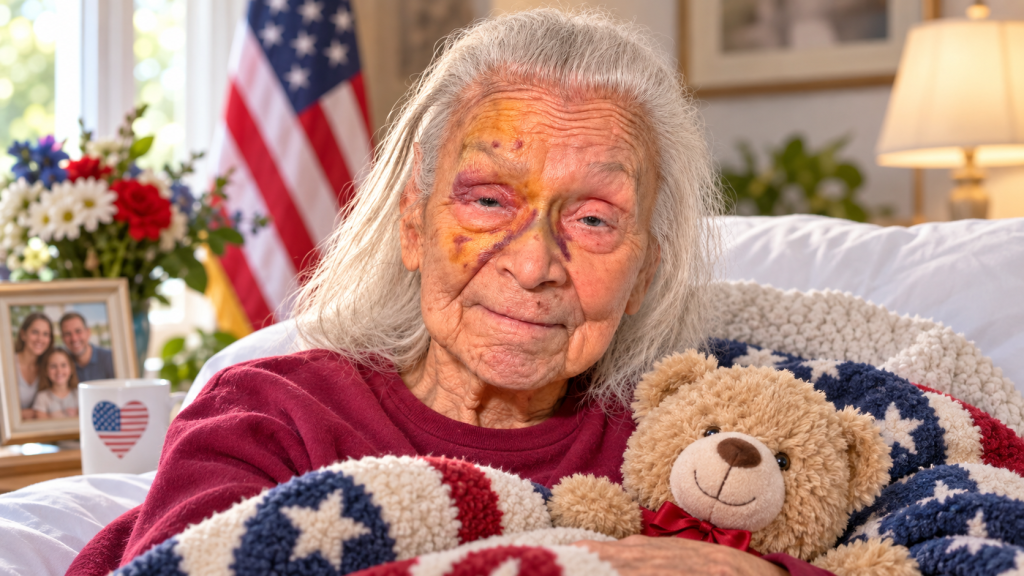
Four days ago, a Texas family was looking at the badly bruised face of a 95-year-old grandmother they lovingly call Wela and wondering how someone they cared about so deeply had ended up with both eyes bruised, her face swollen, and a painful hematoma.
They wanted answers.
They wanted clarity.
But more than anything, they wanted Wela somewhere safe.
Today, according to her granddaughter JoAnna, that part has finally happened.
“Wela has been safely removed from the nursing home where she received her injuries and is now safe.”
For a family that had spent days frightened, confused, and asking questions, those words mattered more than almost anything else.
Wela will turn 96 years old on October 2.
Instead of preparing quietly for another birthday, her family recently found themselves dealing with something they never expected.
JoAnna said relatives discovered Wela with severe bruising around both eyes and noticeable swelling across her face.
The image was difficult to look at.
For anyone with an elderly parent, grandparent, aunt, uncle, or loved one in long-term care, it represented one of the fears families carry quietly in the back of their minds.
You trust other people with someone precious.
You leave after a visit hoping they will receive the same patience, dignity, and care you would give them yourself.
Then one day, something happens.
And suddenly there are questions.
According to JoAnna, the family was told that Wela had rolled out of bed and struck her face on a drawer.
A fall can happen to anyone, especially an elderly person.
But JoAnna said family members received conflicting information about when the incident occurred.
That inconsistency worried them.
They wanted to understand when Wela had been injured.
They wanted to know what happened afterward.
They wanted to know what care she had received.
And ultimately, JoAnna said the family made the decision to call emergency medical services themselves.
That decision led to Wela being medically evaluated.
According to the family, doctors found a hematoma.
Thankfully, JoAnna said the evaluation did not find a brain bleed, skull fracture, or signs of a concussion.
Those were the words her family desperately wanted to hear.
The bruising remained upsetting.
The unanswered questions remained.
But Wela was alive.
She was being evaluated.
And the family could begin focusing on what needed to happen next.
They filed a police report.
JoAnna also said a state licensing investigation was opened.
Because the circumstances surrounding Wela’s injuries remain under investigation, the nursing facility is not being identified here.
That distinction matters.
A photograph can create immediate emotion.
A family’s account can raise serious questions.
But an investigation exists to determine facts.
Until that process is complete, the most responsible thing is not to speculate about exactly how Wela was injured or assign blame that has not been established.
Her family, however, did not need to wait for every question to be answered before making one decision.
They wanted Wela somewhere else.
And now, JoAnna says, she is.
Safe.
Out of the facility.
With her loved ones focused on what comes next.
For many people who saw Wela’s story, that update may feel like the first moment everyone can finally exhale.
But the image of her bruised face is not easily forgotten.
Neither is the love evident in the way her family responded.
When older adults depend on others for daily care, their families often become their voices.
They ask questions.
They make calls.
They compare explanations.
They look closely when something feels wrong.
They request records.
They seek medical evaluations.
And when necessary, they contact authorities.
For Wela’s family, the first priority was making sure she was medically examined and physically safe.
Now they are allowing the appropriate authorities to investigate what happened.
And instead of spending the coming days talking only about fear, bruises, reports, and investigations, they want to turn their attention toward something much happier.
Wela’s 96th birthday.
October 2.
A birthday that, after the last several days, may feel especially precious.
When JoAnna first reached out, many people who heard Wela’s story immediately asked the same question:
“How can we help?”
Some asked whether the family needed money.
Others wondered whether there was a fundraiser.
According to JoAnna, the answer is no.
Wela’s family says they are fortunate enough to provide financially for her needs themselves.
They are not asking strangers to send money.
Instead, they are asking for something simpler.
Love.
Birthday wishes.
Prayers.
A few thoughtful gifts from anyone who genuinely wants to make a 96-year-old grandmother feel remembered.
JoAnna says Wela loves long nightgowns in size small.
Warm socks.
Small head coverings.
Little warm blankets.
Plants.
Flowers.
And Wela’s faith is especially important to her.
JoAnna describes her grandmother as a devoted Apostolic woman whose belief in God has remained an important part of her life.
So anything connected to that faith, her family says, would likely bring her joy.
It is a remarkably ordinary list.
There is nothing extravagant about it.
A warm blanket.
A pair of socks.
A flower.
A nightgown.
Something that reminds her of God.
Maybe that is exactly why it feels so meaningful.
At 95, approaching 96, comfort does not necessarily come from enormous gestures.
Sometimes it is warmth.
Familiarity.
Soft fabric.
A plant near the window.
A handwritten card.
A prayer from someone you have never met.
A reminder that the world outside your room knows your name.
That people cared when they saw your face.
That strangers were hoping you would be okay.
JoAnna says she plans to wrap birthday gifts herself and take them to Wela.
Imagine that moment.
A grandmother approaching her 96th birthday surrounded by packages, cards, flowers, prayers, and messages from people who may never meet her.
People who first learned her name because they were worried.
But who now have the opportunity to celebrate.
That is a very different ending from the one her family feared just days earlier.
PART 2
There is something powerful about the way a frightening story can change once safety is restored.
At first, everyone focuses on the injury.
What happened?
When did it happen?
Why does the explanation seem unclear?
Was the person medically evaluated quickly enough?
Who knew?
Who called whom?
Families replay conversations because they are searching for the moment everything will finally make sense.
JoAnna’s family may continue asking those questions for some time.
Investigations do not necessarily move at the speed frightened families wish they would.
There may be records to review.
Interviews to conduct.
Timelines to establish.
Medical information to examine.
And different accounts to compare.
The family has already taken the steps it believed were necessary by seeking medical attention, filing a police report, and reporting that a state licensing investigation was opened.
Now their role changes.
They can continue advocating for answers while also doing something equally important.
Letting Wela simply be Wela again.
Not “the injured nursing-home resident.”
Not “the woman in the disturbing photograph.”
Not “the subject of an investigation.”
A grandmother.
A woman of faith.
A woman preparing to turn 96.
A person who likes warm socks and flowers.
Someone whose family loves her enough to make noise when they are worried and celebrate loudly when she is safe.
For every family caring for an elderly relative, Wela’s story carries a reminder.
Pay attention.
Not because every bruise means wrongdoing.
Older adults can fall.
Accidents happen.
Medical conditions and medications can sometimes make bruising appear more dramatic.
But families should never feel embarrassed about asking reasonable questions.
“What happened?”
“When did it happen?”
“Who was there?”
“Was a doctor contacted?”
“Can I see the documentation?”
“What is being done now?”
Those are not hostile questions.
They are caregiving questions.
A person does not stop deserving advocacy because they are old.
They do not become invisible because they require assistance.
And they do not lose the right to dignity simply because someone else helps them eat, bathe, walk, or take medication.
At 95 years old, Wela has lived through nearly a century of change.
Presidents.
Wars.
Economic downturns.
Technological revolutions.
Family births.
Family losses.
Celebrations.
Heartbreak.
Ordinary mornings that no history book will ever record.
There are probably stories inside her family that only Wela remembers.
Names younger generations know because she repeated them.
Recipes.
Prayers.
Traditions.
Little sayings.
Family jokes.
Perhaps memories nobody thought to write down because everyone assumed there would always be another day to ask.
That is another reason birthdays like this matter.
Ninety-six is not just a number.
It is time accumulated into one life.
For JoAnna and the rest of Wela’s family, this birthday may feel different.
There is gratitude underneath it now.
Gratitude that the medical evaluation did not show the most devastating injuries they feared.
Gratitude that Wela is no longer in the facility her family wanted her removed from.
Gratitude that strangers cared enough to ask for updates.
And gratitude that instead of preparing for something worse, they can prepare cake, gifts, cards, flowers, and prayers.
That does not erase the investigation.
It should not.
Safety and accountability are separate matters.
A family can celebrate Wela’s birthday and still want answers.
They can feel relieved and angry.
Grateful and confused.
Happy she is safe while still disturbed by what they saw.
Human emotions rarely arrive one at a time.
But right now, there is one fact JoAnna wants people to know.
Wela is safe.
Those three words are the center of this update.
The rest can be investigated.
The rest can be documented.
The rest can be answered when evidence allows.
For today, she is safe.
And she has a birthday coming.
Many people online instinctively respond to heartbreaking stories by opening their wallets.
It is one of the kindest things about communities of strangers.
Someone is struggling?
Start a fundraiser.
Someone needs help?
Send money.
Someone is hurting?
Ask what they need.
But Wela’s family has made it clear that money is not what they are asking for.
They say they can financially provide for her.
That deserves to be respected.
Sometimes helping means honoring exactly what a family asks for instead of deciding what they should want.
In this case, the request is simple.
Make Wela feel loved.
Leave her a birthday message.
Say a prayer.
Send something warm if you choose.
Give her something related to the faith that has mattered to her throughout her life.
Let a woman turning 96 know that people were rooting for her.
Imagine JoAnna sitting beside Wela, reading messages aloud.
“Happy birthday from Oklahoma.”
“Praying for you from Florida.”
“Sending love from California.”
“God bless you, Wela.”
“You are loved.”
“We are so happy you are safe.”
Hundreds or thousands of people may never know whether she hears their specific message.
But taken together, those messages create something powerful.
A chorus.
You matter.
You were seen.
People cared.
And perhaps that is the best direction this story can take now.
Not toward internet anger.
Not toward speculation.
Not toward naming people before investigations are complete.
Toward attention.
Toward accountability through proper channels.
And toward love for one elderly woman whose family refused to stay quiet when they believed something needed attention.
There is also something meaningful about the family refusing to turn the moment into a financial opportunity.
No fundraiser.
No request for cash.
No dramatic campaign.
Just:
She’s safe.
Her birthday is coming.
If you want to do something, make her smile.
That simplicity says something about what this family seems to want most.
Not attention for themselves.
Not profit.
They want Wela protected and celebrated.
The police report and licensing investigation can move through their appropriate processes.
The family can cooperate.
Medical professionals can document what they observed.
Investigators can determine what can and cannot be established.
And the public can resist the temptation to turn uncertainty into certainty before facts are available.
But none of that prevents us from acknowledging the emotional reality.
Seeing an elderly loved one badly bruised is frightening.
Receiving explanations that feel inconsistent is unsettling.
Having to call EMS yourself because you want your loved one evaluated can leave a family wondering whether they should have known something sooner.
Those feelings are real.
And families in similar circumstances should know they are allowed to ask questions.
They are allowed to request information.
They are allowed to seek outside medical care.
They are allowed to report concerns.
They are allowed to advocate.
Because nobody knows an elderly person’s normal appearance, personality, behavior, and routine better than the people who love them.
Sometimes advocacy begins with something as simple as noticing.
That is what makes Wela’s current update feel important.
Four days ago, her family’s focus was fear.
Now their focus can begin shifting toward recovery, comfort, and birthday cake.
Somewhere in Texas, a 95-year-old grandmother is preparing to become a 96-year-old grandmother.
She has already lived almost a century.
And suddenly, people far beyond her family know her affectionate name.
Wela.
They know she likes flowers.
They know she appreciates warmth.
They know faith matters to her.
And they know her granddaughter wanted the world to hear one sentence:
She is safe.
Perhaps the most meaningful birthday gift anyone can give her is to let that word surround her.
Safe.
Safe enough to rest.
Safe enough to celebrate.
Safe enough to smile when JoAnna brings in another card.
Safe enough for her family to focus on candles instead of emergency calls.
Safe enough to begin another year.
Happy early 96th birthday, Wela.
May October 2 bring you warmth, flowers, faith, family, peaceful moments, and the knowledge that more people than you could ever meet were hoping you would be okay.
And to JoAnna and the rest of Wela’s family, the investigation may still have unanswered questions.
Those answers should come from evidence and the proper authorities.
But the update you wanted most is already here.
Your grandmother is out.
Your grandmother is surrounded by people who love her.
And your grandmother is safe.
After everything that happened in four frightening days, there may be no better birthday present than that.
THE END.