
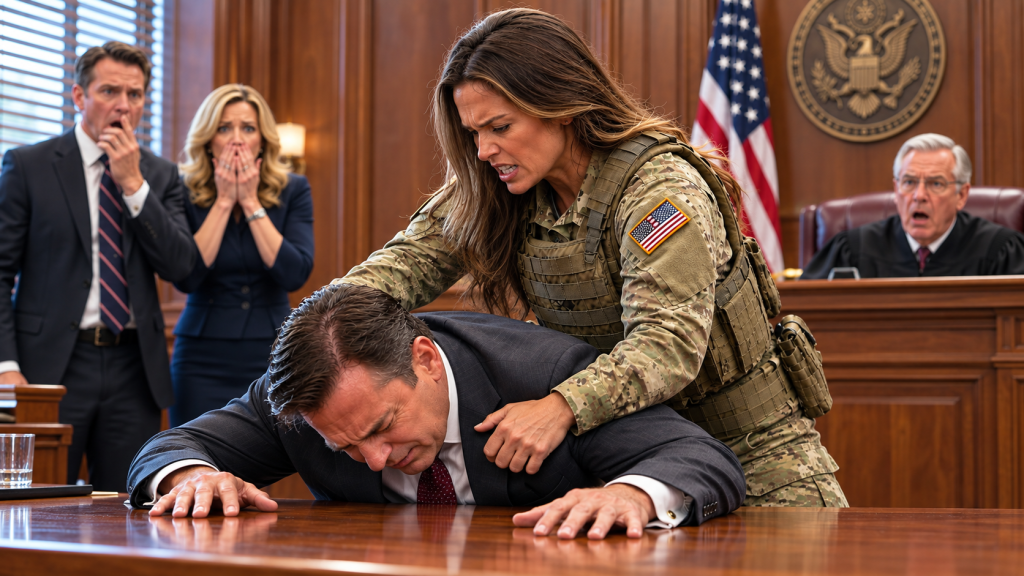
PART 1 The enormous oak doors of the Cook County family courtroom swung open, and every head turned toward me.My boots struck the marble floor in sharp, measured steps. I am Lieutenant Commander Maya Sterling, United States Navy.
I had flown in overnight and come directly from a military assignment, with barely enough time to hand over restricted equipment to base security and race across Chicago before the hearing began. I was still wearing my field uniform and protective gear.
My father saw me first.
Arthur Sterling leaned toward his attorney and smiled.
Not warmly.
Smugly.
My mother, Evelyn, closed her eyes as if my appearance embarrassed her more than the reason we were all sitting in that courtroom.
They were fighting for custody of my fourteen-year-old brother, Toby.
Officially, they claimed they wanted to protect him.
In reality, Toby had inherited a trust worth several million dollars from our grandfather.
The moment he turned fourteen, certain distributions and management rights became subject to court supervision.
And suddenly my parents, who had barely remembered his school conferences, became deeply interested in his “well-being.”
Their attorney, Bradley Vance, stepped into the aisle.
He was perfectly groomed, expensive, and far too comfortable.
“Your Honor,” he said loudly, “this is exactly the kind of unnecessary spectacle we expected.”
Judge Margaret Henderson looked over her glasses.
“Counselor, she has not even reached the witness stand.”
Vance turned toward me.
His eyes moved over my dusty uniform.
“Take off the costume, little girl. You’re in the real world now.”
Then he put a hand against my shoulder and tried to steer me backward.
My body reacted before my anger did.
I caught his wrist, redirected his arm, and pinned him safely against the edge of the counsel table.
Not violently.
Not long.
Just enough to stop him touching me.
“Step back, counselor.”
The courtroom erupted.
My father stood.
“What the hell is wrong with you?”
Judge Henderson slammed her gavel.
“Enough!”
I immediately released Vance and stepped back.
He spun around, red-faced.
“She attacked me!”
“No,” I said.
“You put your hands on me without permission.”
Judge Henderson stared at both of us.
“Lieutenant Commander Sterling, explain.”
I stood straight.
“Your Honor, I apologize for disrupting your courtroom. I responded reflexively when Mr. Vance grabbed me. I released him immediately.”
Vance scoffed.
“Reflexively? Convenient.”
The judge turned toward him.
“And did you put your hands on the witness?”
He hesitated.
“I was directing her—”
“That was not my question.”
His expression tightened.
“Yes.”
Judge Henderson leaned back.
“Then perhaps we can all remember that this is a courtroom, not a hallway confrontation.”
Vance looked stunned.
My father stopped smiling.
The judge pointed toward the witness stand.
“Lieutenant Commander Sterling, sit.”
I did.
Vance returned to his table, furious.
Then he smiled again.
That smile told me he believed the real battle was only beginning.
He was right.
He just misunderstood who had come prepared.
My parents’ case was simple.
They claimed I was too absent to care for Toby.
Too committed to the Navy.
Too unstable in schedule.
Too “militarized,” as Vance repeatedly put it.
They described themselves as wealthy, established, and capable of giving Toby every advantage.
Private school.
Tutors.
Travel.
A permanent home.
On paper, they sounded ideal.
Then my attorney, Daniel Cho, asked me one question.
“Commander Sterling, when was the last time your parents attended one of Toby’s school meetings?”
My mother shifted.
“Three years ago.”
“And you?”
“Last month by video.”
“Who speaks with Toby’s counselor?”
“I do.”
“Who signed his emergency medical authorization last year?”
“I did.”
“Who arranged his tutoring after he began failing algebra?”
“I did.”
My father whispered something to Vance.
Daniel continued.
“Why?”
I looked toward Toby.
He sat beside the court-appointed child advocate.
Small.
Quiet.
Trying not to look at anyone.
“Because he called me.”
Daniel nodded.
“Did he call your parents first?”
“No.”
“Why not?”
I hesitated.
Then Toby looked at me.
I answered.
“Because he said they were too busy.”
My mother whispered:
“That’s unfair.”
The judge heard her.
“So is ignoring a child,” she said.
Silence.
Then Vance stood for cross-examination.
He approached slowly.
“Commander Sterling, how many nights were you physically present in Chicago during the last twelve months?”
“Forty-two.”
He smiled.
“So less than two months.”
“Yes.”
“And you expect this court to believe you can be a full-time guardian?”
“I expect the court to examine the plan I submitted.”
“I’m asking about reality.”
“So am I.”
His smile disappeared.
He held up a document.
“You have active military obligations.”
“Yes.”
“You can be reassigned.”
“Yes.”
“You can deploy.”
“Yes.”
“And yet you think that is more stable than Toby living with his own parents?”
I looked directly at him.
“If the only issue were geography, no.”
He paused.
“What does that mean?”
“It means this hearing is not actually about geography.”
My father sat forward.
Vance narrowed his eyes.
“What is it about?”
I reached for the folder Daniel had placed beside me.
“Money.”
My mother went pale.
Vance laughed.
“There it is.”
He turned toward the judge.
“Your Honor, now we reach the accusation.”
Judge Henderson said:
“Ask your question.”
He faced me.
“Do you have evidence that Arthur and Evelyn Sterling are seeking custody for financial reasons?”
“Yes.”
That answer changed the room.
Vance had expected hesitation.
He got none.
“What evidence?”
Daniel stood.
“Your Honor, we request permission to introduce Exhibit 23.”
The bailiff carried a sealed folder to the judge.
My father’s face changed before she even opened it.
I noticed.
So did Judge Henderson.
Inside were emails.
Bank statements.
Trust documents.
And a transcript of a voicemail my father had accidentally left on my phone.
Three months earlier.
He thought he had ended the call.
He had not.
His voice was unmistakable.
“If we get guardianship, we control the distributions until he’s eighteen. That gives us four years to restructure everything.”
Then my mother:
“And Maya?”
My father laughed.
“She’s never here.”
The courtroom went completely silent.
Vance stood quickly.
“We object to context—”
Judge Henderson raised one hand.
“Sit down.”
He sat.
She read another page.
Then another.
My parents did not look at me anymore.
Daniel asked:
“What did you do after receiving that voicemail?”
“I contacted the trust administrator.”
“And what did you learn?”
“That someone had already requested information about accelerating distributions from Toby’s trust.”
“Who?”
“My father.”
Arthur stood.
“That is completely misleading!”
Judge Henderson slammed the gavel.
“Mr. Sterling, sit down.”
He did.
Slowly.
Daniel continued.
“Was the request approved?”
“No.”
“Why not?”
“Because the trust administrator required court authority.”
Daniel nodded.
“Which would become much easier if Mr. and Mrs. Sterling obtained legal guardianship.”
“Yes.”
Vance jumped up.
“Speculation.”
Judge Henderson looked toward Daniel.
“Sustained. Rephrase.”
Daniel nodded.
“Did that timing concern you?”
“Yes.”
“Why?”
“Because my parents had shown almost no interest in Toby’s daily life until access to the trust became an issue.”
I looked at Toby again.
He was staring at the floor.
That hurt.
This hearing was not supposed to become about humiliating our parents.
But protecting him required truth.
Then Daniel brought out the second file.
This one even Vance had apparently not seen.
That was when my father finally looked afraid.
PART 2
The second file came from a forensic accountant.
My grandfather had created Toby’s trust years earlier after realizing how reckless my father could be with money.
At the time, nobody in the family talked about that part.
We called it “Granddad being cautious.”
The truth was uglier.
Arthur Sterling had lost millions through speculative investments.
He covered part of those losses using family business accounts.
He borrowed against property without telling my mother.
And twice, my grandfather had rescued him.
The trust was designed so Arthur could never control Toby’s inheritance directly.
Until guardianship became possible.
Daniel held up the report.
“Commander Sterling, who requested this forensic review?”
“I did.”
“Why?”
“Because after hearing the voicemail, I wanted to know whether my father had a financial reason to seek access.”
“And what did the review find?”
I looked at Arthur.
He knew.
“Debt.”
Vance objected.
Judge Henderson overruled him.
Daniel continued.
“How much?”
“Approximately 4.6 million dollars in personal and business obligations.”
My mother covered her mouth.
That reaction told me something important.
She had not known the full amount.
Arthur whispered:
“Evelyn—”
She turned toward him.
“Four point six?”
He said nothing.
Daniel continued.
“Was there evidence Mr. Sterling had discussed using Toby’s trust as collateral or a source of repayment?”
“Yes.”
“Where?”
“Emails to his financial adviser.”
A printed message appeared on the courtroom monitor.
Arthur’s words:
Once guardianship is settled, the boy’s trust gives us breathing room.
My mother stared at the screen.
Then at her husband.
“Arthur?”
He whispered:
“Not now.”
That was the worst thing he could have said.
Because for the first time, my mother looked less like my father’s partner and more like someone realizing she had been used too.
Vance requested a recess.
Judge Henderson denied it.
“No, counselor. We are going to finish this.”
He looked furious.
Then he changed tactics.
He attacked me.
“Commander Sterling, isn’t it true you have always resented your father?”
“I disagree with him often.”
“Isn’t it true you left home at eighteen because you couldn’t tolerate family authority?”
“I joined the Naval Academy.”
“That was not my question.”
“Yes, I left at eighteen.”
“And you’ve spent your adulthood proving you don’t need your family.”
“I’ve spent my adulthood building my own life.”
He smiled.
“And now you want Toby.”
I felt my jaw tighten.
“Toby is not something to win.”
“Yet you want guardianship.”
“I want him safe.”
“From his parents?”
“From anyone who sees his inheritance before they see him.”
That shut him up for half a second.
Then he approached me again.
This time he stopped several feet away.
He had learned something.
“So you expect this court to hand a fourteen-year-old to someone who may be deployed overseas?”
“No.”
He frowned.
“No?”
“My petition does not request that Toby live alone with me during deployment.”
Vance blinked.
Daniel smiled faintly.
I continued.
“My plan names my aunt Samantha as secondary residential guardian during any extended assignment, with the court retaining oversight.”
My aunt sat behind us.
She had been a public-school principal for twenty-seven years.
Stable home.
No financial interest in Toby’s trust.
No access to his funds.
Vance looked annoyed.
“And if you are killed in service?”
The courtroom went still.
My mother gasped.
Judge Henderson frowned.
“Counselor.”
But I answered.
“Then Toby remains protected under the contingency plan already filed.”
Vance looked almost disappointed that I did not react emotionally.
I had heard worse questions.
I had prepared for worse realities.
What I had not prepared for was Toby standing up.
“Can I say something?”
Everyone turned.
The child advocate immediately looked at the judge.
Judge Henderson softened.
“Would you like to speak privately with me?”
Toby shook his head.
“No. I want them to hear.”
The judge thought for a moment.
Then nodded.
“Go ahead.”
Toby looked at our parents.
His voice trembled.
“Dad doesn’t know what grade I’m in.”
Arthur’s face collapsed.
“Toby—”
“He told somebody last month I was in eighth grade.”
He swallowed.
“I’m a freshman.”
No one spoke.
Toby continued.
“Mom knows more, but she always says Dad handles money and she doesn’t want to fight.”
My mother began crying.
Toby looked at me.
“Maya calls.”
My throat tightened.
“Even when she’s gone.”
He looked toward the judge.
“She makes me send pictures of my homework because she thinks I lie about finishing it.”
A few people smiled.
Even Judge Henderson.
Toby continued.
“When I had the panic attack at school, Dad sent his assistant.”
Arthur closed his eyes.
“Maya stayed on video with me for three hours.”
I looked down.
I had not wanted that in court.
It was his private pain.
Then Toby said:
“I don’t care about the trust.”
The judge leaned forward.
“I know.”
“I wish Granddad never left it to me.”
Arthur whispered:
“Don’t say that.”
Toby turned toward him.
“See?”
His voice cracked.
“You heard ‘trust.’ You didn’t hear me.”
That sentence destroyed whatever remained of my father’s case.
Judge Henderson called a recess after that.
In the hallway, my mother approached me.
For once, she did not look polished.
She looked exhausted.
“Did you know about the debt?”
“Yes.”
“How long?”
“Six weeks.”
She covered her face.
“He told me we were restructuring.”
“I’m sorry.”
She looked at me sharply.
“You should have told me.”
“I tried.”
That stopped her.
Three weeks earlier, I had called.
She ended the conversation after two minutes because Arthur told her I was “being dramatic again.”
She remembered.
“I didn’t listen.”
“No.”
Tears filled her eyes.
“I never listen when it involves him.”
I said nothing.
That was her realization to carry.
Arthur came out next.
He did not apologize.
He pointed at me.
“You’ve always wanted to destroy this family.”
“No.”
“You brought private finances into court.”
“You brought Toby’s trust into your finances.”
His face hardened.
“I am his father.”
“And that does not make his inheritance yours.”
He stepped closer.
Then stopped.
Not because he feared me.
Because two courthouse deputies were watching.
For the first time that day, he understood something I had learned long ago.
Authority has limits.
The hearing resumed at 2:15.
Judge Henderson took nearly twenty minutes before speaking.
She said the court’s responsibility was not to reward wealth, punish career choices, or decide which adult looked more respectable.
Its responsibility was Toby.
She found the financial evidence deeply concerning.
She also criticized me.
That surprised my parents.
She looked directly at me.
“Lieutenant Commander Sterling, your military career creates practical complications. Love alone does not make a custody plan workable.”
“I understand.”
“Your contingency planning is better than most petitions I see.”
“Thank you.”
Then she turned toward my parents.
“But planning for absence is very different from being emotionally absent while living in the same house.”
Arthur stared forward.
The judge ordered independent management of Toby’s trust.
Neither my parents nor I would control the money.
A professional trustee would remain in place under court supervision.
That was exactly what I wanted.
Then she granted temporary guardianship to me, with my aunt Samantha approved as secondary residential guardian when duty required.
My mother began crying.
Arthur whispered something to Vance.
The judge was not finished.
“Mr. and Mrs. Sterling will receive structured visitation subject to Toby’s therapeutic recommendations.”
My father stood.
“You’re taking my son?”
Judge Henderson looked at him.
“No, Mr. Sterling.”
She paused.
“Your choices brought you here.”
He slowly sat back down.
Outside the courthouse, cameras were waiting.
Someone had leaked the case.
Daniel told me not to speak.
So I didn’t.
I walked Toby toward my truck.
He stared at my uniform.
“You really came straight from work?”
“Pretty much.”
“You look ridiculous.”
I stopped.
He grinned.
For the first time all day, I laughed.
“Watch it.”
He climbed inside.
Then asked:
“Am I going to have to call you Mom now?”
“Absolutely not.”
“Good.”
“I was planning on Supreme Commander.”
He groaned.
“Never mind. Send me back.”
That laugh mattered more than the ruling.
The next months were not easy.
Toby started therapy.
So did Mom.
Dad did not.
At first.
His financial problems became public after creditors filed claims.
Several assets were sold.
The giant lake house disappeared.
So did the private club membership he loved showing off.
None of that made me happy.
Losing money was not justice.
Accountability was.
Eventually, my mother separated from him.
Not because I told her to.
Because once the family structure stopped protecting his behavior, she began seeing how much of herself she had surrendered to keeping him comfortable.
A year later, Dad entered counseling.
He called me afterward.
“I was wrong.”
I nearly dropped the phone.
“About what?”
“Toby.”
Silence.
“I saw the trust before I saw my son.”
That was the first honest sentence I had heard from him in years.
I did not immediately forgive everything.
But I listened.
Toby remained with me and Samantha under the court-approved arrangement.
When I traveled, he stayed with her.
When I was home, we argued about homework, shoes left in hallways, screen time, and whether cereal counted as dinner.
Normal things.
Exactly what I wanted.
His trust remained untouched except for approved education and health expenses.
At eighteen, he would gain more control under the original terms.
By then, I hoped he would understand something our family had nearly forgotten.
Money should support a life.
It should never become the reason people pretend to care about one.
Years later, Toby still tells the story about the day I walked into family court dressed like I had taken a wrong turn on the way to a military exercise.
His favorite part is not the financial evidence.
Not the judge.
Not even our father’s face when the trust was placed beyond his reach.
His favorite part is Bradley Vance touching my shoulder.
“You should have seen her face,” Toby tells people.
I always correct him.
“No.”
I point at him.
“You should have seen the judge’s.”
Because the most important thing Judge Henderson did that day was not punish my parents.
She refused to be distracted by wealth, uniforms, arrogance, or appearances.
She looked at the one person everyone claimed to be fighting for.
A fourteen-year-old boy who wanted someone to hear him.
My parents entered that courtroom believing money made them powerful.
Their attorney thought an expensive suit made him untouchable.
And they looked at my uniform and saw a daughter they could embarrass.
They were wrong.
My training did not win that hearing.
Evidence did.
Planning did.
And most importantly, Toby did.
I walked into court ready to fight for my brother.
By the end of the day, the judge made sure none of us could ever use him as something to fight over again.
THE END! THANKS FOR READING!