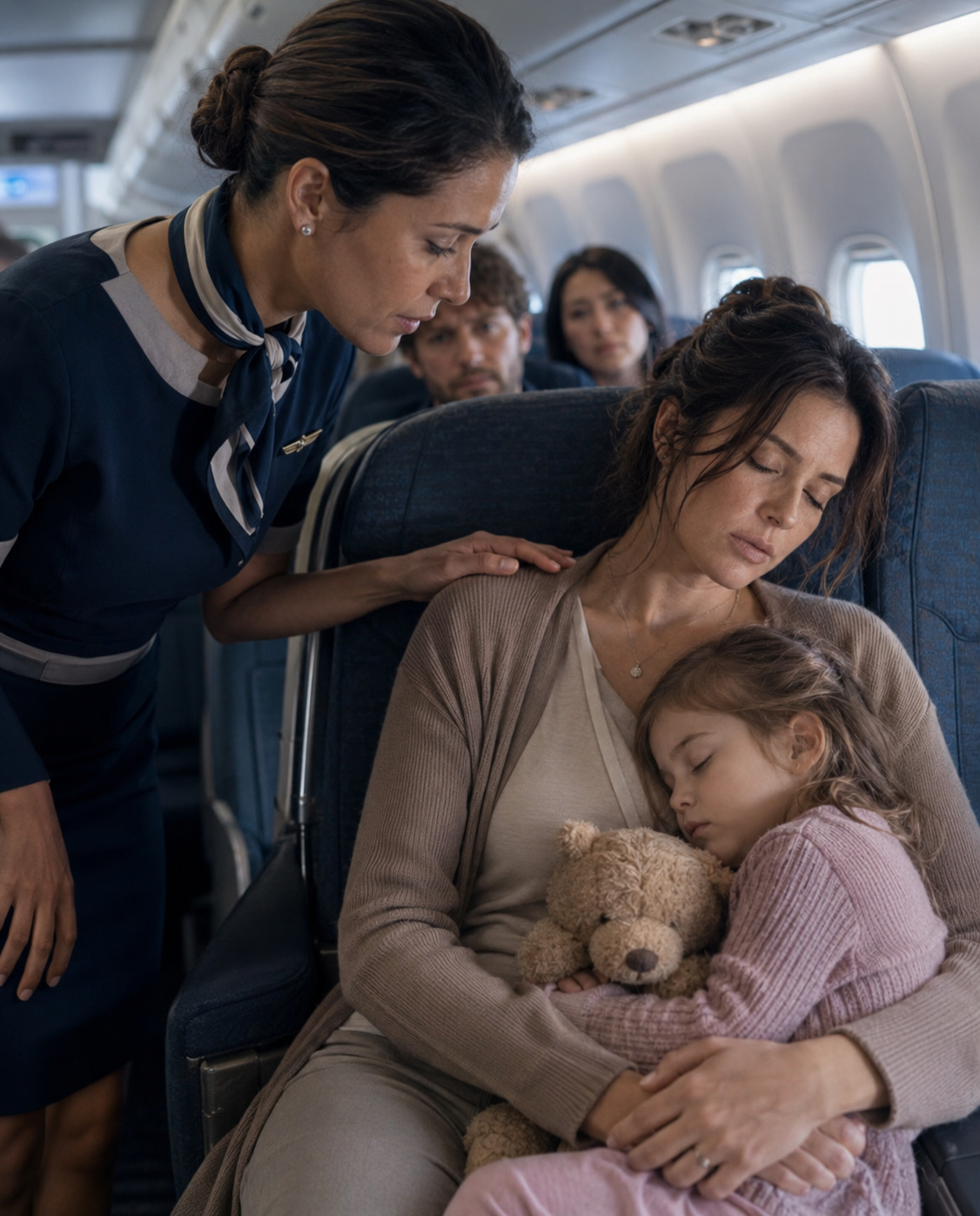

Around two hours after takeoff over the Atlantic, the captain’s voice suddenly came over the intercom and silenced nearly three hundred passengers.
“If there is a fighter pilot on board, please make yourself known to the cabin crew immediately.”For a moment, nobody moved.Nobody spoke.
Even the babies seemed to stop crying.
The overnight flight from New York to Madrid had started like any other long international trip.
The cabin lights had been dimmed.
Passengers had settled beneath thin blankets.
Some watched movies without sound.
Others leaned against windows, staring into the endless darkness above the ocean.
In seat 8A, thirty-eight-year-old Laura Vance had been sleeping with a book closed on her lap.
She wore a plain green sweater, black jeans, and old sneakers.
Her hair was tied back loosely.
A silver chain with her daughter’s initials rested beneath her collar.
To everyone around her, she looked like an exhausted single mother taking the first quiet flight she had had in years.
No one looking at Laura would have guessed that she had once been Commander Laura Vance, one of the most decorated F-16 pilots in the United States Air Force.
She had flown through storms, alarms, and hostile skies.
She had made decisions in seconds that other people would spend a lifetime trying to understand.
But Laura had walked away from that life after one mission went wrong.
Her best friend and wingman, Captain Elise Morgan, never came home.
Laura had survived.
Elise had not.
Since then, Laura had refused interviews, ceremonies, medals, and invitations to speak.
She did not want to be called a hero.
She did not want anyone saluting her.
She wanted to pick up her daughter from school, make pancakes on Sundays, and live quietly enough that nobody ever needed her to save the day again.
That was why she had chosen seat 8A.
A window.
A little distance.
A place where she could disappear among strangers.
Then the captain’s voice returned.
“Ladies and gentlemen, this is your captain. We are dealing with a technical situation requiring immediate assistance. If anyone aboard has experience flying military fighter aircraft, please notify a member of the cabin crew now.”
This time, fear moved through the cabin like cold air.
A mother pulled her baby closer.
An elderly man reached across the aisle and held his wife’s hand.
A teenager took out his headphones and whispered, “Why would they need a fighter pilot?”
Laura opened her eyes.
She heard something in the captain’s voice that most passengers missed.
Controlled panic.
The kind pilots used when everything was going wrong, but they could not afford to sound afraid.
A flight attendant hurried down the aisle, scanning faces.
She tried to smile, but Laura saw the fear behind her eyes.
Whatever was happening was worse than the passengers knew.
Laura looked down at her hands.
She told herself not to move.
That part of her life was over.
She had promised herself she would never again carry the weight of other people’s survival.
Then she looked across the aisle.
A little girl in pajamas clutched a stuffed rabbit.
Two rows ahead, a young father whispered a prayer.
Behind Laura, someone began crying softly.
An old voice from her training days rose in her memory.
A pilot never leaves people behind.
Laura unbuckled her seat belt.
The flight attendant stopped beside row eight.
“Ma’am,” she whispered, “do you know anyone nearby with military aviation experience?”
Laura pushed her blanket aside.
“I do.”
The attendant blinked.
“You do?”
Laura stood.
Her tired expression changed.
Her shoulders straightened.
Her voice became calm, clear, and steady.
“I’m retired Air Force. F-16s. Commander Laura Vance.”
The flight attendant’s eyes widened.
“Please come with me.”
The walk to the cockpit felt longer than the flight itself.
Passengers turned to watch her pass.
Some looked relieved.
Others looked confused.
One man muttered, “That woman?”
Laura ignored him.
She had heard worse.
At the cockpit door, the lead flight attendant typed a code, knocked twice, and waited.
The door opened just enough.
Laura stepped inside.
The cockpit was dim, lit by instrument panels and warning lights.
The captain, a gray-haired man with tense eyes, looked over his shoulder.
“Commander Vance?”
“Retired,” Laura said.
“Tonight, I don’t care.”
The first officer sat in the right seat, pale and sweating, with an oxygen mask hanging near his shoulder.
Laura immediately noticed the problem.
Several screens were flickering.
The autopilot warning light was on.
The weather radar showed broken patches of storms ahead.
And beyond the windshield, far in the darkness, a faint flashing light moved beside them.
Not a star.
Not another airliner.
A fighter jet.
Laura’s stomach tightened.
“What happened?” she asked.
The captain spoke quickly.
“We had an electrical fault. Primary communication is damaged. Backup radio works only intermittently. Our transponder started sending wrong altitude data. Air traffic control thought we were descending without clearance. Then we lost clean communication.”
Laura looked toward the flashing light outside.
“And now you have military escort.”
“Yes,” the captain said. “Two NATO fighters intercepted us twenty minutes ago. We can hear pieces of their transmission, but we can’t respond reliably. They’ve been using visual signals. Neither of us has military intercept training beyond the basic airline material.”
The first officer swallowed.
“One fighter keeps moving ahead of us and banking. I think they want us to follow, but we don’t know whether they’re directing us around weather, toward a diversion airport, or warning us about something else.”
Laura leaned forward.
Outside, the fighter jet slid into view off the left side.
It rocked its wings once.
Then dipped slightly.
Laura’s old training returned so quickly it frightened her.
“They’re ordering you to follow.”
The captain nodded.
“We thought so.”
“No,” Laura said. “Not thought. That’s the signal. They want you to follow immediately.”
The captain gestured to the storm display.
“Our planned route goes through that gap.”
Laura studied the radar.
Then she looked outside again.
The fighter ahead flashed its lights in a pattern.
Laura felt her pulse change.
“That gap is closing,” she said. “They’re moving you north.”
The captain’s jaw tightened.
“We’re low on options. Lisbon is too far. Madrid is possible but weather is worsening. The nearest diversion is an air base in the Azores, but they haven’t cleared us verbally.”
The fighter rocked its wings again.
Laura watched carefully.
Then the jet turned gently left.
“Follow him,” she said.
The captain hesitated only a second, then banked the airliner.
The enormous aircraft responded slowly compared to the fighters Laura had flown, but the captain handled it well.
Behind them, passengers gasped as the plane turned unexpectedly.
The captain reached for the intercom.
“Ladies and gentlemen, we are changing course due to weather and a technical issue. Please remain seated with your seat belts fastened.”
His voice was calm.
Laura knew the passengers would still hear the lie inside it.
Not a cruel lie.
A necessary one.
The fighter moved ahead through clouds, its light blinking in the darkness.
Laura stood behind the seats, watching its position.
Every movement mattered.
Every signal had meaning.
The captain glanced at her.
“You’ve done this before?”
“Yes.”
“Under pressure?”
Laura looked at the storm ahead.
“Yes.”
The first officer’s breathing grew uneven.
His hand shook near the controls.
Laura noticed.
“Are you okay?”
He tried to nod.
“I’m fine.”
The captain answered for him.
“He had chest pain after the electrical fault. We called for a doctor. He refuses to leave the seat.”
Laura’s expression hardened.
“Then get the doctor back in here.”
The first officer protested.
“I can help.”
“You already did,” Laura said. “Now don’t become the second emergency.”
Within minutes, a doctor passenger entered the cockpit and guided the first officer out.
The captain looked at Laura.
“I can fly alone, but I could use another set of trained eyes.”
Laura looked at the right seat.
Her throat tightened.
For a second, she was not on an airliner over the Atlantic.
She was back in her fighter, alarms screaming, Elise’s voice breaking over the radio.
Laura, I can’t hold it.
She closed her eyes.
Then she thought of her daughter, Emma, asleep in Boston at her grandmother’s house, waiting for a Christmas video call from Madrid.
Laura had promised Emma she would come home.
And that meant helping everyone else get home too.
She sat in the first officer’s seat.
“I’m not rated on this aircraft,” she said.
“I know,” the captain replied.
“I can read signals, monitor instruments, help with checklists, and keep you honest.”
“That’s exactly what I need.”
The next hour became a battle of patience.
The fighter escort guided them around a dangerous storm cell.
The airliner shook violently.
Thunder flashed inside the clouds.
Passengers screamed when the plane dropped.
Laura kept her voice calm.
“Wings level.”
“Altitude steady.”
“Fighter moving right.”
“Signal confirms heading.”
The captain flew manually with both hands firm on the controls.
Sweat ran down his temple.
But he never lost discipline.
Finally, a broken radio transmission came through.
“Commercial flight… cleared… Lajes Field… emergency landing… follow escort…”
Laura exhaled.
“They cleared us to the air base.”
The captain nodded.
“Good.”
But the hardest part was still ahead.
The electrical fault had affected several systems.
The landing would be manual.
The runway would be unfamiliar.
The weather was rough.
And nearly three hundred people were waiting in the dark behind them, trusting a crew they could not see.
The captain made the announcement.
“We will be landing shortly at a military airfield as a precaution. Please follow all crew instructions.”
Laura heard crying behind the cockpit door.
She heard prayers.
She heard a child ask, “Are we going to crash?”
Her hands tightened.
The fighter jet came alongside one last time.
The pilot turned the aircraft slightly.
For just a moment, Laura could see the helmeted figure inside.
Then the fighter’s lights flashed.
Laura almost smiled.
“What did he say?” the captain asked.
Laura swallowed.
“He said good luck.”
The runway appeared through rain like a thin strip of salvation.
The captain lowered the landing gear.
A warning tone sounded, then stopped.
The aircraft descended.
Too much crosswind.
“Left drift,” Laura said.
“I see it,” the captain replied.
Rain slammed the windshield.
The runway lights blurred.
The plane rocked.
Laura’s heart pounded, but her voice stayed steady.
“Correcting.”
“Altitude.”
“Hold it.”
The wheels hit hard.
The cabin erupted in screams.
The aircraft bounced once, then settled.
The captain deployed reverse thrust.
The runway rushed beneath them.
Slowly, painfully, the plane decelerated.
At last, it stopped.
For one second, there was silence.
Then the cabin exploded with applause, sobs, and relieved laughter.
The captain leaned back and closed his eyes.
Laura realized her hands were shaking.
He looked at her.
“Commander Vance, thank you.”
She shook her head.
“Laura.”
He nodded.
“Laura.”
When she finally stepped out of the cockpit, the entire cabin turned toward her.
The flight attendant had tears in her eyes.
The little girl with the stuffed rabbit waved shyly.
The man who had muttered “that woman” looked down at his hands.
Laura returned to seat 8A quietly.
She did not want applause.
She did not want attention.
But passengers began clapping anyway.
Not loudly at first.
Then louder.
Row by row.
Laura sat by the window and pressed one hand to her mouth.
For years, she had believed survival was guilt.
She had believed being alive when Elise was not meant she had no right to feel proud of anything she had done in the sky.
Then an elderly woman across the aisle leaned toward her.
“My husband is alive because of you,” she whispered. “So am I.”
Laura’s eyes filled.
She looked out the window.
In the distance, one of the fighter jets climbed back into the clouds, disappearing into the night.
Hours later, after passengers were safely taken into the terminal, Laura borrowed a phone charger and called her daughter.
Emma answered immediately.
“Mom? Are you okay? Grandma said your flight landed somewhere else.”
Laura closed her eyes at the sound of her child’s voice.
“I’m okay, sweetheart.”
“Were you scared?”
Laura looked through the glass at the aircraft sitting under emergency lights.
“Yes,” she said honestly. “A little.”
“But you helped?”
Laura smiled through tears.
“I helped.”
Emma was quiet for a moment.
Then she said, “That means you’re still a pilot.”
For years, those words would have hurt.
That night, they healed something.
Laura looked down at her hands.
The same hands that had once flown fighters.
The same hands that packed school lunches now.
The same hands that had gripped a cockpit armrest and helped guide three hundred strangers through the dark.
“Yes,” Laura whispered.
“I guess I am.”
The next morning, the passengers continued to Madrid on another aircraft.
Laura returned to seat 8A.
This time, nobody saw an ordinary tired woman.
They saw the person who had stepped forward when fear filled the cabin.
But Laura did not feel like a hero.
She felt like a mother.
A pilot.
A survivor.
Someone who had finally understood that leaving the past behind did not mean pretending it never existed.
Sometimes the thing you run from is the very thing someone else needs to survive.
And sometimes, at thirty-eight thousand feet above the ocean, when the captain asks if there is a fighter pilot on board, the answer comes from a woman in seat 8A who thought she was finished saving people.
She was wrong.
THE END! THANKS FOR READING!