
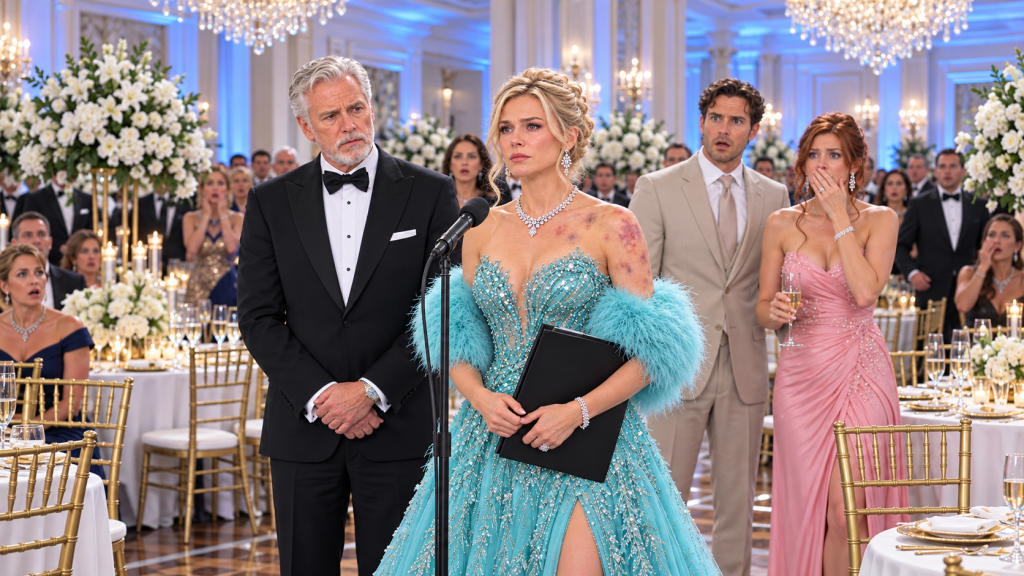
PART 2 For several seconds after Malcolm said my name, the ballroom became unnaturally quiet. Not silent exactly. I could still hear the air-conditioning. The faint clink of someone setting down a glass. The soft hum of stage equipment.
But the room itself seemed to stop breathing.
I walked toward the stage without looking back.
My shoulder still hurt where Julian had struck me.
My wrist was beginning to redden where his fingers had closed around it.
I kept moving.
When I reached the stairs, Malcolm extended one hand.
“Welcome, Nora.”
“Thank you.”
I stepped beneath the lights.
From the stage, I could see almost everyone.
Employees.
Executives.
Board members.
Spouses.
Clients.
And near the champagne table, my husband.
Julian looked as if someone had removed the floor beneath him.
Camilla stood beside him, but she was no longer touching his arm.
I accepted the microphone.
“For those of you who don’t know me,” I began, “my name is Nora Vance.”
A nervous ripple moved through the room.
Most people knew exactly who I was now.
I smiled slightly.
“And apparently, some of you know me only as Julian Vance’s decorative wife.”
A few people looked down.
Julian’s face went pale.
Malcolm did not move.
Neither did Aurelia’s general counsel, Helen Park, who stood beside the stage with a leather folder tucked beneath one arm.
I continued.
“Northstar Holdings began fifteen years ago as a private investment vehicle created by my mother, Evelyn Hart.”
Julian stared.
I had told him my mother left me investments.
That was true.
I had never told him how extensive those investments were.
Not because I was hiding wealth from a husband I trusted.
Because early in our marriage, whenever I mentioned business, Julian became dismissive.
He called finance “boring rich-person paperwork.”
When I attended board meetings for my mother’s foundation, he teased me about “playing executive.”
When I once tried discussing a distressed manufacturing acquisition, he interrupted me halfway through.
“Nora, I love you, but leave corporate strategy to people who actually do it.”
After that, I stopped explaining.
He preferred ignorance because ignorance supported his belief that he was the most important person in our marriage.
I let him have that illusion.
Until the illusion became dangerous.
“Over the last decade,” I continued, “Northstar expanded into logistics, healthcare infrastructure, energy services, and technology.”
Julian’s mouth opened.
I looked directly at him.
“Yes, Julian. That Northstar.”
Recognition finally hit him.
Three months earlier, Aurelia’s board had announced that an outside investor was considering a rescue transaction.
Julian had complained about Northstar constantly.
“They’re vultures.”
“They’ll gut the company.”
“They don’t understand our culture.”
Once, while eating dinner in our kitchen, he said:
“Whoever runs Northstar probably inherited money and hired smarter people to make decisions.”
I had asked:
“Do you know who runs it?”
“No.”
Then he laughed.
“Why would you?”
Now two hundred people were watching him realize he had mocked his wife’s company at his own dining table.
I continued.
“When Aurelia Systems approached Northstar eighteen months ago, the company faced serious pressure. Debt had risen. Several contracts had been lost. Expansion costs had exceeded projections.”
Employees listened carefully.
Some had spent months wondering whether layoffs were coming.
I knew that fear.
Our due diligence had shown departments already operating understaffed.
I had seen payroll projections that would have eliminated nearly eight hundred jobs if refinancing failed.
“That was why we invested,” I said. “Not because Aurelia had no value, but because it still had a great deal of value—especially in its people.”
Applause began somewhere near the back.
Then spread.
Julian did not clap.
Camilla did.
Very slowly.
Her face had changed.
She knew enough about corporate politics to understand that being attached to Julian at that moment was suddenly dangerous.
I turned toward Malcolm.
“Would you like to explain the governance changes?”
His expression was almost amused.
“Gladly.”
He took the microphone.
“As part of the completed acquisition, Northstar will appoint four new directors to Aurelia’s board. Ms. Vance will serve as executive chair during the transition.”
Another wave of applause.
Julian looked ready to be sick.
Then Malcolm added:
“The board also completed its review of several internal control concerns.”
The room changed again.
That was the part Julian had not expected.
Neither had Camilla.
Her eyes snapped toward Helen Park.
Helen opened the folder.
Julian’s promotion had never existed.
At least not anymore.
Six weeks earlier, Northstar’s review team had found irregularities involving Aurelia’s marketing and strategic partnerships budgets.
Nothing dramatic at first.
Just unusually high vendor costs.
Consulting invoices without clear deliverables.
Entertainment charges routed through departments that had nothing to do with entertainment.
One vendor stood out.
Price Communications Advisory.
Camilla Price’s brother owned it.
Over eighteen months, Aurelia had paid the firm $412,000.
The company had performed some legitimate work.
That mattered.
This was not a case where every payment was fake.
But the contract had never been disclosed to the board as a related-party relationship.
Worse, several invoices had been approved directly by Julian.
And Camilla had participated in selecting the vendor.
I had discovered the connection while reviewing acquisition documents.
At first, I said nothing.
I wanted facts.
Not assumptions.
Northstar hired an external forensic accounting team.
They found more.
Luxury hotel stays billed as conference expenses on dates when no conferences occurred.
Private dinners classified as client development.
Jewelry purchases hidden within executive hospitality reimbursements.
One of those purchases matched the diamond earrings Camilla was wearing that evening.
My earrings.
Or at least the same pair.
I had not yet determined whether Julian had taken mine or purchased an identical set through company funds.
That distinction mattered legally.
Emotionally, not much.
Malcolm continued.
“Effective immediately, the board has placed Chief Strategy Officer Julian Vance on administrative leave pending completion of the internal review.”
The ballroom erupted into whispers.
Julian finally moved.
He pushed through the crowd.
“This is ridiculous.”
Malcolm looked down from the stage.
“Julian.”
“You can’t announce something like that publicly.”
Helen Park stepped forward.
“It was scheduled for formal communication tomorrow morning. Your conduct this evening changed the timing.”
Julian froze.
“What conduct?”
I looked at my shoulder.
Then my wrist.
Several people nearby did the same.
His face hardened.
“Nora slipped.”
Camilla stared at him.
I almost felt sorry for her.
Almost.
Malcolm said:
“Hotel security has already been asked to preserve the ballroom footage.”
Julian’s eyes widened.
There were cameras.
Of course there were.
A hotel hosting corporate events for hundreds of people had cameras throughout its public spaces.
Julian looked at me.
“You planned this.”
“No.”
I shook my head.
“I planned to announce the acquisition.”
“You planned to humiliate me.”
“You handled that part yourself.”
A few people reacted.
Julian pointed toward me.
“You’ve been lying to me for years.”
The irony was almost impressive.
I replied:
“I never told you I was poor.”
“You let me believe—”
“I let you believe what you preferred to believe.”
His face burned.
“You’re my wife.”
“Yes.”
“That means I had a right to know.”
“Interesting.”
I glanced toward Camilla.
She looked away.
Julian followed my gaze.
“Don’t do this here.”
“You brought her here.”
“She works for the company.”
“In my earrings?”
Camilla’s face drained.
Julian went completely still.
I stepped down from the stage.
The room opened around us.
I stopped several feet away from Camilla.
“Where did you get those?”
She touched one earring instinctively.
“Julian gave them to me.”
“Of course he did.”
She looked at him.
“They were a gift.”
I nodded.
“Did he tell you they belonged to me?”
Her hand dropped.
“What?”
Julian interrupted.
“They didn’t.”
I looked at him.
“My jewelry inventory photos say otherwise.”
His jaw tightened.
I continued.
“The pair disappeared from my safe six weeks ago.”
Camilla slowly removed one earring.
“Julian?”
He looked furious.
Not ashamed.
Furious that the facts had become public.
“I bought you another pair.”
“With what money?”
He said nothing.
Helen answered.
“That question is part of the current audit.”
Camilla removed the second earring.
She placed both on the table beside her champagne glass.
Then she turned to Julian.
“You told me you were separated.”
The sentence hit differently than I expected.
I looked at her.
Julian snapped:
“Camilla, don’t.”
She stared at him.
“You said Nora refused to make the divorce public because she was emotionally unstable.”
A dozen people heard it.
Maybe more.
I laughed once.
Not because it was funny.
Because the lie was so perfectly Julian.
He had made himself the hero in both relationships.
To me, Camilla was only a colleague.
To Camilla, I was apparently a fragile wife refusing to accept the end of my marriage.
Julian took one step toward her.
“We’ll discuss this privately.”
“No.”
Camilla backed away.
“You said you were sleeping in the guest room.”
I looked at him.
“You were?”
He glared at me.
“You know what our marriage has been like.”
“Yes.”
I did.
I also knew he had slept beside me three nights earlier.
He had kissed my forehead that morning before leaving for work.
He had asked whether I wanted to spend the weekend in Vermont.
The affair had not replaced our marriage.
He had been maintaining both.
That somehow made the deception feel colder.
Camilla whispered:
“How long has she known?”
I answered.
“About you?”
“Yes.”
“Seven weeks.”
Her eyes widened.
“You knew?”
“Yes.”
“Why didn’t you confront him?”
“Because I was buying his company.”
The silence afterward was almost beautiful.
PART 3
Julian did not come home that night.
He texted me at 1:14 a.m.
WE NEED TO TALK BEFORE YOU DESTROY EVERYTHING.
I stared at the message for several seconds.
Then took a screenshot and forwarded it to my attorney.
I replied only:
Communicate through counsel.
His answer arrived immediately.
DON’T BE RIDICULOUS. I’M YOUR HUSBAND.
I did not respond.
By eight the next morning, Aurelia’s board had formally confirmed Julian’s administrative leave.
Camilla was also placed on leave while the company reviewed the vendor relationship and expense approvals.
Again, I refused to decide their guilt based on my marriage.
Aurelia had employees who deserved a fair process.
So did shareholders.
So did Julian and Camilla, whether I liked them or not.
The audit continued.
The results were worse than I expected but less dramatic than gossip later suggested.
Julian had not stolen millions.
He had not secretly transferred the company into an offshore account.
Reality was more ordinary.
And therefore more believable.
He had abused discretion.
Over three years, approximately $287,000 in executive expenses lacked sufficient business justification.
Some were ultimately documented appropriately.
Others were reimbursed to Aurelia after review.
The Price Communications contract had delivered real services, but the relationship had not been properly disclosed or competitively reviewed.
Invoices included unusually high retainers.
Travel reimbursements had weak documentation.
Several expenditures appeared personal.
The board concluded that Julian’s judgment and disclosure failures made him unsuitable for continued executive leadership.
His employment was terminated.
Camilla’s contract was also ended after the investigation found she had participated in the undisclosed related-party arrangement and failed to follow conflict-of-interest requirements.
Neither left in handcuffs.
There was no dramatic police raid.
No secret federal agents.
Just termination letters, repayment negotiations, legal correspondence, and reputations damaged by their own decisions.
That felt more appropriate.
The marriage was different.
I filed for divorce three days after the party.
Julian called me from a new number.
I answered because I thought it might be a client.
“Nora.”
I almost hung up.
“Wait.”
“What?”
“I’m sorry about the party.”
I said nothing.
“I shouldn’t have touched you.”
“No.”
“I was angry.”
“That is not an explanation.”
“I know.”
He paused.
“I was under enormous pressure.”
There it was.
The old pattern.
Excuse disguised as accountability.
I said:
“You struck me in front of two hundred people because you believed I was embarrassing you by existing beside your mistress.”
He inhaled.
“It wasn’t like that.”
“It was exactly like that.”
“You don’t understand what was happening with Camilla.”
I nearly smiled.
“I understand enough.”
“She made me feel appreciated.”
“Then perhaps she can appreciate you somewhere else.”
“Nora.”
“I’m ending this call.”
“Did you ever love me?”
That stopped me.
Not because I doubted myself.
Because I realized he genuinely believed my refusal to tolerate betrayal meant the love had never existed.
“Yes.”
I said it clearly.
“I loved you for sixteen years.”
Silence.
“That is why what you did mattered.”
He whispered:
“Can we fix it?”
“No.”
“Just like that?”
“No, Julian.”
My voice remained calm.
“Not just like that.”
I looked around the kitchen where I stood.
The table where we had eaten together.
The flowers he sent on anniversaries.
The chair where he had once held me while I cried after my mother died.
There had been real love.
That was what made betrayal complicated.
I continued.
“It ended one lie at a time.”
Then I hung up.
Our divorce took eleven months.
Julian hired an aggressive attorney.
Mine was patient.
That combination created a great deal of paperwork.
He initially argued that Northstar’s value should be treated as marital property.
That claim quickly became more complicated because most of my ownership traced directly to assets inherited from my mother and held separately before and during the marriage.
Still, there were marital assets.
Homes.
Retirement accounts.
Joint investments.
Vehicles.
Those were valued and divided according to the applicable law and our agreements.
I did not try to leave him penniless.
I wanted separation.
Not revenge.
Julian received substantial assets.
Less than he wanted.
More than internet strangers would later believe he deserved.
That is how divorce often works.
The diamond earrings became almost comical.
The original pair had indeed come from my safe.
Julian eventually admitted taking them.
He claimed he believed that because we were married, the jewelry was “ours.”
My attorney disagreed.
So did the purchase documentation showing my mother had given them to me years before the marriage.
The earrings were returned.
I never wore them again.
I sold them.
The proceeds funded a leadership scholarship for women entering technology finance.
Petty?
Perhaps.
Useful?
Absolutely.
Camilla contacted me once.
Six months after the party.
She asked to meet.
My first instinct was no.
Then curiosity won.
We met at a quiet café.
She looked different without corporate armor.
No red dress.
No perfect hair.
No sharp smile.
Just tired.
“I’m not asking you to forgive me,” she said.
“Good.”
She nodded.
“I knew he was married.”
I appreciated that she did not pretend otherwise.
“But I believed him when he said it was over.”
“Did you?”
She looked down.
“Some days.”
I waited.
“Other days, I knew I was choosing not to ask questions.”
That sounded honest.
She continued.
“He told me you lived separate lives.”
“We didn’t.”
“I know that now.”
“He told you I was unstable.”
“Yes.”
“Did that make sleeping with my husband easier?”
She winced.
“Yes.”
Good answer.
Not flattering.
True.
She said:
“I’m sorry.”
I studied her.
“For the affair?”
“For treating you like an obstacle instead of a person.”
That landed.
I nodded once.
She continued.
“I also wanted to tell you something about the party.”
“What?”
“When he hit your shoulder…”
Her voice trailed off.
“I had seen him angry before. Never like that.”
I said nothing.
“It scared me.”
“He was very comfortable humiliating me.”
“Yes.”
She looked ashamed.
“And I stood there.”
“Yes.”
She swallowed.
“I’m sorry for that too.”
I did not forgive her that day.
But I stopped needing to hate her.
Those are different things.
Aurelia required more of my attention than I originally expected.
The company had survived financially.
Its culture needed repair.
Years of executive favoritism had created strange rules.
Certain people received contracts because they knew someone.
Others were excluded from meetings because they challenged leadership.
Expense approvals depended more on seniority than documentation.
Several employees told me they had raised concerns but stopped after being labeled difficult.
That bothered me more than the money.
Systems fail long before balance sheets reveal it.
We changed vendor approvals.
Introduced conflict disclosures.
Created anonymous reporting channels.
Separated expense authorization from executive rank.
Required board review for related-party contracts.
None of it was glamorous.
Good governance rarely is.
But slowly, trust improved.
During my first all-company meeting as executive chair, an engineer asked:
“Are there going to be layoffs?”
I answered honestly.
“Some roles may change. But Northstar did not invest in Aurelia to dismantle it.”
Another employee asked:
“Are you going to run everything yourself?”
“No.”
That surprised people.
“I bought a majority position. I did not suddenly become an expert in every department.”
Leadership, I had learned from my mother, meant knowing what you did not know.
We hired a new CEO.
Dr. Maya Chen had spent twenty years in industrial software.
No family connection.
No personal friendship.
No loyalty test.
She was simply excellent.
Within two years, Aurelia returned to profitability.
Not spectacularly.
Steadily.
I preferred steadily.
Julian struggled after leaving.
I learned that through mutual acquaintances.
For nearly a year, he blamed me publicly.
Then Camilla.
Then the board.
Then “corporate politics.”
Eventually, people stopped listening.
His career did not disappear.
He found consulting work.
Smaller firms.
Shorter contracts.
He was still intelligent.
Still strategic.
His problem had never been talent.
It was entitlement.
About three years after the divorce, I received an email from him.
Subject:
NO RESPONSE NEEDED.
I almost deleted it.
Then opened it.
Nora,
I spent a long time telling myself you destroyed my career because it was easier than admitting I did.
You did not make me hide expenses.
You did not make me approve a contract I should have disclosed.
You did not make me cheat.
You did not make me put my hands on you at that party.
I was angry because I had built my identity around being more successful than you. When you walked onto that stage, I realized the entire hierarchy I imagined between us had never existed.
Instead of being proud of you, I felt humiliated.
That tells me more about me than it ever did about you.
I am sorry.
Julian.
I read it twice.
Then closed the laptop.
I never replied.
He said no response needed.
For once, I respected his request.
Years passed.
The story of the anniversary party became company folklore.
Employees exaggerated it.
According to one version, I had secretly purchased Aurelia solely to catch Julian cheating.
False.
According to another, I fired him from the stage.
Also false.
The truth was less theatrical.
Northstar had been evaluating Aurelia long before I knew about Camilla.
The affair changed my marriage.
It did not create the acquisition.
The investigation changed Julian’s employment.
I did not personally fire him in a jealous rage.
That distinction mattered to me.
Power should not become a weapon merely because someone has hurt you.
I had spent years watching Julian confuse power with permission.
I refused to become him after gaining more of it.
That lesson shaped the company.
Five years after the acquisition, Aurelia celebrated its twenty-fifth anniversary.
We returned to the Halcyon Hotel.
Same ballroom.
Same chandeliers.
I almost chose another venue.
Then decided I was tired of letting bad memories own good rooms.
Malcolm had retired.
Maya was CEO.
Aurelia employed more people than it had on the night Northstar invested.
We had launched new products, expanded internationally, and restored the retirement match that had been temporarily reduced during the debt crisis.
Before the event, I stood near the champagne table.
The same place Julian had struck me.
I touched my shoulder without thinking.
No pain.
Only memory.
Maya approached.
“You okay?”
“Yes.”
“You have the face.”
“What face?”
“The one people get when they’re remembering something they wish they weren’t.”
I smiled.
“I’m fine.”
She followed my gaze.
“Ah.”
She knew the story.
Everyone did.
“Want to move the table?”
I laughed.
“No.”
That mattered.
Later that evening, Maya introduced me for a short anniversary speech.
This time, walking toward the stage felt different.
I was not revealing anything.
Not exposing anyone.
Not proving something to my husband.
I was simply going to work.
I looked at the employees below.
Some had been at the twentieth anniversary.
Many had not.
I said:
“Five years ago, this company was afraid of its future.”
The room quieted.
“Fear creates strange behavior.”
I paused.
“Sometimes people hide information because they believe the truth will make them vulnerable. Sometimes leaders punish questions because questions threaten control.”
I thought of Julian.
Of Camilla.
Of myself.
“Healthy organizations cannot operate that way.”
I looked around the room.
“Neither can healthy relationships.”
A few people smiled.
I continued.
“Transparency does not mean perfection. It means problems can be named before they become disasters.”
That was the lesson.
Not that a wife secretly being richer than her husband makes a good revenge story.
Not that humiliation should be returned with greater humiliation.
The real problem had begun years earlier.
Julian believed partnership meant hierarchy.
He needed me smaller so he could feel larger.
He liked my intelligence as long as it did not challenge his.
He admired my independence until he realized it existed beyond him.
Camilla made him feel powerful because she reinforced the version of himself he wanted to believe.
And for too long, I had accepted being underestimated because correcting him seemed exhausting.
That was my mistake.
Not his affair.
Not his misconduct.
Those belonged to him.
My mistake was believing silence kept a marriage peaceful.
Silence only kept it quiet.
There is a difference.
After my speech, I stepped down.
A young analyst approached.
She looked nervous.
“Ms. Vance?”
“Nora is fine.”
She smiled.
“I just wanted to say something.”
“What?”
“I was here five years ago.”
I laughed.
“You look twelve.”
“I was an intern.”
“That explains it.”
She smiled.
“I saw what happened.”
My expression changed.
“I’m sorry.”
“No.”
She shook her head.
“It helped me.”
I frowned.
“How?”
“My boyfriend at the time used to embarrass me in front of people and then tell me I was too sensitive.”
I stayed quiet.
“When your husband hit your shoulder, I remember thinking everyone could see it.”
Her voice softened.
“And then when you didn’t leave…”
I understood.
“You realized you didn’t have to either.”
She nodded.
“I ended things two weeks later.”
My eyes filled.
“Are you okay now?”
“Very.”
She smiled.
“I’m engaged.”
“To someone kind?”
“The kindest.”
“Good.”
She walked away.
I stood there longer than necessary.
For years, I had thought the most important moment that night was Malcolm saying my name.
It wasn’t.
It was the moment Julian told me to leave and I realized I didn’t have to obey.
Everything afterward came from that.
The acquisition was already signed.
The audit already existed.
His affair already happened.
The announcement only revealed truths that were already there.
But my refusal changed me.
“No. I think I’ll stay.”
Four words.
Nothing dramatic.
Yet sometimes a life changes because one person finally stops walking away from their own place in it.
I eventually remarried.
Not quickly.
Seven years after Julian.
His name was Thomas.
He taught architectural history and owned exactly three suits, all slightly wrinkled.
On our second date, he asked what Northstar did.
I explained.
He listened for twenty minutes.
Asked intelligent questions.
Then said:
“So basically, you buy complicated companies and make everyone read better spreadsheets.”
I laughed so hard the waiter stared.
“Yes.”
“That sounds terrifying.”
“It can be.”
He never needed me smaller.
That was new.
When we married, the ceremony was tiny.
No chandeliers.
No company board.
No announcement.
Just people we loved.
At dinner, Thomas leaned toward me.
“You know what my favorite thing about you is?”
“What?”
“You always stay for the announcement.”
I stared at him.
Then laughed.
He had heard the story.
Of course.
“Careful.”
“Why?”
“I own fifty-eight percent of this marriage.”
He shook his head.
“Absolutely not.”
“Fine. Fifty-one.”
“Still hostile.”
For once, power was something we could joke about because neither of us needed it to control the other.
That felt like success.
Years earlier, Julian had looked at me in a crowded ballroom and said another woman belonged beside him.
He believed he was deciding where I belonged.
He was wrong.
No husband decides that.
No title decides that.
No affair.
No company.
No room full of people.
I belonged wherever I chose to stand.
That night, I chose the stage.
And everything changed after that.
THE END! THANKS FOR READING!