
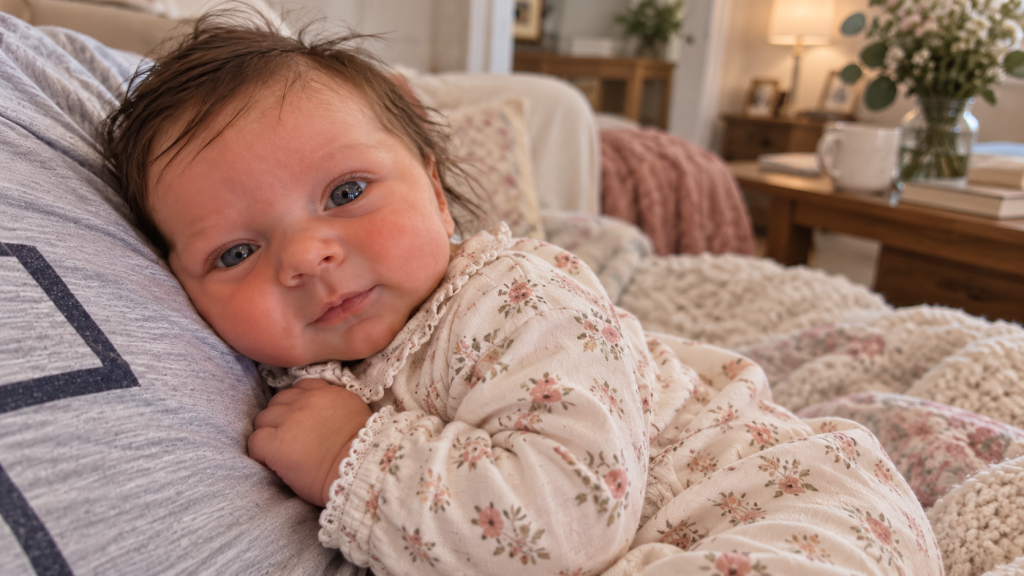
PART 2 For several seconds, I couldn’t understand what Lucas was pointing at. The baby was crying against my chest, her tiny fists opening and closing beneath the hospital blanket while Hannah stood beside me shaking so badly that one of the nurses reached out to steady her.
“Her back,” Lucas repeated. His voice sounded almost frightened. I carefully shifted the blanket. Just beneath the baby’s left shoulder blade was a dark crescent-shaped birthmark. Not large. Not dangerous. Nothing medically alarming.
But I knew that mark.
I had one almost exactly like it.
So did my son.
And when Lucas and I were children, our mother used to joke that the little crescent was the family stamp.
I stared at it.
Then at Lucas.
“Lucas.”
He stepped backward.
“No.”
Hannah looked between us.
“What is it?”
Lucas pointed at me.
“She has Emma’s birthmark.”
My name was Emma.
I stared at him.
“So?”
“So this is impossible.”
A nurse frowned.
“I’m sorry, sir, what exactly are you concerned about?”
Lucas ignored her.
He looked at Hannah.
“That baby can’t be ours.”
Hannah’s face crumpled.
“What are you saying?”
Lucas ran both hands through his hair.
“We used your egg. We used my sperm. Emma only carried her.”
“Yes,” Hannah whispered.
“Then why does she have Emma’s family birthmark?”
I stared at him.
“Because you are my twin brother.”
He blinked.
“What?”
“We have the same family.”
“That isn’t how this works.”
“Actually, inherited traits absolutely can appear in relatives.”
He shook his head violently.
“No.”
The nurse stepped in.
“Mr. Carter, a birthmark cannot establish maternity or paternity.”
Lucas barely seemed to hear her.
His eyes were locked on the baby.
“I knew something was wrong.”
That sentence changed the room.
Hannah stared.
“What do you mean you knew?”
Lucas went quiet.
“Lucas?”
He looked at the floor.
“I had another test done.”
My stomach tightened.
“What test?”
He rubbed his face.
“A fertility test.”
Hannah’s expression went blank.
“When?”
“Six months ago.”
The baby was only minutes old.
Hannah looked as if she had aged ten years.
“You had a fertility test six months ago?”
Lucas nodded.
“Why didn’t you tell me?”
“Because I didn’t want to scare you.”
“What did it say?”
Silence.
“Lucas.”
His voice dropped.
“It said my sperm count was almost zero.”
Hannah stumbled backward.
I felt cold.
“But the embryos were already created before that,” I said.
He looked at me.
“I know.”
“Then what exactly are you thinking?”
“I’m thinking maybe something went wrong.”
“With the clinic?”
“Yes.”
Hannah shook her head.
“No.”
“I’m thinking maybe the embryo wasn’t ours.”
Her eyes widened.
“You think Emma somehow carried her own baby?”
“I don’t know what I think.”
I looked at my brother.
The man I had trusted enough to carry a child for.
The man who had spent months talking to my stomach, buying tiny shoes, assembling a crib, and arguing over names.
Now he stood three feet away from his daughter acting as though she were evidence from a crime scene.
I said:
“Then stop making declarations until you do know.”
He looked at me.
“She has your mark.”
“And your mark.”
Lucas froze.
“What?”
I stared.
“You have one.”
“No, I don’t.”
“Yes, you do.”
Hannah looked at him.
“Where?”
I almost laughed from disbelief.
“On his hip.”
Lucas stared at me.
“How would you even remember that?”
“Because we were five years old and Mom photographed us at the lake in matching swimsuits. You have a small crescent near your right hip.”
His face changed.
“That’s different.”
“How?”
“It’s smaller.”
“Lucas, listen to yourself.”
Hannah started crying again.
The nurse gently took the baby from my arms so I could rest.
Lucas looked toward her.
Then away.
He could not even look at his daughter.
I felt something inside me harden.
“You are not leaving this hospital until we understand what happened.”
“I need air.”
“No.”
He looked stunned.
“You cannot stop me.”
“No, but Hannah can decide whether she ever forgives you if you walk out now.”
That stopped him.
Hannah looked at me.
Then Lucas.
“Did you really plan to leave without telling me about the fertility test?”
He whispered:
“I thought it didn’t matter.”
“It matters now.”
“I know.”
“No, Lucas.”
She wiped her face.
“It mattered six months ago.”
The doctor eventually returned and explained what should have been obvious from the beginning.
A birthmark was not proof of anything.
The baby was healthy.
Hospital staff had no evidence that the surrogacy process had failed.
If the parents had concerns about biological parentage, DNA testing could confirm it.
Lucas immediately requested testing.
Hannah agreed.
I agreed too.
Not because I believed I was the baby’s biological mother.
I knew the embryo transfer had been created from Hannah’s egg and Lucas’s sperm according to all of the records.
But once doubt entered the room, facts were the only way out.
The next forty-eight hours were some of the strangest of my life.
Hannah stayed with the baby constantly.
She named her Amelia.
The name they had chosen months earlier.
Lucas came and went.
He never fully abandoned the hospital.
But he kept his distance.
Every time he looked at Amelia, I could see fear working behind his eyes.
I became angry enough that eventually I told him:
“Stop staring at her like she did something wrong.”
He flinched.
“I’m not.”
“Yes, you are.”
“I’m trying to understand.”
“She doesn’t need to be understood. She needs to be loved.”
He looked at me.
“You think this is easy?”
“No.”
I lowered my voice.
“I think you are making it harder than it has to be.”
He stared toward the nursery window.
“What if she isn’t mine?”
“Then you deal with the facts when you have them.”
“And until then?”
“You behave like the father who spent years begging for her.”
He had no answer.
The DNA results arrived five days later.
We met at Hannah and Lucas’s house.
Amelia slept in a bassinet beside Hannah.
Lucas sat across from us holding the envelope.
His hands shook.
“Open it,” Hannah said.
He did.
His eyes moved down the page.
Then stopped.
I watched his face collapse.
“What?”
Hannah grabbed the report.
Probability of paternity:
Greater than 99.99%.
Lucas was Amelia’s biological father.
The maternal analysis confirmed Hannah as the biological mother.
No embryo mix-up.
No secret donor.
No biological connection to me beyond the expected family relationship.
I had been the gestational carrier.
Exactly as planned.
Hannah covered her face and sobbed.
I looked at Lucas.
He stared at the paper.
“She’s mine.”
I felt anger rise again.
“Yes.”
He started crying.
“I’m sorry.”
Hannah stood.
“No.”
He looked at her.
“What?”
“You don’t get to say sorry and skip everything between the hospital and now.”
He looked stunned.
“I know.”
“No, you don’t.”
She picked up Amelia.
“For five days, you looked at our daughter like she was a problem to solve.”
His face crumpled.
“I was scared.”
“So was I.”
She held Amelia closer.
“I was terrified. But I did not reject her.”
Lucas covered his face.
I said nothing.
This was their marriage.
Their wound.
The DNA test answered one question.
It did not repair what happened.
The fertility clinic agreed to conduct a full records review.
Lucas insisted.
For once, I agreed with him.
If his recent fertility test showed an extremely low sperm count, he wanted to understand how the embryos had been created.
The answer was less dramatic than his imagination.
The embryo creation had taken place almost fourteen months before his new fertility test.
At that earlier time, his sample had been documented in the low-normal range.
Not ideal.
But usable.
Several viable embryos were created.
One was later transferred to me.
The clinic found no evidence of labeling errors, donor material, or procedural irregularity.
Lucas’s newer test did not retroactively change his fertility at the time the embryos were created.
His doctor explained that sperm counts can change because of many factors and that a result from one point in time does not necessarily describe every earlier or future period.
The physician also told him something he desperately needed to hear:
“You took a later medical result and treated it as proof that something impossible must have happened earlier.”
Lucas looked down.
“That’s what I did.”
The doctor nodded.
“Fear filled the gap before facts did.”
That sentence stayed with all of us.
But another secret remained.
Why had Lucas taken the fertility test at all?
Hannah asked him repeatedly.
He avoided the question.
Finally, two weeks after Amelia’s birth, he told us.
Our father had recently been diagnosed with a hereditary condition affecting fertility.
It was not life-threatening.
But it had made Lucas question whether he might have inherited something.
He had been tested without telling Hannah.
When the result showed near-zero sperm count, he panicked.
He convinced himself their fertility struggle had always been his fault.
And then he hid it.
Hannah stared at him.
“You watched me blame myself.”
Lucas closed his eyes.
“Yes.”
“For years.”
“Yes.”
“You let me take medication and undergo procedures while believing my body was failing us.”
“I didn’t know until recently.”
“But when you did know, you still said nothing.”
He whispered:
“Yes.”
That became the real betrayal.
Not the birthmark.
Not the DNA test.
The secrecy.
Lucas had always presented himself as the strong twin.
The logical one.
The protector.
But his fear of being seen as infertile had become so intense that he had built an entire secret life around one lab report.
He had not cheated.
He had not switched embryos.
There was no dramatic medical conspiracy.
There was simply shame.
And shame, if hidden long enough, can become destructive.
Hannah asked him to leave the house temporarily.
I supported her.
Lucas was devastated.
“But Amelia—”
“You are her father,” Hannah said.
“I am not stopping you from being her father.”
“Then why are you making me leave?”
“Because being her father does not automatically make you a safe husband right now.”
That hurt him.
Good.
Some truths should hurt.
PART 3
The next six months were not dramatic.
They were difficult.
Which is often harder.
Lucas rented a small apartment ten minutes away.
He visited Amelia according to a schedule Hannah agreed to.
At first, visits happened at the house.
Then he took Amelia for walks.
Later, short afternoons alone.
He learned bottles.
Diapers.
Baths.
Sleep schedules.
Pediatric appointments.
The ordinary work of being a father.
He also started therapy.
Not because Hannah demanded it.
Because our mother did.
She arrived at his apartment one Sunday with groceries and told him:
“If you let pride destroy your marriage after waiting years for that child, I will personally haunt you while I’m still alive.”
That sounded like Mom.
Lucas went.
Therapy forced him to confront something older than infertility.
Growing up as twins, we had always been compared.
I was the emotional one.
Lucas was the reliable one.
I cried.
He fixed things.
I asked for help.
He handled problems quietly.
Everyone praised him for it.
Somewhere along the way, Lucas learned that fear was something to conceal.
If he was scared, he became controlling.
If he was uncertain, he researched alone.
If he was ashamed, he buried information.
That strategy worked until the day his daughter was born.
Then everything he had hidden exploded at once.
I had my own complicated feelings.
For months, people kept calling me generous.
Selfless.
Amazing.
For being a surrogate.
But I did not feel amazing.
I felt angry.
I had carried Amelia for nine months.
I had experienced nausea.
Back pain.
Insomnia.
Medical appointments.
Labor.
Recovery.
I had done all of it believing I was helping two people I loved become parents.
Watching Lucas reject her even briefly made me question whether I had made a terrible mistake.
One night, I told Hannah:
“If I had known he would react like that, I never would have agreed.”
She looked at Amelia sleeping in her arms.
“I’m still glad you did.”
“I know.”
“Are you?”
I stared at the baby.
“Yes.”
I was.
Because Lucas’s failure did not erase Amelia.
She was not a mistake because an adult had panicked.
That distinction mattered.
Some relatives suggested that because I had carried her, maybe I should take a larger role.
That made me uncomfortable.
I was her aunt.
Not her mother.
The surrogacy agreements had been clear.
Hannah was her biological and intended mother.
Lucas was her biological and intended father.
I was the gestational carrier.
Emotion did not change those facts.
I loved Amelia deeply.
But loving her meant respecting the family structure we had intentionally created.
Six months after the birth, Hannah allowed Lucas to move home.
Not because she had forgotten.
Because he had changed consistently.
He had attended therapy.
Shown up for every scheduled visit.
Stopped asking when she would “get over it.”
Taken responsibility without blaming the fertility clinic.
And perhaps most importantly, he apologized to Amelia.
She was an infant.
She understood nothing.
But he did it anyway.
I happened to be there.
He held her against his chest.
“I’m sorry I looked at you and saw my fear instead of my daughter.”
Hannah cried.
So did I.
Lucas continued.
“There was never anything wrong with you.”
That sentence mattered more than the DNA report.
The birthmark remained.
Of course.
It did not disappear just because everyone finally understood it.
When Amelia was one, she began pointing at it whenever someone changed her clothes.
By three, she called it her moon.
“My moon mark.”
I showed her mine.
My son showed her his.
Finally, Lucas showed her the small crescent mark near his hip.
Amelia laughed.
“Daddy moon!”
Lucas cried afterward.
He thought nobody saw.
I did.
I said nothing.
Sometimes shame heals quietly.
Hannah and Lucas had frozen embryos remaining.
For years, everyone assumed they would eventually have another baby.
But after Amelia’s birth, they stopped making plans.
The question felt too complicated.
Would Hannah carry?
Would they use another surrogate?
Did they want another child?
Eventually, they decided Amelia was enough.
Not because they were afraid.
Because they were happy.
That was an important difference.
My relationship with Lucas changed too.
We remained close.
But I stopped treating him as the twin who could do no wrong.
That illusion had ended.
Oddly, losing it made our relationship more honest.
One afternoon, years later, he said:
“You used to think I was the good twin.”
I laughed.
“No.”
“You did.”
“You used to think you were.”
He smiled.
“Also true.”
Then he became serious.
“Did you hate me after the hospital?”
“For a while.”
He nodded.
“I deserved that.”
“I don’t know if people deserve hatred.”
“Anger, then.”
“Yes.”
He looked toward Amelia playing with my son.
“I hated myself.”
“That didn’t help anyone either.”
He looked at me.
“What did?”
“Showing up.”
That became the theme of our family afterward.
Not perfection.
Presence.
Lucas could never undo the first minutes of Amelia’s life.
He could not erase Hannah’s memory of standing in a hospital room while her husband rejected their child.
But he could determine what the next thousands of moments looked like.
He did.
He was there for first steps.
First words.
Preschool.
Fevers.
Birthday cakes.
Dance classes.
Broken crayons.
Parent-teacher conferences.
The ordinary accumulation of fatherhood.
When Amelia was eight, she asked the question we had known would eventually come.
“Mom said Aunt Emma carried me in her belly.”
Hannah and Lucas had always planned to tell her the truth.
No secrets.
Not anymore.
“Yes,” Hannah said.
“Why?”
“Because Mommy had trouble carrying a baby, and Aunt Emma helped us.”
Amelia looked at me.
“You grew me?”
I laughed.
“For a while.”
She thought about that.
“Then why aren’t you my mom?”
The room went quiet.
I answered carefully.
“Because carrying a baby and being a parent are not always the same thing.”
She looked at Hannah.
“Mommy is my mom because I came from her egg?”
“Yes.”
“And Daddy is Daddy because…”
She looked at Lucas.
“Because of your stuff.”
We all laughed.
Close enough.
Then she asked:
“Did Daddy always want me?”
Silence.
Lucas could have lied.
He didn’t.
He sat beside her.
“I wanted you before you were born more than almost anything in the world.”
She smiled.
“But when you were born, I got scared.”
Her smile faded.
“Of me?”
“No.”
He shook his head.
“Of something I didn’t understand.”
He explained that he had gotten confusing medical information and saw her birthmark and made a bad assumption.
He did not tell an eight-year-old every painful detail.
But he told the truth.
“I thought something had gone wrong.”
“What?”
“I thought maybe I wasn’t your biological dad.”
Her eyes widened.
“But you are.”
“Yes.”
“Did you leave?”
Lucas swallowed.
“For a little while, I didn’t know what to do.”
Amelia stared at him.
Then asked:
“Were you dumb?”
I covered my mouth.
Hannah turned away to hide laughter.
Lucas nodded solemnly.
“Extremely.”
Amelia accepted that.
Children sometimes handle truth better than adults fear they will.
She leaned against him.
“Okay.”
That was not the end of the conversation forever.
At thirteen, she asked again.
This time Lucas told her more.
The fertility test.
The birthmark.
The DNA report.
The temporary separation.
He did not make himself the hero.
That mattered.
Amelia listened.
Then said:
“So Mom stayed with you?”
“Eventually.”
She looked at Hannah.
“Why?”
Hannah smiled.
“Because people can do terrible things and still become better people.”
Amelia frowned.
“Does that mean you have to forgive them?”
“No.”
Hannah answered immediately.
“You never have to stay with someone just because they apologize.”
Lucas nodded.
“Your mother stayed because she watched my behavior change over time.”
Amelia looked at her father.
“You’re lucky.”
He smiled.
“I know.”
The old fertility report became less frightening over time.
Lucas later repeated testing.
His numbers improved somewhat but remained inconsistent.
Doctors explained that fertility can fluctuate and that a single test should be interpreted within broader medical context.
He eventually stopped seeing the report as a verdict on his identity.
That was the deeper healing.
Men are often taught to connect fertility with masculinity.
Women often receive similar messages about motherhood.
Our family had been damaged by those assumptions.
Hannah had spent years believing her difficulty conceiving made her inadequate.
Lucas later believed his fertility result made him defective.
Both had carried shame that should never have belonged to them.
Amelia destroyed those beliefs simply by existing.
She was not evidence of anyone’s failure.
She was a child.
That sounds obvious.
It took us years to understand.
When Amelia turned sixteen, she chose biology as her favorite subject.
Naturally.
She became fascinated by genetics.
One evening, she made our entire family participate in a presentation for school.
Dominant traits.
Recessive traits.
Hereditary variation.
She included a photograph of our crescent birthmarks.
Lucas looked nervous.
She noticed.
“Dad, relax. I’m not exposing the family scandal.”
He laughed.
“What scandal?”
“The Great Birthmark Panic.”
Hannah nearly spit out her drink.
That became the family name for it.
Humor arrived only because enough time and honesty had passed.
Years earlier, the same phrase would have hurt.
Now it reminded us that what once seemed catastrophic had eventually become understandable.
When Amelia graduated from high school, Lucas stood beside me in the audience.
He cried before her name was even called.
“You know she hasn’t graduated yet.”
“Shut up.”
“She’s still sitting down.”
“Emma.”
“You’re embarrassing yourself.”
Then Amelia crossed the stage.
Lucas stood.
Applauded louder than anyone.
I watched him.
For a moment, I saw the hospital again.
His pale face.
The newborn in his arms.
“I can’t take her.”
Then I looked at the man standing beside me eighteen years later.
There are moments we cannot erase.
But they do not have to become the only evidence of who we are.
After graduation, Amelia ran toward us.
She hugged Hannah first.
Then Lucas.
Then me.
“Thanks for growing me, Aunt Emma.”
I laughed.
“You’re welcome.”
Lucas smiled.
I looked at him.
“Remember when you wouldn’t take her home?”
His face twisted.
“Do you have to mention that today?”
“Yes.”
“Why?”
“Because look at you now.”
He glanced at Amelia.
“I know.”
Then he whispered:
“I almost let fear steal all of this.”
That was the real lesson.
Not the DNA.
Not the fertility test.
Not the birthmark.
Fear had convinced Lucas to answer a question before he had facts.
He saw something he did not understand and immediately created the worst explanation.
Then he acted on it.
That is how people destroy relationships.
Not always through evil.
Sometimes through certainty without evidence.
The clinic review ultimately confirmed what should have been our starting point:
The embryos had been created correctly.
The biological parents were Lucas and Hannah.
I had carried their daughter.
The birthmark was simply a family trait appearing through a family we all shared.
Nothing sinister.
Nothing impossible.
But fear had turned an ordinary genetic resemblance into a crisis.
When people hear our story, they often ask whether I regret being a surrogate.
I don’t.
I regret that Lucas reacted the way he did.
I regret Hannah’s pain.
I regret the secrecy around the fertility test.
But I do not regret Amelia.
She brought truth into a family that had become too comfortable hiding fear.
She taught Lucas that fatherhood is not confirmed by resemblance or paperwork.
DNA establishes biology.
Parenthood is built afterward.
In bottles.
Bedtime stories.
School pickups.
Apologies.
Showing up.
And Hannah taught all of us something equally important:
Forgiveness is not pretending something never happened.
She never erased the hospital from their history.
She simply refused to let it control every day that followed.
As for me, I learned that helping people create a family does not mean carrying responsibility for what they do with that gift.
I had given Lucas and Hannah an opportunity.
Their choices afterward belonged to them.
Thankfully, Lucas eventually chose correctly.
Not once.
Thousands of times.
That is why Amelia grew up knowing her father loved her.
Not because he never failed.
Because after failing terribly, he stopped running from what he had done.
And every year on Amelia’s birthday, Lucas tells her the same thing.
“You were wanted.”
The first time I heard him say it, I almost cried.
Because it was true.
She had always been wanted.
The only problem was that, for one frightening moment, fear became louder than love.
Thankfully, it did not stay that way.
THE END ! THANKS FOR READING!