
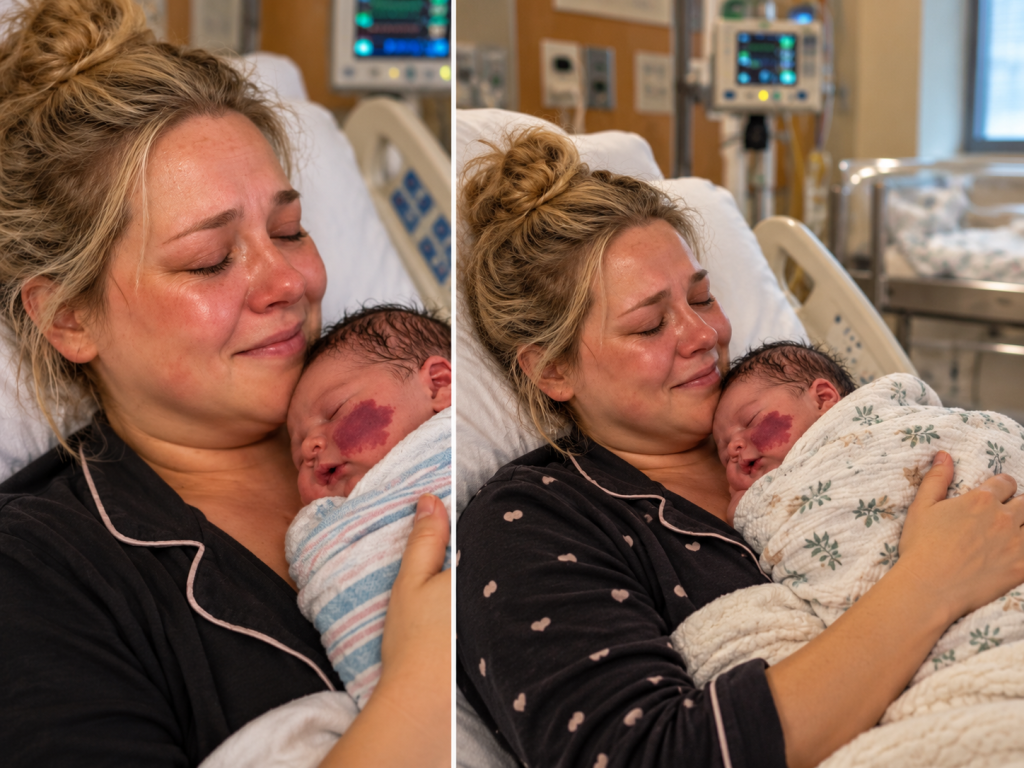
PART 2 For several seconds, I honestly believed I had misheard them. The baby was sleeping against my chest, wrapped tightly in a white hospital blanket.Her tiny mouth opened once, then closed.
Perfectly peaceful.
Completely unaware that the two people who had begged for her existence were standing six feet away discussing whether they wanted her.
“What do you mean, ‘not the baby you wanted’?” I asked.
Samantha looked at Ronald.
Ronald looked at the floor.
That frightened me more than anything.
“Samantha.”
She finally spoke.
“The clinic told us the embryo was male.”
I stared at her.
“What?”
Ronald rubbed both hands over his face.
“We specifically selected a male embryo.”
I looked down at the baby girl in my arms.
Then back at them.
“You selected?”
Samantha started crying.
“We didn’t tell you because we knew you would judge us.”
“You let me carry this child for nine months without telling me you only wanted her if she was a boy?”
“That’s not what I’m saying.”
“It is exactly what you’re saying.”
Ronald stepped forward.
“There could have been a laboratory error.”
“A laboratory error does not explain why neither of you will touch her.”
His expression hardened.
“We were promised a son.”
The baby stirred.
Instinctively, I rocked her.
Samantha covered her face.
“I pictured him for years, Alison.”
“Him?”
“Yes.”
“You didn’t picture a child?”
She looked at me.
“I pictured my son.”
Something inside me changed at that moment.
Not anger.
Not yet.
Clarity.
For two years, they had told me they wanted to become parents.
They had not.
They wanted a specific dream delivered to them.
And now that dream had arrived in the wrong wrapping.
I reached for the call button beside the hospital bed.
Ronald frowned.
“What are you doing?”
“Calling the nurse.”
“Why?”
“Because we need a hospital social worker and the surrogacy attorney here before anybody leaves.”
Samantha stared at me.
“Alison, don’t make this bigger than it is.”
I almost laughed.
“You just rejected your newborn daughter because she’s female. I don’t know how to make that small.”
The nurse came first.
Then the charge nurse.
Then a hospital social worker named Denise.
Within an hour, our attorney, Meredith Cole, joined by phone.
She had handled the gestational-carrier agreement months earlier.
The arrangement had been very clear.
The embryo had been created using Samantha’s egg and Ronald’s sperm.
I had no genetic connection to the baby.
I was the gestational carrier.
The contract described Samantha and Ronald as the intended parents.
It also contained detailed provisions for unexpected medical complications, prenatal findings, birth procedures, and parental responsibility.
What it did not contain was a clause saying:
If the baby is not the sex you hoped for, you may walk away.
Meredith’s voice became very quiet when Ronald explained what had happened.
“Let me make sure I understand,” she said. “The baby is healthy?”
“Yes,” the pediatrician answered.
“And Samantha and Ronald are refusing to assume care because they expected a boy?”
Ronald immediately objected.
“We’re not refusing anything permanently.”
Samantha added, “We just need time.”
Meredith said, “Then take time to process your emotions. But understand that the child’s needs cannot be suspended while you decide whether she matches your expectations.”
Samantha began crying again.
“I can’t do this.”
I looked at her.
“You asked me to do this.”
She flinched.
Nine months.
Morning sickness.
Back pain.
Insomnia.
Weekly appointments near the end.
I had rearranged my entire life because she told me this child would be loved beyond measure.
Now the child had been alive for less than two hours, and Samantha could barely look at her.
Denise, the social worker, asked the question nobody else had yet asked.
“Would either of you like to hold your daughter?”
Silence.
Ronald looked away.
Samantha whispered, “Not right now.”
I tightened my arms around the baby.
“Then I will.”
Denise looked at me carefully.
“Alison, you need to understand that decisions about temporary care will have legal implications.”
“I understand.”
I didn’t.
Not really.
But I understood one thing.
That baby was not spending her first night alone because two adults had decided disappointment mattered more than responsibility.
A DNA test was ordered immediately.
So was a review by the fertility clinic.
Samantha and Ronald left the hospital before sunset.
They didn’t take the baby.
They didn’t kiss her goodbye.
Samantha paused beside my bed before walking out.
“I need you to understand that I’m in shock.”
“So is she.”
“She doesn’t know what’s happening.”
“No,” I said. “That’s the only mercy in this room.”
Her face crumpled.
Then she left.
I cried after the door closed.
Not because I regretted carrying the baby.
Because I had trusted my sister.
The next morning, the nurses asked what name should be placed on the temporary paperwork.
Samantha and Ronald had chosen no girl’s name.
Only a boy’s name.
Nathaniel.
For months, Samantha had rubbed my stomach and said, “My little Nathan.”
Now there was a daughter lying beside me with no name.
I looked at her tiny face.
Her eyes were closed.
One fist rested beside her cheek.
“Lily,” I whispered.
I don’t know why.
The name simply came.
The nurse smiled.
“Lily?”
“Just for now.”
But the name stayed.
Three days later, preliminary DNA results confirmed exactly what the original records should have shown.
Lily was Samantha and Ronald’s biological child.
There had been no embryo swap.
No mysterious donor.
No hidden explanation.
The fertility clinic found the real problem twenty-four hours later.
A documentation error.
A technician had entered the wrong embryo identification code into one part of the patient portal.
The transferred embryo had never been genetically confirmed as male.
The clinic’s internal records showed that the embryo selected for transfer had been listed as female in the embryology file.
Samantha and Ronald had misunderstood—or ignored—later paperwork that did not match what they wanted to believe.
Meredith explained it to us during a conference call.
“There is no evidence that another embryo was transferred.”
Ronald sounded furious.
“So the clinic made a mistake.”
“The portal contained incorrect information.”
“Then this is their fault.”
“No,” Meredith said.
That silenced him.
“The documentation problem is theirs. Your reaction to your daughter is yours.”
I wanted to hug her through the phone.
Samantha said almost nothing.
Then she asked:
“Can we place her for adoption?”
My stomach dropped.
“You’re serious?”
“Alison—”
“You begged for eight years to become a mother.”
“I know.”
“You asked me for two years to carry this baby.”
“I know.”
“You came to every appointment.”
“I know!”
Her voice cracked.
“But I can’t look at her without thinking about everything that went wrong.”
I closed my eyes.
There it was.
Lily had become a symbol of disappointment before she had even learned to focus her eyes.
I said, “Then she deserves better.”
Samantha went quiet.
Ronald snapped, “Don’t act like you can just keep her.”
“I’m not acting like anything.”
But privately, the thought had already formed.
If they truly did not want Lily, I did.
That terrified me.
I was thirty-eight.
My children were grown.
I had not planned to start over.
I had agreed to pregnancy, not motherhood.
But every time Lily curled her fingers around mine, one question kept returning.
Where would she go if I stepped away?
A legal process began.
Not overnight.
Not with one dramatic signature.
Lawyers became involved on both sides.
A guardian was appointed to focus on Lily’s interests.
The fertility agreement was reviewed.
State parentage rules were examined.
Samantha and Ronald received independent counsel.
They were offered counseling.
The hospital made sure nobody was making decisions during immediate postpartum chaos.
For ten days, Lily remained in temporary care arrangements while I stayed closely involved.
Samantha visited once.
She stood beside the bassinet.
For several minutes, she said nothing.
Then Lily opened her eyes.
Samantha started crying.
I thought maybe everything would change.
Maybe she would reach down.
Maybe she would finally see her daughter.
Instead, she whispered:
“I’m sorry.”
Then she walked out.
That was when I stopped hoping for a miracle from Samantha.
I started fighting for stability for Lily.
Not revenge.
Stability.
There was a difference.
PART 3
Three weeks after Lily’s birth, Samantha and Ronald formally stated through their attorneys that they did not intend to parent her.
I read that sentence three times.
Then I threw the document onto my kitchen table and cried harder than I had since the hospital.
My adult daughter, Grace, found me there.
She was twenty-one and home from college.
She picked up the document.
“They’re giving her up?”
“Yes.”
Grace sat across from me.
“What happens to Lily?”
“I can apply to adopt her.”
She stared.
“You want to?”
“I think I do.”
“You’re going to be fifty-six when she graduates high school.”
“I know.”
“You just got your life back after raising us.”
“I know.”
“You promised yourself you were done changing diapers.”
Despite everything, I laughed.
“I know.”
Grace reached across the table.
“Then why?”
I looked toward the portable bassinet beside the couch.
Lily had been placed with me temporarily while the case proceeded.
“She shouldn’t grow up believing she was unwanted because she was born a girl.”
Grace’s eyes filled with tears.
“That’s not enough reason to raise a child.”
“No.”
“What’s the other reason?”
I smiled.
“I love her.”
Grace nodded.
“Okay.”
“Okay?”
“We’ll figure it out.”
My son Michael took longer.
He was twenty-three and living two states away.
When I told him, he went completely silent.
Then:
“Mom, are you sure?”
“No.”
He laughed softly.
“At least you’re honest.”
“I’m terrified.”
“That sounds more normal.”
Then he said something that stayed with me.
“If Lily comes into our family, she never hears that she ruined anybody’s plans.”
“She won’t.”
“I mean ever.”
“I promise.”
My children became her fiercest protectors.
The legal process took months.
Samantha avoided me almost completely.
Ronald became angry when he learned that I intended to adopt Lily.
That surprised me.
“You don’t want her,” I said during a mediation session.
“That doesn’t mean you should raise her.”
“Why?”
“Because everybody will know.”
I stared at him.
“Know what?”
“What happened.”
Finally, I understood.
This was not about Lily.
It was about embarrassment.
If Lily disappeared into a closed adoption far away, Ronald and Samantha could tell people the pregnancy had suffered some private complication.
If I adopted her, she would remain visible.
A living reminder that they had rejected their own daughter.
Ronald wanted secrecy.
I refused.
Not because I intended to publicly shame them.
Because Lily deserved access to her true history.
The mediator asked Ronald:
“Are you seeking custody?”
“No.”
“Do you intend to parent the child?”
“No.”
“Are you objecting to Alison because you believe she is unfit?”
“No.”
“Then what precisely is your objection?”
Ronald said nothing.
That was effectively the end of that argument.
Several months later, after all required reviews and approvals, Lily became my daughter legally.
Samantha did not attend the final hearing.
Ronald didn’t either.
Grace and Michael did.
So did two of my closest friends.
The judge looked over the paperwork.
Then at me.
“You understand this is a permanent commitment?”
“Yes.”
“You understand that raising a child at this stage of your life may require significant financial and emotional adjustments?”
“Yes.”
“And you still wish to proceed?”
I looked at Lily.
She was seven months old by then.
She was sitting in Grace’s lap chewing on the corner of a stuffed rabbit.
“Yes.”
The judge smiled.
“Then congratulations.”
Everyone cried.
Even Michael.
He later denied it.
Things did not become magically easy.
Lily woke at two in the morning.
Then four.
Then five-thirty.
I remembered why younger parents always look exhausted.
I had to rearrange my work schedule.
Grace helped when she could.
Michael came home more often.
My living room filled with toys again.
My carefully organized kitchen developed bottles on every counter.
And my quiet life disappeared.
I loved it.
Not every second.
Anyone who says they love every second of parenting has never stepped barefoot on a plastic toy at three in the morning.
But I loved her.
Samantha stayed away for almost a year.
Then, on Lily’s first birthday, she appeared outside my house.
Alone.
I almost didn’t open the door.
She held a wrapped present.
“I know I don’t have the right.”
“No,” I said. “You don’t.”
She flinched.
“I just wanted to see her.”
“Why?”
Her eyes filled with tears.
“Because I think about her every day.”
That made me angry.
“Then why did it take a year?”
“Because I was ashamed.”
“Good.”
She nodded.
“I deserved that.”
I said nothing.
Samantha looked older.
Not physically, exactly.
Just worn.
She continued.
“Ronald and I separated.”
I hadn’t known.
“When?”
“Four months ago.”
“Why?”
“Because we couldn’t stop blaming each other.”
“For Lily?”
“For everything.”
She looked at the present.
“Afterward I started therapy.”
“That’s good.”
“I finally admitted something.”
I waited.
“I didn’t reject Lily because she was a girl.”
I frowned.
“You literally said she wasn’t the child you wanted.”
“I know.”
“Then what are you saying?”
“I rejected what she represented.”
“That is not better.”
“No.”
She wiped her eyes.
“For eight years, every doctor appointment became another thing I couldn’t control. When the fertility clinic said we had a male embryo, I built this entire future around it. I picked a name. I imagined the nursery. I imagined Ronald teaching him baseball. I made the fantasy so specific that when reality changed, I broke.”
I looked at her.
“Parents don’t get to order children from a catalog.”
“I know that now.”
“You should have known it then.”
“Yes.”
Her honesty disarmed me more than excuses would have.
She looked through the window.
Lily was inside with Grace, smashing frosting across her high-chair tray.
“Does she know about me?”
“She’s one.”
Samantha almost smiled.
“Right.”
“When she’s old enough, she will know the truth.”
Fear passed over Samantha’s face.
“All of it?”
“Yes.”
“Even what I said?”
“Age appropriately. But I will not lie to her.”
Samantha swallowed.
“I understand.”
I let her stay for ten minutes.
She did not hold Lily.
She did not ask to be called Mom.
She placed the birthday present beside the others and left.
That became the beginning of something complicated.
Not reconciliation.
Not immediately.
For years, Samantha existed at the edges of Lily’s life.
Birthday cards.
Christmas gifts.
Occasional supervised visits.
When Lily was four, she knew Samantha as Aunt Samantha.
When she was six, she asked:
“Why does Aunt Samantha cry when she sees me?”
I said:
“Because sometimes grown-ups make choices they regret.”
“What choice?”
“We’ll talk about it when you’re older.”
She accepted that for a while.
At nine, she asked again.
This time, I told her more.
I explained that Samantha and Ronald had desperately wanted a child.
That I had carried her for them.
That when she was born, they became overwhelmed and made a decision they later regretted.
Lily stared at me.
“They didn’t want me?”
I chose my words carefully.
“They were not ready to be the parents you deserved.”
“That means yes.”
Children can cut through adult language better than lawyers.
I reached for her.
“Yes.”
She cried.
I hated that day.
But I would have hated lying more.
“Was it because something was wrong with me?”
“No.”
“Then why?”
“Because something was wrong in the way they were thinking.”
She looked at me.
“Did you want me?”
I smiled through tears.
“The second they stepped away from you, I stepped closer.”
She climbed into my lap.
Even at nine, she still fit.
Barely.
“What if you hadn’t?”
“That’s a question I don’t need to answer because I did.”
Years passed.
Samantha eventually rebuilt a relationship with Lily, but never as her mother.
That role belonged to me.
And Samantha respected it.
Ronald disappeared almost completely.
He remarried.
Later, I learned he had a son with his second wife.
I felt nothing about that.
No anger.
No jealousy.
By then, Lily was fourteen and far more interested in volleyball, astronomy, and expensive sneakers than in the man who had once called her the wrong child.
One evening, she came home from school furious.
“Someone told me you ‘stole’ me from Aunt Samantha.”
I put down my coffee.
“Who?”
“It doesn’t matter.”
“It matters to me.”
“Mom.”
That word still did something to my heart every time.
“What did you say?”
“I said you didn’t steal me. She gave me up.”
I sat beside her.
“Both versions are too simple.”
She rolled her eyes.
“Here comes Mom the diplomat.”
I smiled.
“Your beginning involved adults making painful decisions. I never want you turning yourself into a weapon against Samantha.”
“But what she did was awful.”
“Yes.”
“Then why do you protect her?”
“I’m not protecting her.”
“What are you doing?”
“Protecting you from carrying anger that belongs to adults.”
She went quiet.
I had learned something over the years.
Teaching Samantha a lesson did not mean destroying her.
The lesson had already happened.
She had watched the child she rejected grow into an extraordinary person.
She had learned that motherhood was not a prize handed to the person with the strongest biological claim or the biggest dream.
It was responsibility.
Presence.
Night feedings.
Fevers.
School meetings.
Broken hearts.
Birthday cakes.
Apologies.
Showing up again and again.
By Lily’s eighteenth birthday, Samantha had become someone I could sit beside without remembering only the hospital.
Not because I forgot.
I never did.
Because she changed.
At Lily’s graduation party, Samantha approached me while Lily was outside taking photographs with friends.
“You did everything I said I would do.”
I looked at her.
“What?”
“When I begged you to carry her.”
Her eyes filled with tears.
“I told you I would love that baby more than anything.”
I said nothing.
“You did.”
I swallowed.
“Samantha—”
“No. Let me say it.”
She took a breath.
“I thought the punishment for what I did was losing the chance to raise her.”
I waited.
“But that wasn’t it.”
“What was?”
“Watching you raise her showed me what I had thrown away.”
I looked through the window.
Lily was laughing beside Grace and Michael.
My three children.
Not the family I had planned.
The family I had.
Samantha whispered:
“I’m sorry.”
“I know.”
“Do you forgive me?”
I thought carefully.
“I forgave you years ago.”
She cried.
“That doesn’t mean I think what you did was okay.”
“I know.”
“And it doesn’t rewrite Lily’s story.”
“I know.”
“But yes.”
I hugged my sister.
Not because she deserved to forget.
Because I deserved to stop holding the weight.
That night, after everyone left, Lily handed me a small box.
“What’s this?”
“Graduation gift.”
“I’m supposed to give you one.”
“Open it.”
Inside was a silver necklace.
A tiny pendant shaped like a lily.
On the back were engraved four words:
YOU CHOSE ME TWICE.
I started crying immediately.
“What does twice mean?”
She smiled.
“First when you agreed to carry me.”
My throat tightened.
“And second?”
“When you decided to keep loving me after everything changed.”
I pulled her into my arms.
Years earlier, I had lain in that hospital bed believing I needed to teach Samantha and Ronald a lesson they would never forget.
At the time, I imagined the lesson would be dramatic.
Expose them.
Humiliate them.
Make them regret what they had done.
But that was not the lesson.
The lesson was Lily.
Every birthday they missed.
Every school performance.
Every ordinary morning.
Every milestone they could have witnessed as parents.
I did not have to punish them.
Life showed them what their decision had cost.
And Lily never became an instrument of revenge.
That mattered most.
She became exactly what she had always deserved to be.
Not the wrong embryo.
Not the unwanted girl.
Not somebody’s failed dream.
My daughter.
THE END! THANKS FOR READING!