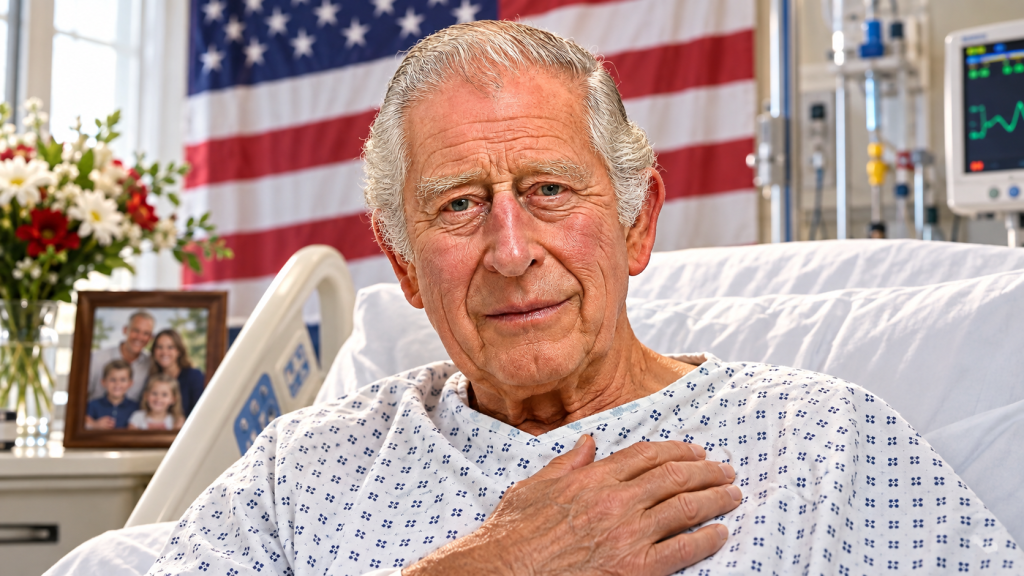
King Charles III drew widespread attention during a high-profile French state visit to Britain on July 8, 2025, after photographs from Windsor Castle showed the monarch with a noticeably bloodshot right eye.
The striking appearance immediately sparked questions among royal watchers, particularly because Charles had already been undergoing treatment following his cancer diagnosis announced by Buckingham Palace in February 2024.
But despite the concern generated by the photographs, reporting at the time indicated that the redness was caused by a burst blood vessel in the eye and was not connected to the King’s cancer treatment.
A palace source told Fox News Digital that Charles had experienced a burst blood vessel and said the condition was unrelated to his other health issues. Buckingham Palace itself did not issue a detailed public medical statement about the eye in the reporting cited at the time.
The visible redness appeared as Charles welcomed French President Emmanuel Macron and his wife, Brigitte Macron, to Windsor Castle for the beginning of a major state visit.
Charles, then 76, was accompanied by Queen Camilla, while Prince William and Catherine, Princess of Wales, also played prominent roles in the ceremonial welcome.
Photographs showed Charles smiling and speaking with Macron despite the bright red area visible in the white of his right eye.
There were no obvious signs in the public ceremony that the King was experiencing serious discomfort.
The appearance nevertheless attracted attention because of the continuing interest surrounding Charles’ health.
Buckingham Palace had announced on February 5, 2024, that doctors had identified a form of cancer after a separate issue was discovered during treatment for a benign enlarged prostate. The palace did not publicly disclose the specific type of cancer. At the time, Charles began regular treatment and temporarily postponed public-facing duties while continuing state business and official paperwork.
He subsequently returned to public-facing engagements in April 2024, with the palace saying doctors were sufficiently encouraged by his progress for him to resume a number of duties.
That medical history meant even a relatively minor visible change in the King’s appearance could generate intense public scrutiny.
In this instance, however, the reported explanation was far less alarming than some social-media speculation suggested.
A burst blood vessel on the surface of the eye is medically known as a subconjunctival hemorrhage.
According to Mayo Clinic, the condition occurs when a tiny blood vessel breaks beneath the conjunctiva, the clear membrane covering the white part of the eye.
Because the blood becomes trapped beneath that transparent layer, it can create a vivid red patch that may look dramatic even when the underlying problem is minor.
Mayo Clinic describes the condition as being somewhat comparable to a bruise beneath the skin.
It can occur after coughing, sneezing, straining, rubbing the eye or minor trauma, although in some cases no clear cause is identified.
Most importantly, a typical subconjunctival hemorrhage is usually harmless and does not cause pain, discharge or changes in vision. The blood is gradually absorbed by the body, generally disappearing within several days to a few weeks.
That medical context helped explain why Charles was able to continue with the extensive ceremonial schedule surrounding Macron’s visit.
The French president’s arrival was not an ordinary diplomatic meeting.
It was a full state visit featuring some of the most elaborate ceremonial traditions available to the British monarchy.
Macron and Brigitte Macron were formally welcomed at Windsor Castle, where military personnel, carriage processions and royal ceremonial elements were used to mark the visit.
Associated Press reported that nearly 1,000 British military personnel took part in the pageantry, demonstrating the monarchy’s continuing role in British diplomatic “soft power.”
Prince William and Catherine were involved in the opening events before Macron and his wife joined Charles and Camilla at Windsor.
The French president later participated in political discussions and delivered an address to Parliament during a visit that focused heavily on cooperation between Britain and France.
Macron argued for closer European coordination on defense, migration, trade, artificial intelligence, climate issues and other international challenges.
Reuters reported that he called for Britain and France to reduce strategic dependence on larger powers including the United States and China while deepening cooperation between their countries.
Against that diplomatic backdrop, the photograph of Charles’ red eye represented a very small element of a much larger state occasion.
Yet public interest in the image reflected a broader reality surrounding the King since his cancer diagnosis.
His health had become an unavoidable part of how every major royal engagement was covered.
Buckingham Palace’s original cancer announcement in February 2024 was unusually direct by traditional royal standards.
The palace confirmed that a form of cancer had been discovered during medical investigations following Charles’ treatment for an enlarged prostate.
It also emphasized that the King intended to continue constitutional responsibilities while receiving treatment.
Charles himself later thanked the public for messages of support, saying that sharing his diagnosis had helped raise awareness of organizations assisting cancer patients and their families.
His gradual return to public duties became an important part of the royal calendar.
By July 2025, he was again carrying out major ceremonial engagements, including hosting international leaders.
The Macron state visit therefore served as another visible demonstration that Charles was continuing to perform the public aspects of his role while receiving medical care.
Fox News reported that a royal aide had previously characterized the King’s approach as one of managing his illness while following medical advice and attempting to continue living as normally as possible.
The eye incident illustrates how easily visible medical symptoms can generate conclusions that go far beyond the evidence.
Because Charles had cancer, some observers naturally wondered whether the redness might be related to his treatment.
However, the palace source cited in contemporary reporting specifically said it was not.
There was no public evidence in that reporting establishing a connection between the eye condition and Charles’ cancer.
That distinction is important.
A photograph can show that an eye is red.
It cannot establish why.
The reported explanation came from a palace source, while the general medical description of subconjunctival hemorrhage is consistent with the dramatic but often harmless appearance visible in photographs.
Mayo Clinic notes that while the condition usually does not require treatment, repeated episodes or symptoms such as eye pain, injury or changes in vision should be discussed with a healthcare professional.
Charles’ appearance was also notable because Catherine, Princess of Wales, had undergone her own cancer treatment during roughly the same period in royal history.
She announced in January 2025 that she was in remission after treatment.
Her participation in the Macron welcome consequently carried additional symbolic weight, with both she and the King appearing prominently at the same major ceremonial event following periods of reduced public activity because of cancer.
Photographs from Windsor showed Catherine wearing a pale pink Dior ensemble as she appeared alongside Prince William.
Her return to major royal engagements had also been watched closely after she publicly discussed the difficulty of adjusting to life after cancer treatment.
The simultaneous presence of Charles and Catherine made the state visit particularly significant for a monarchy that had faced an unusually difficult period of health challenges.
Yet the official purpose of the day remained diplomacy.
The Macrons received traditional royal hospitality at Windsor.
The visit included a carriage procession, military ceremony and a state banquet in St. George’s Hall.
The guest list later included prominent figures from politics, business and entertainment.
The events were designed to emphasize the historic relationship between Britain and France while giving political leaders space to discuss current strategic concerns.
Charles’ role as head of state was central to that ceremonial diplomacy.
Although Britain’s monarch does not determine government policy, state visits allow the sovereign to represent continuity and national symbolism while elected officials conduct political negotiations.
The French visit therefore offered a particularly visible example of the modern monarchy’s diplomatic function.
Even while the King’s red eye became one of the most widely discussed images of the day, he continued greeting guests, participating in formal ceremonies and carrying out the scheduled program.
No cancellation or major alteration of the state visit was publicly attributed to the eye issue.
That fact was consistent with the reported explanation of a minor burst blood vessel rather than an acute medical emergency.
Still, the incident demonstrated the intense level of observation that follows an aging monarch undergoing cancer treatment.
A slight change in posture, appearance or schedule can quickly become international news.
That attention is amplified by social media, where isolated photographs are often shared without the context provided by medical experts or official sources.
A bright red eye can look disturbing.
But appearance alone is not a diagnosis.
In Charles’ case, reporting pointed toward a common and typically minor explanation.
The distinction between concern and evidence became especially important because the King’s cancer type and many details of his treatment remained private.
Buckingham Palace had deliberately disclosed the diagnosis while limiting the amount of specific medical information released.
That meant there were genuine unanswered questions surrounding his health.
It did not mean every visible physical change was necessarily related to cancer.
The July 8 images should therefore be understood within the information available at the time.
Charles did have cancer and was undergoing treatment.
His right eye did appear markedly red during the French state visit.
A palace source said a burst blood vessel was responsible and specifically described it as unrelated to his cancer treatment.
Medical guidance indicates that such subconjunctival hemorrhages frequently look more serious than they are and commonly resolve without treatment.
Meanwhile, Charles continued performing his duties.
That may ultimately be the most important aspect of the episode.
The photographs captured something visually dramatic, but the events surrounding them showed a monarch carrying on with a demanding state occasion.
Macron received the traditional welcome.
The royal family participated.
Diplomatic discussions proceeded.
The state banquet went ahead.
And the King remained at the center of the ceremony.
For royal watchers already attentive to his cancer treatment, the bloodshot eye understandably prompted concern.
But responsible interpretation requires separating what was visible from what was actually established.
The visible fact was a red right eye.
The reported explanation was a burst blood vessel.
The available reporting said it was unrelated to the King’s cancer.
Anything more serious would have required evidence that was not provided.
In a period when every photograph of King Charles can trigger new questions about his health, the Windsor episode served as a reminder that an alarming image does not necessarily indicate an alarming diagnosis.
Sometimes, as medical guidance explains, a dramatic red patch really can be something as ordinary as a tiny broken blood vessel.
And on July 8, 2025, while the world studied his appearance, Charles simply continued with the work of welcoming a visiting president to Windsor Castle.