
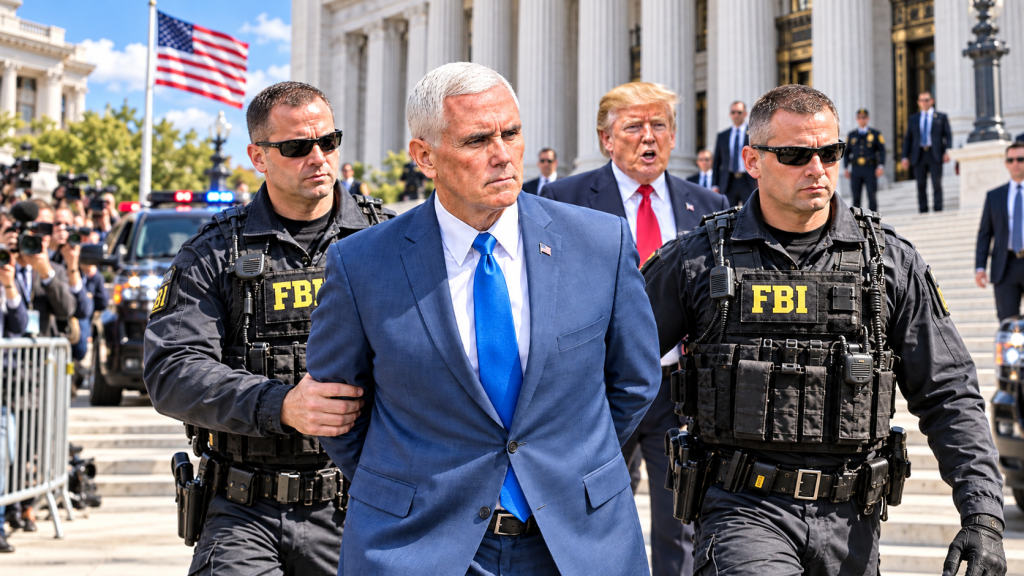
A dramatic headline began circulating online with an irresistible opening: “20 Minutes ago in Washington DC, Mike Pence was confirmed as…”The wording suggested that former Vice President Mike Pence had suddenly been appointed to a powerful new political position.
Some versions went even further.
They described a silent room, a closed-door gathering and what sounded almost like a political coronation.
According to the posts, Pence had supposedly taken control of one of the most important conservative institutions in Washington and was positioning himself for a new role at the center of American politics.
There was only one problem.
The public record does not support that story.
As of September 19, 2026, there is no credible announcement showing Pence being installed as president of the Heritage Foundation, taking control of the organization, or being “confirmed” as some kind of alternative political leader.
Heritage’s own current leadership page lists Kevin Roberts as its president. Its board of trustees is chaired by Barb Van Andel-Gaby. Pence is not listed as the organization’s president or chairman.
What did happen in Washington was real—but very different.
On September 15, Pence was scheduled to receive the inaugural Yale Patriot Public Service Award for Executive Leadership at the Yale CEO Caucus in Washington, D.C.
Yale announced the honor several days beforehand.
The event was not a secret transfer of political power.
It was an award ceremony connected to Yale’s CEO Caucus.
Former House Speaker Nancy Pelosi was also selected for a separate inaugural Yale Patriot Public Service Award for Legislative Leadership at the same gathering, underscoring that the event was not a Republican succession meeting or conservative “coronation.”
Pence nevertheless does remain active in conservative politics and policy.
And that is where the more interesting—and factual—story begins.
After leaving the vice presidency, Pence founded Advancing American Freedom, or AAF, a conservative policy and advocacy organization.
The organization describes Pence as its founder.
Its current president, however, is Tim Chapman.
That distinction is important because viral posts can take a real political organization associated with a famous figure and exaggerate his formal role within it.
AAF has been expanding.
Its official website describes the organization as a home for conservative policy work involving economic issues, constitutional questions, legal advocacy and traditional conservative priorities.
In September 2026, it released “Affordability 101,” a package containing 101 policy proposals focused on the cost of living, economic production and limited-government approaches.
AAF launched that project on Capitol Hill on September 17, with organization officials pitching the material as a roadmap for lawmakers.
That is real influence.
But influence is different from holding public office.
Pence is not president of the United States.
He is not exercising presidential powers.
And describing a think tank or policy network as a “shadow presidency” is political interpretation, not an established fact.
Still, there is a reason Pence’s policy organization has attracted attention.
In late 2025, more than a dozen Heritage Foundation staffers moved to Pence’s organization amid internal disputes within the conservative movement.
Axios reported that the departing Heritage personnel included leaders from legal, economic and data teams.
National Review separately reported additional departures and described tensions surrounding Heritage’s leadership.
Those moves strengthened AAF’s policy operation and drew attention to a broader ideological dispute within American conservatism.
The New York Times later described the episode as part of a wider debate over the direction of the post-Trump conservative movement, noting that eighteen former Heritage staffers ultimately joined Pence’s organization.
That creates a much more complicated picture than the viral headline suggests.
Pence did not quietly walk into a room and take control of Heritage.
Rather, an organization he founded has attracted experienced conservative policy professionals, including people who previously worked at Heritage.
At the same time, Heritage continues to operate under its own leadership.
Those two institutions can compete for experts, donors, ideas and influence without one “taking over” the other.
Pence’s relationship with Heritage also goes back decades.
After leaving office, he had previously joined Heritage as a distinguished visiting fellow and publicly credited the organization with helping shape his conservative philosophy.
Heritage itself highlighted that relationship at the time.
But American conservatism has changed significantly since then.
Pence and President Donald Trump dramatically diverged after the 2020 election, particularly over Pence’s refusal to attempt to overturn certified electoral votes on January 6, 2021.
Since leaving office, Pence has continued advocating a more traditional version of conservatism associated with Ronald Reagan-era ideas such as free markets, social conservatism and a strong international role for the United States.
AAF’s own materials continue presenting Pence in precisely that ideological tradition.
That gives Pence a political role.
But it does not make him the head of a secret government.
PART 2
The phrase “shadow presidency” is particularly misleading because it can imply powers Pence does not possess.
Think tanks can be influential.
They write policy papers.
Recruit experts.
Train staff.
Submit legal briefs.
Advocate legislation.
Provide personnel who may later work in government.
Meet with politicians.
And attempt to shape the intellectual direction of political parties.
But they cannot sign legislation.
They cannot issue executive orders.
They do not command federal agencies.
They do not control the military.
And their leaders do not become presidents simply because their ideas influence lawmakers.
Pence’s organization is actively trying to shape conservative policy.
That is not secret.
It says so publicly.
Its website regularly publishes legal filings, policy proposals and commentary.
For example, during September 2026 AAF published or promoted work dealing with parental rights, property rights, free speech, constitutional interpretation and economic affordability.
People may support those positions.
They may oppose them.
They may argue that Pence’s organization represents traditional conservatism more effectively than competing groups.
Others may believe the current Republican Party has moved in a different ideological direction.
Those are legitimate political debates.
But they should not be confused with factual claims that Pence has been “confirmed” to an office he has not received.
The September 15 event provides a good example of how online misinformation can develop.
Start with something real:
Mike Pence was appearing in Washington.
Add another true fact:
He remains connected to conservative policy organizations.
Add another:
His think tank has hired former Heritage staff.
Then remove the context.
Replace “receiving a Yale public-service award” with “closed-door coronation.”
Replace “founder of a think tank” with “taking control of the right’s most powerful idea factory.”
Finally, imply that something enormous has occurred without actually finishing the headline.
“Mike Pence was confirmed as…”
That unfinished sentence is useful for engagement because readers have to click.
But it also allows the post to create an impression without making a clear claim that can easily be checked.
The verified facts are less sensational but more informative.
Pence received recognition at a Washington event.
He remains the founder of Advancing American Freedom.
Tim Chapman is the organization’s president.
AAF has expanded its policy operation.
Former Heritage employees have moved there.
And Pence continues participating in arguments over the future of American conservatism.
Meanwhile, Heritage remains separately led by Kevin Roberts.
The viral text also suddenly shifts to Melania Trump and Barron Trump.
That is another sign readers should be cautious.
Nothing in the evidence connecting Pence to the September Washington event establishes any relationship between that development and Barron Trump’s upbringing.
They are separate stories.
Barron, born in 2006, has generally maintained a lower public profile than several other members of the Trump family.
Reporting has described Melania Trump as protective of his privacy over the years, and he has made relatively limited political appearances compared with some of Donald Trump’s adult children.
But claims about Melania’s motives—such as saying she conducted a deliberate private “mission” to shield Barron from his father’s fame—should be presented carefully unless directly supported by her statements or reliable reporting.
There is a difference between observing that Barron had an unusually private childhood for the son of a president and claiming to know precisely what motivated every parenting decision.
Barron is now an adult.
Reporting in 2026 describes him as continuing his education while attracting public interest because of his family.
But there is no factual reason to attach that story to claims about Pence supposedly assuming some new political command in Washington.
The two narratives appear to have been blended into one attention-grabbing social-media post.
That technique has become increasingly common.
A recognizable political name appears in the headline.
A dramatic but incomplete claim creates curiosity.
Real biographical information follows.
Then speculation and emotional language fill the gaps.
By the end, a reader may remember the emotional impression while forgetting that the central claim was never demonstrated.
In Pence’s case, the underlying political story is interesting enough without exaggeration.
A former vice president who broke sharply with Trump over January 6 remains involved in conservative politics.
He has created an organization that promotes a different strand of conservative thought.
That organization has recruited experienced policy professionals.
It publishes detailed proposals.
And it seeks influence with lawmakers and conservative institutions.
Those are measurable facts.
Whether that project ultimately becomes more influential within the Republican Party is a question that will be answered through politics, policy debates, fundraising, elections and institutional competition—not through a mysterious ceremony in Washington.
There is also nothing unusual about former vice presidents remaining active after leaving office.
Some write books.
Some establish foundations.
Some teach.
Some advise companies.
Some become advocates for specific policies.
Others attempt another presidential campaign.
Pence himself ran for the Republican presidential nomination in the 2024 cycle before ending his campaign in October 2023.
His subsequent work through AAF represents another way of remaining involved in national politics without holding elected office.
The language used to describe that work therefore matters.
“Pence builds a conservative policy organization” is factual.
“Pence attracts former Heritage staff” is factual.
“Pence receives a leadership award in Washington” is factual.
“Pence was secretly confirmed as the leader of a shadow presidency” is not supported by the evidence reviewed here.
That does not mean Pence lacks influence.
It means influence should be described accurately.
The same principle applies whether a political claim benefits or damages Trump, Pence, Democrats, Republicans or any other political figure.
Before sharing a dramatic breaking-news headline, ask a few basic questions.
What exactly was the person appointed to?
Who announced it?
Is there an official statement?
Does the organization itself list the person in that role?
Are established news organizations independently reporting the same event?
And does the headline actually finish the claim it begins?
In this case, those checks substantially change the story.
The verified September event was a Yale recognition ceremony in Washington, not a political coronation.
Pence remains founder of Advancing American Freedom, while Tim Chapman serves as its president.
Kevin Roberts remains listed as president of the Heritage Foundation.
And Pence’s growing policy network represents an attempt to influence conservative politics—not a transfer of presidential authority.
That may not produce the same shock as:
“20 Minutes ago in Washington DC, Mike Pence was confirmed as…”
But it has one major advantage.
It tells readers what actually happened.
THE END.