
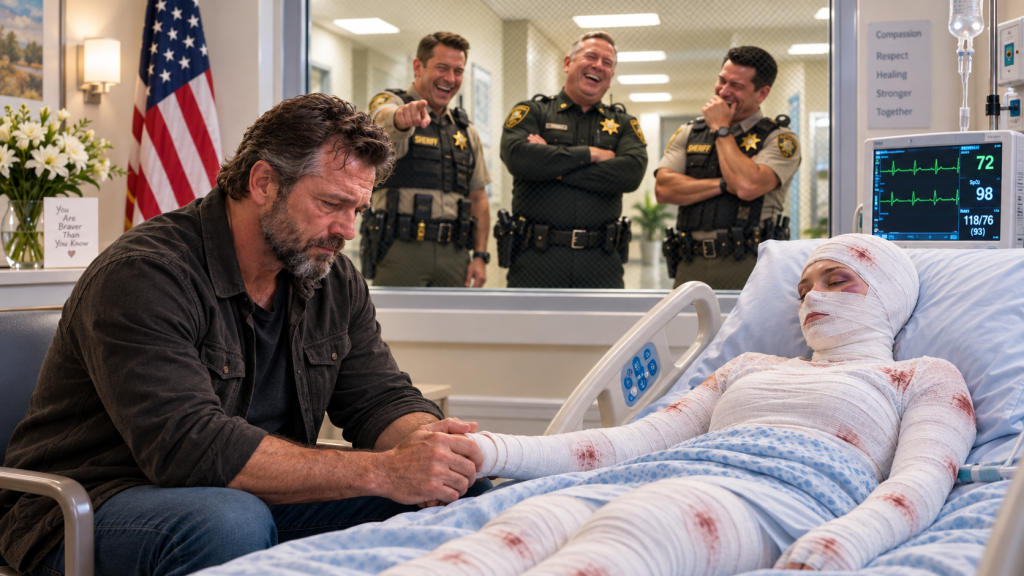
I was mopping a courthouse floor when I got the call that my seventeen-year-old son had been shot through both kneecaps by the county sheriff—and that the man had laughed while he screamed.
Less than an hour later, I was standing beside my boy’s hospital bed, listening to him whisper, “Dad… I don’t think I’ll ever walk again.” The sheriff thought I was just a gray-haired janitor. He had no idea who I used to be.
THE MEN I CALLED WERE NOT COMING WITH GUNS
“Get the team together,” I said.
The silence on the other end lasted three seconds.
Then Mason Cole spoke.
“How many?”
“Four.”
Another pause.
“You included yourself?”
“Yes.”
“What happened?”
I looked through the windshield toward the seventh floor of Mercy General.
“My son was shot by Sheriff Rick Barnes.”
Mason’s breathing changed.
“Alive?”
“Barely.
Both knees.”
“Dennis…”
“He’s seventeen.”
That was all I had to say.
Mason and I had spent fourteen years working together before I walked away from the life.
He had pulled me out of a burning vehicle outside Kandahar.
I had carried him six miles after a helicopter went down in a place whose name never appeared in any newspaper.
We had buried friends together.
We had also learned one important lesson together.
Anger was useful only when you controlled it.
“Listen to me,” Mason said.
“No weapons.
No threats.
No hero nonsense.”
“I know.”
“You sure?”
I closed my eyes.
“I want Barnes destroyed, Mason.”
“That isn’t what I asked.”
I stared at the hospital windows.
Finally, I answered.
“I want him destroyed by the truth.”
“Good.”
I heard typing.
“I’ll call Elena and Briggs.”
Those names pulled memories from places I had spent years trying not to visit.
Elena Vasquez had once been our intelligence analyst.
She could take fifty meaningless details and find the one thread holding them together.
Daniel Briggs had been communications and surveillance.
After leaving government service, he built a digital-forensics company in Denver that worked with attorneys and federal agencies.
Mason himself had retired from operational work years ago.
What I had not known until that night was that he now worked as a special investigator attached to a federal inspector general’s office.
“What do you need from me?”
I asked.
“Nothing reckless.
Start with facts.”
I looked toward the emergency entrance.
“My son says Barnes shot him.”
“That’s testimony.
We need evidence.”
“Barnes was there.”
“Still evidence we have to preserve.”
“You think the department will destroy it?”
“I think a sheriff who shoots a seventeen-year-old through both knees and laughs may not be especially concerned about paperwork.”
I said nothing.
Mason continued.
“Find out where it happened.
Who was there.
Cameras.
Witnesses.
Dispatch logs.
Body camera footage.
Don’t confront Barnes.”
Then he added quietly:
“And Dennis?”
“What?”
“If he knows who you used to be, this may not be about Tyler.”
The line went dead.
I sat in the car for another minute.
Then my phone rang again.
This time it was Sarah.
“Tyler’s out of surgery.”
I was upstairs before she finished the sentence.
Dr.
Harold Donnelly met us outside the recovery area.
“The surgery went as well as it could,” he said.
“We stabilized both legs.
There’s serious damage, but I want both of you to stop using the word never.”
Sarah looked at him.
“What?”
“Tyler said he’d never walk again.
Dennis probably thinks the same thing.”
I did.
Harold shook his head.
“I won’t promise anything.
But seventeen-year-olds heal in ways sixty-year-old doctors can only envy.”
For the first time that night, I felt something other than rage.
Hope.
Small.
Fragile.
But alive.
We entered Tyler’s room.
His eyes were half-open.
I sat beside him.
“Son, I need to ask you something.”
He blinked.
“Where did it happen?”
His lips moved.
“Old county impound lot.”
I frowned.
“What were you doing there?”
His expression changed.
Not fear.
Guilt.
“Dad…”
“What?”
“I lied to you.”
Sarah stepped closer.
“About what?”
Tyler glanced toward the door.
Then whispered:
“I wasn’t there by accident.”
I felt something cold settle in my stomach.
“What were you doing?”
He swallowed.
“I was following Sheriff Barnes.”
Sarah stared at him.
“Why would you follow the sheriff?”
Tyler shut his eyes.
“Because I thought he was stealing from people.”
And just like that, the shooting became something entirely different.
THE STORY MY SON HAD NEVER TOLD US
Tyler worked on the school newspaper.
Calling it a newspaper was generous.
It was four pages printed twice a month and distributed in the cafeteria beneath a sign that said THE LIVINGSTON LANTERN.
Most stories were football scores, student elections, cafeteria complaints, and teachers retiring.
But Tyler loved it.
He had inherited Sarah’s curiosity and, unfortunately, my inability to leave unanswered questions alone.
Three months earlier, Tyler had started researching county vehicle auctions for a class project about local government.
Cars seized after arrests were sometimes auctioned.
Nothing unusual about that.
Except Tyler noticed the same three buyers kept winning.
The companies had different names.
Mountain State Recovery.
Western Fleet Holdings.
Boulder Ridge Equipment.
But the mailing address for all three led to the same empty office above a laundromat.
Tyler went further.
The winning bids were often absurdly low.
A pickup worth thirty thousand dollars sold for forty-eight hundred.
A nearly new SUV sold for six thousand.
A horse trailer seized in a fraud investigation disappeared from the auction list completely.
Then Tyler found something even stranger.
Several vehicles resurfaced months later at a dealership thirty miles away.
The dealership belonged to Sheriff Barnes’s brother-in-law.
“Why didn’t you tell us?”
Sarah asked.
Tyler stared at his blanket.
“Because you would’ve made me stop.”
“You’re seventeen!”
“That’s exactly why.”
I almost smiled despite everything.
Sarah did not.
“What happened tonight?”
I asked.
Tyler looked at me.
“I saw Barnes leave the courthouse around eight.”
My skin prickled.
I had been working two floors away.
“He met Judge Vale in the parking garage.”
Judge Marcus Vale.
County judge.
Sixty-two years old.
Charity dinners.
Church fundraisers.
Campaign posters showing him beside veterans and schoolchildren.
And for the past eleven years, I had emptied his trash can every night.
Tyler continued.
“They drove separately to the impound lot.
I followed on my bike.”
“You followed a sheriff and a judge alone at night?”
“I know it was stupid.”
“Yes,” Sarah snapped.
“It was.”
“What did you see?”
I asked.
“A truck.”
“What truck?”
“Black Ford.
No plates.”
Tyler paused.
“Barnes opened the gate.
Judge Vale gave him an envelope.
Then another man came out of the office.”
“Did you recognize him?”
“No.”
“What happened next?”
“I took pictures.”
Sarah closed her eyes.
I understood immediately.
“They saw you.”
Tyler nodded.
“I tried to leave.
Barnes drove around the gate and blocked me.”
His fingers began trembling.
“He told me to give him my phone.”
“Did you?”
“No.”
Despite myself, I felt proud.
Then ashamed for feeling proud.
“What happened?”
“He grabbed me.
I pushed him away.”
“Then?”
“He drew his gun.”
Sarah whispered, “Oh God.”
“I raised my hands.”
Tyler’s eyes filled with tears.
“I told him I was a kid.”
My jaw tightened.
“He asked my name.”
I stopped breathing.
“What?”
“He asked my name.”
“Did you tell him?”
“He already knew.”
Tyler looked directly at me.
“He said, ‘Irwin.
Dennis Irwin’s boy.’”
Everything in the room seemed to move farther away.
Mason’s warning returned immediately.
If he knows who you used to be, this may not be about Tyler.
“What exactly did Barnes say?”
I asked.
Tyler struggled to remember.
“He said… ‘Your father spent seventeen years pretending he doesn’t exist.
Let’s see if this wakes him up.’”
Sarah turned toward me.
“What does that mean?”
I did not answer.
“Dennis?”
Before I could respond, Tyler continued.
“He made me kneel.”
My hand tightened around the chair.
“He told the deputy with him to turn around.”
“There was a deputy?”
“Yes.
Young guy.
I don’t know his name.”
“And then?”
Tyler’s breathing quickened.
“He shot once.”
Sarah covered her mouth.
“I fell.”
His voice shrank.
“Then he walked around me.”
I could see the memory in Tyler’s eyes.
“He said, ‘Can’t have you limping crooked.’”
The monitor started beeping faster.
Harold stepped into the room.
“That’s enough.”
But Tyler grabbed my wrist.
“Dad.”
“I’m here.”
“My phone.”
“What about it?”
“He took it.”
“We can get another phone.”
“No.”
Tyler shook his head desperately.
“You don’t understand.”
Then he whispered the sentence that changed everything.
“I wasn’t recording on my phone.”
Briggs arrived at Mercy General at 2:40 in the morning.
He was fifty-eight now, heavier than I remembered, with silver hair and reading glasses hanging from his collar.
When he saw me, he wrapped both arms around me.
No greeting.
No questions.
Just an old friend holding another old friend together.
Then he looked through the glass at Tyler.
“They did that to your kid?”
“Yes.”
His jaw moved.
“Where’s the recording?”
Tyler had hidden a tiny action camera inside the reflector casing under the seat of his bicycle.
He had bought it secondhand.
The camera automatically uploaded low-resolution backup clips whenever it connected to trusted Wi-Fi.
And earlier that evening, before following Barnes, Tyler had stopped outside the public library.
The library Wi-Fi was on his trusted list.
That meant the camera had synchronized everything recorded before he left.
It would not contain the actual shooting.
But it might contain the beginning of the night.
Briggs opened Tyler’s cloud account from a laptop.
There were fourteen files.
The first eleven were school footage.
Basketball.
Friends.
A teacher complaining about somebody parking in his space.
The twelfth showed Tyler riding past the courthouse.
The thirteenth showed Sheriff Barnes leaving the underground garage.
The fourteenth lasted eight minutes and nineteen seconds.
Briggs clicked it.
The image bounced as Tyler pedaled.
Then the camera steadied when he stopped across from the county impound lot.
Through the darkness, we saw Barnes.
Judge Vale.
And a third man.
Briggs froze the frame.
“Dennis.”
I leaned closer.
“What?”
“You know him?”
At first, I didn’t.
The man was older.
Thinner.
Balding.
Then he turned sideways.
A scar crossed the back of his neck.
My stomach dropped.
I had seen that scar before.
Seventeen years earlier.
In another country.
On another continent.
On the last night of my old life.
“His name was Raymond Cutter,” I said.
Briggs slowly looked at me.
“That’s impossible.”
“I watched him die.”
THE MAN WHO HAD BEEN DEAD FOR SEVENTEEN YEARS
Operation Lantern was never supposed to become part of my family’s life.
So I had never told Sarah the whole story.
Not because I did not trust her.
Because some memories become poison when carried into a peaceful home.
Seventeen years earlier, my team had been sent to locate an American logistics contractor suspected of selling military movement schedules to an armed network overseas.
His name was Raymond Cutter.
Cutter knew when convoys moved.
Where temporary command posts were established.
Which routes carried medical personnel.
Information only a handful of trusted contractors could access.
Three attacks had already been linked to leaked schedules.
Eleven Americans were dead.
We were ordered to bring Cutter in alive.
We found him inside an abandoned warehouse near the border.
He ran.
Shots were fired.
A fire started during the chaos.
Part of the structure collapsed.
We recovered what command identified as Cutter’s remains.
The case ended.
Officially.
But something had bothered me for years.
The dental identification had been rushed.
The report was sealed almost immediately.
Two investigators trying to review the case were reassigned.
Then I was offered a promotion.
I refused it.
Six weeks later, Tyler was born.
I walked away.
Now Raymond Cutter was alive in Colorado, standing beside my county sheriff.
And my son had photographed him.
Sarah listened without interrupting.
When I finished, she stared at me as though seventeen years had suddenly opened between us.
“You knew someone might have survived?”
“No.”
“But you suspected something was wrong.”
“Yes.”
“And you never told me.”
“I wanted it finished.”
Her eyes hardened.
“You wanted it finished for you.”
That hurt because it was true.
“Sarah—”
“Our son is lying there because somebody from your old life knows your name.”
“I don’t know that yet.”
“Barnes mentioned you before he shot him!”
She lowered her voice immediately, looking toward Tyler’s room.
Then she whispered:
“Don’t protect me from the truth now, Dennis.”
I nodded.
“No more secrets.”
At 3:15, Mason arrived.
Elena joined us by secure video from Washington.
For the first time in seventeen years, the old team was together.
Not in camouflage.
Not in some concrete operations room beneath fluorescent lights.
One in a hospital conference room.
One on a laptop screen.
One wearing a winter coat over pajamas.
And me still wearing my courthouse janitor shirt.
Mason studied the image of Cutter.
“No doubt?”
“No doubt.”
Elena enlarged the frame.
“I agree.”
Sarah looked around.
“What does a supposedly dead military contractor have to do with a county sheriff?”
Elena answered.
“That’s what we’re going to find out.”
Within forty minutes, she had three screens filled with records.
Raymond Cutter had not disappeared after Operation Lantern.
He had become Raymond Cutler.
Then Raymond Carter.
Then, twelve years earlier, Ray Cullen.
Under that name, he operated a consulting firm registered in Wyoming.
The firm provided “asset recovery and administrative services” to several rural sheriff’s departments.
Including ours.
Then Briggs found the payment records.
Livingston County had paid Cullen Strategic Services $1.8 million over nine years.
For services described only as administrative processing.
Mason leaned toward the screen.
“That amount should have triggered an audit.”
“It did,” Elena said.
“What happened?”
“Audit withdrawn.”
“By whom?”
Elena’s eyes narrowed.
“County Judge Marcus Vale.”
Nobody spoke.
Then she opened another file.
“And Vale’s campaigns received donations from six corporations connected to Cutter.”
Sarah whispered, “So Tyler discovered a money scheme?”
“No,” Elena said.
“Your son discovered the edge of one.”
“What’s underneath it?”
Elena looked directly at us through the camera.
“I don’t know yet.”
Then Mason’s phone rang.
He answered.
Listened.
His expression changed.
“What?”
He looked at me.
“That was a contact at the state bureau.”
“What happened?”
“Barnes filed his report.”
I already knew what was coming.
Mason continued.
“He claims Tyler attacked him with a tire iron.”
Sarah shot out of her chair.
“That’s a lie!”
“Barnes says he fired because Tyler continued advancing after multiple commands.”
“My son was on a bicycle!”
“There’s more.”
Of course there was.
“Barnes says Tyler may have been involved in an attempted theft from the impound lot.”
I almost laughed.
It was too predictable.
“Body camera?”
“Malfunctioned.”
“Deputy witness?”
“Supports Barnes.”
“Name?”
Mason checked.
“Deputy Ethan Cole.”
Tyler had said young.
That fit.
Then Briggs slowly turned his laptop around.
“Dennis.”
On the screen was a still frame from Tyler’s bicycle camera.
The impound office window reflected the sheriff’s vehicle.
Beside it stood another shape.
A deputy.
His chest camera showed a blinking red light.
Recording.
Barnes had lied.
The body camera had been running.
The question was whether the footage still existed.
THE SHERIFF CAME TO THE HOSPITAL
At 8:12 the next morning, Sheriff Rick Barnes walked into Mercy General carrying flowers.
I was standing outside Tyler’s room.
He stopped when he saw me.
Barnes was fifty-four, broad-shouldered, perfectly groomed, with silver beginning at his temples.
His uniform looked freshly pressed.
His badge gleamed.
He held the flowers in one hand.
A performance.
“Mr.
Irwin.”
I looked at the flowers.
“Sheriff.”
“I came to see how your boy is doing.”
“You shot him.”
His expression did not change.
“There’s an investigation.”
“You shot him.”
“He attacked a law enforcement officer.”
I stepped closer.
Mason’s words echoed in my head.
No threats.
No hero nonsense.
So I kept my hands at my sides.
“My son says he had his hands up.”
Barnes sighed.
“Kids say things when they’re scared.”
“Your body camera should clear that up.”
For the first time, something moved behind his eyes.
Barely.
But I saw it.
“My camera malfunctioned.”
“The deputy’s?”
He smiled.
“You’ve been busy for a janitor.”
There it was.
He had come here to test me.
Not Tyler.
Me.
“Being ignored gives a man plenty of time to listen,” I said.
Barnes stepped closer.
His voice dropped.
“You should’ve stayed invisible, Dennis.”
My blood went cold.
He knew.
“You knew who I was before last night.”
“I know lots of things.”
“What do you want?”
He smiled again.
Then looked through the glass at my son.
“Your boy made an unfortunate choice.”
“Taking pictures?”
“Digging into things that don’t belong to him.”
“And shooting him was supposed to fix that?”
Barnes leaned close enough that I could smell coffee on his breath.
“No.”
His next words were almost a whisper.
“That was supposed to wake Reaper up.”
Every instinct I had buried screamed at once.
I wanted to put him against the wall.
I wanted to wipe the smile from his face.
I wanted to become the man he clearly expected me to become.
Then I understood.
That was exactly what he wanted.
I stepped backward.
Barnes frowned.
“You were hoping I’d hit you,” I said.
He smiled.
“Why would I want that?”
“Hospital cameras.”
The smile faded.
“You provoke me.
I attack the sheriff.
Suddenly the father of the boy you shot is a violent former special operator with a secret military history.”
I looked him directly in the eyes.
“Then maybe Tyler becomes the troubled son of a dangerous man instead of the kid you shot while he was surrendering.”
Barnes said nothing.
I continued.
“You didn’t shoot Tyler because you were angry.”
His jaw tightened.
“You shot him because you needed me angry.”
The elevator opened behind him.
Two state investigators stepped out.
Barnes glanced toward them.
Then back to me.
He handed me the flowers.
“Take care of your family, Dennis.”
I let them fall to the floor.
He walked away.
Mason appeared from around the corner.
“You handled that better than I expected.”
“I wanted to kill him.”
“I know.”
“Does that make me a bad father?”
“No.”
He looked at the elevator doors.
“Doing it would.”
At 10:06, we got our first break.
Deputy Ethan Cole disappeared.
His patrol vehicle was found outside a grocery store.
Personal phone left inside.
Wallet in console.
Service weapon locked in the trunk.
Barnes announced that Cole was under “temporary administrative review.”
Mason did not believe it.
Neither did I.
At 11:43, Briggs received an encrypted email.
No subject.
One attachment.
Twenty-seven seconds of video.
Deputy Cole’s body camera.
We watched.
Dark gravel.
Tyler kneeling.
Hands above his head.
Barnes stood six feet away.
Tyler shouted:
“I didn’t do anything!”
Barnes replied:
“You did when you followed me.”
Then Tyler said:
“My dad knows people.”
Barnes laughed.
“I’m counting on it.”
The video jerked.
A gun appeared in Barnes’s hand.
Cole’s voice said:
“Sheriff, don’t.”
Barnes turned.
“Turn around, Deputy.”
The video ended.
Sarah began crying.
Mason stared at the frozen screen.
“That’s enough to destroy his story.”
But Briggs looked worried.
“Why only twenty-seven seconds?”
Another email arrived.
Three words.
FIND ME FIRST.
Then coordinates.
Mason looked at me.
“Could be Cole.”
“Could be a trap.”
“Yes.”
I stood.
“We’re still going.”
“No,” Sarah said.
I turned.
She was staring at me.
“Not you.”
“Sarah—”
“You promised no more secrets.
So I’m not going to pretend I don’t know what you’re thinking.”
I said nothing.
“You think you can protect everyone because that used to be your job.”
Her voice softened.
“But your job now is being Tyler’s father.”
She nodded toward Mason.
“Let the investigator investigate.”
She was right.
I hated it.
But she was right.
Mason and two state agents went to the coordinates.
They found Deputy Cole hiding in an abandoned hunting cabin twenty-six miles north of town.
Alive.
Terrified.
And carrying the full body-camera memory card.
THE TRUTH WAS WORSE THAN THE SHOOTING
Deputy Cole agreed to talk only after federal protection was arranged.
His statement lasted four hours.
The first hour destroyed Sheriff Barnes.
The next three nearly destroyed Livingston County.
Barnes had been running the impound operation for nearly a decade.
Seized vehicles were undervalued.
Shell companies purchased them.
Money moved through Cutter’s consulting company.
A portion returned to Barnes.
Another portion funded Judge Vale’s campaigns, vacations, and investment accounts.
But vehicle theft was the smallest part.
Cutter had used the county’s remote location to create false identities for witnesses, fugitives, and private clients willing to pay.
Birth certificates.
Driver’s licenses.
Property records.
Court orders sealing fabricated histories.
Some clients were simply wealthy people hiding assets.
Others were criminals.
And several had been connected to classified investigations years earlier.
Cutter had not escaped Operation Lantern by luck.
Someone inside the American system had helped him.
Cole had learned too much six months earlier.
He tried to report Barnes to Judge Vale.
Vale told Barnes.
From that day forward, Cole cooperated because he was frightened.
Until Tyler was shot.
“I watched a kid raise his hands,” Cole told investigators.
“I watched my sheriff shoot him anyway.”
Cole wiped his eyes.
“And I turned around because he told me to.”
He had spent the night thinking about Tyler screaming.
Then he copied the body-camera footage before Barnes’s people could erase it.
But one question remained.
Why Dennis?
Why me?
Why seventeen years?
Elena found the answer at 2:18 that afternoon.
She called Mason.
Mason came directly to Tyler’s room.
His face told me before he spoke.
“Dennis, you need to sit.”
“I’m fine.”
“Sit.”
I did.
Sarah stood beside me.
Mason placed a folder on the table.
“Operation Lantern was compromised from Washington.”
I stared at him.
“We knew that was possible.”
“No.
Listen.”
He opened the file.
“The order identifying Cutter’s remains came from an intelligence liaison assigned to the Pentagon.”
“Who?”
Mason slid a photograph toward me.
The man was younger in the picture.
Dark hair.
No glasses.
But I knew the face.
Marcus Vale.
I stared at it.
“No.”
“He wasn’t a judge then,” Mason said.
“He was a military legal adviser working as a liaison to the contractor investigation.”
“That’s impossible.”
“He signed the verification package that declared Cutter dead.”
Sarah whispered, “Judge Vale helped him disappear?”
“Yes.”
My mind raced backward through seventeen years of ordinary nights.
Marcus Vale walking past me in the courthouse.
Sometimes smiling.
Sometimes saying good evening.
Once handing me twenty dollars at Christmas.
Eleven years I had cleaned his office.
Eleven years I had emptied the trash can of the man who had helped bury the truth from my final operation.
“He knew me,” I said.
Mason nodded.
“He had to.”
“Then why let me work there?”
Nobody answered immediately.
It was Elena, speaking through Mason’s phone, who finally said it.
“Because he wanted to watch you.”
I felt sick.
She continued.
“Your employment application was approved unusually fast seventeen years ago.
Before Vale became a judge, he was already politically connected in Livingston County.”
“That doesn’t prove—”
“Dennis, your name appeared in an email recovered from Cutter’s old server.”
Mason handed me another page.
The email was dated sixteen years earlier.
One sentence had been highlighted.
IRWIN HAS SETTLED IN LIVINGSTON.
LEAVE HIM ALONE UNLESS HE STARTS LOOKING.
Sarah sat down.
For sixteen years, they had known exactly where I lived.
They had watched me raise my son.
Watched Sarah buy groceries.
Watched Tyler play basketball.
And I had never known.
I turned the page.
Another email.
This one was from only three months earlier.
THE BOY IS ASKING QUESTIONS ABOUT AUCTIONS.
A reply came from someone identified only as MV.
HANDLE THE BOY CAREFULLY.
WE MAY HAVE USE FOR THE FATHER.
I looked at Mason.
“What use?”
He slid over one final page.
Barnes had researched my military history.
Not the public version.
The sealed version.
Mission reports.
Psychological evaluations.
Combat citations.
Details no county sheriff should ever have possessed.
“They wanted you to react,” Mason said.
“Why?”
“Because Cutter is preparing to disappear again.”
I stared at him.
Mason continued.
“They needed attention somewhere else.”
Then I understood.
A decorated former operator attacking or killing a county sheriff after his son was shot would become national news.
Every reporter in Colorado would descend on Livingston.
Federal agents would focus on me.
My military history would leak.
The story would become Dennis Irwin, secret soldier turned vigilante father.
Meanwhile Cutter vanished.
Vale destroyed records.
And Barnes, if he survived, became the wounded hero.
My son’s suffering had been bait.
I stood.
“Where’s Cutter now?”
“We don’t know.”
“When did Tyler photograph him?”
“Last night.”
“So he may still be close.”
Mason nodded.
Then my phone rang.
Unknown number.
I answered.
No one spoke for several seconds.
Then Raymond Cutter said:
“Hello, Reaper.”
THE LAST TRAP
His voice sounded older.
But I remembered it.
“You’ve had a long life for a dead man,” I said.
Cutter laughed softly.
“So have you.”
“What do you want?”
“To correct a misunderstanding.”
“You shot my son?”
“No.”
“You helped the men who did.”
“Your son was unfortunate.”
I clenched my teeth.
“He has a name.”
“Yes.
Tyler.”
That was worse.
Cutter continued.
“Barnes was supposed to frighten him.
The shooting was excessive.”
“You expect me to believe that?”
“I don’t care what you believe.”
“Then why call?”
“Because Barnes is unraveling.”
I looked at Mason, who was already signaling Briggs to trace the connection.
“Judge Vale?”
“Judge Vale is frightened.”
“And you?”
Cutter chuckled.
“I survived you seventeen years ago.
I’m not easily frightened.”
“What do you want?”
“A trade.”
I glanced toward Tyler.
“For what?”
“The recording your son made.”
“You already took his phone.”
“Don’t insult me, Dennis.
Your son inherited more from you than your eyes.
We know there was another device.”
“What do I get?”
“Your family gets forgotten.”
I almost laughed.
“You’ve been watching us sixteen years.”
“And you’ve been safe sixteen years.”
“Until Tyler noticed you stealing cars.”
“That boy notices too much.”
My hand tightened around the phone.
“Say his name again.”
Silence.
Cutter understood the warning.
Then he said:
“Midnight.
Old courthouse records annex.
Bring the camera storage.”
“You know I don’t have it.”
“You’ll find a way.”
The line disconnected.
Briggs shook his head.
“Burner.
Routed badly enough that I got a general area.”
“Where?”
“Livingston.”
Mason looked at me.
“He’s still here.”
“What’s the plan?”
“You’re not going.”
“He asked for me.”
“That’s why you’re not going.”
But this time I shook my head.
“He won’t expose himself for anybody else.”
“Dennis—”
“I’m not asking to go alone.”
Mason studied me.
Then slowly nodded.
At 11:58 that night, I walked into the abandoned courthouse records annex carrying a small memory card.
The building had been unused for five years.
Dust covered the counters.
Metal shelves filled the rooms.
I wore no weapon.
Not because I trusted Cutter.
Because I finally understood the only way to beat men like him.
I had spent half my life learning how to survive violence.
Tonight, I needed him to believe violence was exactly what I wanted.
“Dennis.”
Cutter stepped from behind a shelf.
Older.
Gray.
But unmistakable.
For seventeen years, part of me had wondered whether Operation Lantern failed because I had made a mistake.
Seeing him alive answered the question.
“You look disappointed,” he said.
“I’m thinking about the men who died because of you.”
“That was war.”
“No.
That was money.”
He smiled.
“Still moral after all these years.”
“Still alive after all these years.”
His expression changed slightly.
“Card.”
I held it up.
“You first.”
“About what?”
“Vale.”
Cutter laughed.
“You’re recording this.”
“I hope so.”
He looked around.
“You came without a gun?”
“Yes.”
“That isn’t the Reaper I remember.”
“You never knew me.”
“I knew enough.”
“No.
You knew reports.”
He stepped closer.
“You killed twelve men in one night.”
“I rescued nine hostages that night.”
“The reports focused on the twelve.”
“People like you always do.”
For the first time, his smile disappeared.
Then another voice came from the darkness.
“You talk too much, Ray.”
Judge Marcus Vale stepped into the room.
I should have been surprised.
I wasn’t.
He wore an overcoat over a suit.
No judicial robe.
No campaign smile.
Just a frightened old man.
“Judge,” I said.
Vale looked at me with disgust.
“Seventeen years.”
“What?”
“I spent seventeen years wondering when you would realize who I was.”
I almost smiled.
“I emptied your trash.”
His face tightened.
“Yes.”
“Maybe you weren’t as important as you thought.”
Cutter laughed.
Vale did not.
Then Vale reached into his coat.
I stayed still.
A handgun appeared.
He pointed it at me.
“Give him the card.”
“There’s nothing on it.”
Cutter’s head snapped toward me.
“What?”
“It’s blank.”
Vale raised the gun.
“You came here with nothing?”
“No.”
“What did you bring?”
“An audience.”
Vale’s eyes widened.
Cutter turned toward the door.
Nothing happened.
That was intentional.
No dramatic federal agents rushing in.
No shouted commands.
No flashing lights.
Just silence.
Because silence makes guilty people talk.
I looked at Vale.
“You approved Cutter’s false death certificate.”
He said nothing.
“You gave Barnes access to sealed military files.”
Still nothing.
“You told him to use Tyler to provoke me.”
Vale finally spoke.
“You think anyone will believe you?”
“I think Deputy Cole will.”
His face changed.
“And the body camera.”
Cutter swore.
Vale stared at him.
“You said Cole was handled.”
“I said Barnes would handle him.”
“And Barnes is an idiot.”
I let them continue.
Cutter stepped toward Vale.
“Forget Irwin.
We leave now.”
Vale raised the weapon toward him.
“No.”
Cutter stopped.
Then the final piece fell into place.
These men were not partners anymore.
They were drowning men trying to stand on each other.
I said quietly:
“Barnes already talked.”
It was a lie.
But Vale did not know that.
His face went white.
Cutter turned sharply.
“What did he say?”
I shrugged.
“Enough.”
“He wouldn’t.”
“He knows he’s facing attempted murder.”
Vale whispered, “That coward.”
Cutter moved toward him.
“This is your fault.”
“My fault?”
“You insisted on staying here!”
“You needed my courts!”
“You needed my money!”
“You were dead until I gave you a life!”
There.
Mason had what he needed.
And Vale kept going.
“I created Raymond Cullen!
I signed the seals!
I buried Lantern!
Barnes was supposed to scare the boy, not cripple him!”
Cutter shouted:
“Shut up!”
Too late.
The rear doors opened.
“Federal agents!
Weapon down!”
Vale spun.
For half a second, the gun shifted toward the doorway.
Then I saw something in his face.
Panic.
His finger tightening.
My old instincts returned.
I moved before I thought.
I struck his wrist away from the doorway and drove him backward into the metal shelving.
The pistol hit the floor.
Agents flooded the room.
Cutter ran three steps before Mason tackled him.
Vale screamed that he was a judge.
Nobody cared.
Within thirty seconds, both men were handcuffed.
I stood in the middle of the records annex breathing hard.
Mason looked at me from the floor beside Cutter.
“You couldn’t resist one move?”
“He had a gun.”
“Fair.”
An agent secured Vale.
Cutter looked up at me.
The arrogance was gone.
“You think this ends anything?”
I walked toward him.
“No.”
I thought about Tyler.
“It starts his recovery.”
Then Mason’s phone rang.
He listened.
Slowly smiled.
“What?”
He looked at Cutter.
“Sheriff Barnes just requested counsel.”
Cutter laughed bitterly.
“That means nothing.”
Mason shook his head.
“He requested a federal cooperation agreement.”
Now Cutter stopped smiling.
Barnes was talking.
THE MAN EVERYONE THOUGHT WAS JUST A JANITOR
The arrests began before sunrise.
Sheriff Rick Barnes was taken into federal custody at 4:17 a.m.
Judge Marcus Vale was removed from office pending prosecution.
Raymond Cutter was charged under his current identity and several former identities while federal investigators reopened everything connected to Operation Lantern.
By the end of the week, eleven county employees had been suspended.
Three resigned.
Two were arrested.
The state took temporary control of the sheriff’s department.
Reporters filled the streets outside the courthouse.
People who had ignored me for seventeen years suddenly wanted interviews.
I refused every one.
I did not want to be famous.
I wanted my son to walk.
Barnes’s body-camera footage did not exist.
Deputy Cole’s did.
And it was enough.
The full recording showed Tyler on his knees with empty hands.
It showed Barnes ignoring Cole’s objections.
It showed the first shot.
Then Cole turned away.
But the audio continued.
Tyler screamed.
Barnes laughed.
Then Barnes said something none of us had heard before.
“Come on, kid.
Give your old man a reason to become himself again.”
That sentence destroyed the last claim that the shooting had been self-defense.
Barnes eventually admitted the plan.
He had been told to frighten Tyler.
Then he decided hurting him would create a stronger reaction.
He believed a man like me could never watch his child suffer and remain controlled.
He believed violence lived in me like a switch.
All he had to do was flip it.
He was wrong.
The newspapers wanted to call me a hero.
I hated that too.
Deputy Cole was the one who had risked everything by preserving the footage.
Briggs recovered the financial records.
Elena connected Cutter to Operation Lantern.
Mason convinced federal authorities to move before Vale could destroy evidence.
Sarah kept me from walking directly into the trap Barnes had built.
And Tyler?
Tyler had started the whole thing with a secondhand camera and the stubborn belief that public officials should not be allowed to steal from people just because nobody important was watching.
Three weeks after the shooting, Tyler underwent another surgery.
Two months later, doctors fitted him with braces.
Four months after that, he stood between parallel rehabilitation bars.
I was beside him.
Sarah was crying before he even moved.
Tyler looked down at his legs.
“I can’t.”
“Yes, you can.”
“What if they give out?”
“Then I catch you.”
He looked at me.
“You promise?”
I smiled.
“That one I can promise.”
He moved his right foot.
Half an inch.
Then the left.
His face twisted with effort.
The therapist kept one hand near his waist.
“Again.”
Tyler moved.
One step.
Then another.
Sarah covered her mouth.
I could barely see through my own tears.
My son had once whispered that he would never walk again.
Now he crossed four feet of hospital flooring like he was climbing Everest.
When he reached me, his knees trembled.
I wrapped my arms around him.
“You did it.”
He laughed and cried at the same time.
“Four feet.”
“Four more than yesterday.”
His basketball career was over.
That truth hurt him.
There were nights when I heard him crying behind his bedroom door.
Days when he refused therapy.
Weeks when he could not look at the old trophies above his desk.
Healing was not a heroic montage.
It was ugly.
Slow.
Unfair.
But Tyler kept going.
He discovered sports journalism.
Then investigative reporting.
A year after the shooting, THE DENVER SENTINEL published his first guest column.
The title was simple:
THE PEOPLE NOBODY NOTICES
It was about janitors.
Receptionists.
Court clerks.
Nurses.
Deputies too frightened to speak.
Teenagers adults dismissed as children.
Ordinary people who saw important things because powerful people forgot they were in the room.
Tyler ended the article with one sentence:
“My father taught me that being invisible and being powerless are not the same thing.”
I read that sentence fourteen times.
Then I went into the garage so Tyler would not see me cry.
Barnes eventually pleaded guilty to federal civil-rights violations, obstruction, conspiracy, evidence tampering, and charges connected to the shooting.
Judge Vale fought every charge.
He blamed Barnes.
Then Cutter.
Then political enemies.
Then failing memory.
The recordings buried him.
Cutter tried to trade old intelligence secrets for leniency.
Some information proved valuable.
Not enough.
Operation Lantern was officially reopened.
The names of three men who had died during the compromised missions were cleared of accusations that had followed them for years.
Their families received letters acknowledging that the intelligence failure had come from inside the system.
That mattered to me more than I expected.
I attended Mason’s retirement dinner the following summer.
Briggs was there.
Elena flew in.
For the first time since our operational days, all four of us sat at the same table without watching doors or checking windows.
Mason raised a glass.
“To Reaper.”
I shook my head.
“No.”
Everyone looked at me.
I lifted my glass.
“To Tyler.”
That was when Sarah stood.
“There’s something Dennis still doesn’t know.”
I looked at her.
“What now?”
She reached into her purse.
My stomach tightened.
After everything we had survived, I had developed a strong dislike of envelopes.
Sarah handed me one.
Inside was a letter from the county courthouse.
I read the first line.
Then looked at her.
“You applied for this?”
“No.”
Mason smiled.
“I might have mentioned your name.”
The newly appointed county administrator was offering me the position of courthouse security and compliance director.
I laughed.
“You’ve got to be kidding.”
Briggs grinned.
“You spent seventeen years cleaning the place.
You know every door, camera, basement pipe, judge, clerk and broken lock better than anybody.”
“I’m sixty-one.”
“Exactly,” Elena said.
“Old enough to know when not to do something stupid.”
Sarah squeezed my hand.
“Take it.”
I stared at the letter.
For most of my life, I had existed in extremes.
Soldier.
Then janitor.
A man with access to secrets.
Then a man nobody noticed.
Maybe there was room between those worlds.
Maybe serving did not require disappearing.
I accepted the job.
But that was not the final surprise.
That came eighteen months after Tyler was shot.
We were sitting inside the federal courthouse in Denver on the final day of Judge Vale’s trial.
Tyler walked beside me with a cane.
He no longer needed braces.
He would probably always have pain.
He would never move exactly as he once had.
But he was walking.
Vale had been convicted on nearly every major count.
Cutter had already pleaded guilty.
Barnes was awaiting sentencing.
The prosecutor asked me to remain after court.
When the room emptied, a woman in a navy suit approached.
She introduced herself as Assistant Inspector General Rebecca Sloan.
“I wanted to give you something,” she said.
She handed me a sealed folder.
“What is it?”
“The complete declassification review of Operation Lantern.”
My hands went still.
“Why me?”
“Because you were blamed for part of the operation’s failure.”
I looked at her.
“What?”
That was news to me.
She nodded.
“Not formally.
Internally.”
I opened the folder.
There were reports I had never seen.
One contained an evaluation written after my final mission.
OPERATOR IRWIN MAY HAVE COMPROMISED EXTRACTION BY ALTERING ROUTE WITHOUT AUTHORIZATION.
I stared at it.
“That route change saved my team.”
“We know.”
Another document contradicted the first.
Then another.
Then a page bearing Marcus Vale’s old signature.
He had tried to place suspicion on me after Cutter disappeared.
My career had not simply ended because I chose family.
Someone had quietly ensured I would never return to sensitive work.
Vale.
For seventeen years, I believed I had walked away cleanly.
In reality, he had been closing doors behind me.
I felt strangely calm.
“Why show me now?”
Sloan turned to Tyler.
“Because his investigation uncovered records connected to the same financial network Vale used seventeen years ago.”
Tyler blinked.
“My auction story?”
“Yes.”
She smiled faintly.
“You weren’t just investigating stolen county cars.”
She opened another document.
“The shell companies purchasing those vehicles were descendants of companies Cutter used to move money during Operation Lantern.”
I looked at my son.
He looked at me.
Neither of us spoke.
Sloan continued.
“When Tyler followed Sheriff Barnes that night, he unknowingly reopened the same investigation his father had started seventeen years earlier.”
That was the twist none of us had seen coming.
Tyler had not stumbled into my past.
He had finished it.
My seventeen-year-old son, armed with nothing more dangerous than curiosity and a cheap camera, had exposed the conspiracy that an elite military unit, multiple federal investigators, and seventeen years of classified files had failed to completely uncover.
Tyler looked at me.
“So… technically I completed your mission?”
I stared at him.
Then laughed.
Sarah started laughing too.
Even Mason, sitting behind us, shook his head.
“Kid’s going to be unbearable now.”
Tyler grinned.
“I’m putting it on my college application.”
“Absolutely not.”
“Too late.”
We walked outside together.
Reporters waited beyond the courthouse steps.
Cameras lifted the moment they saw us.
Eighteen months earlier, my son had been lying in a hospital bed believing his life was over.
Now he stood beside me.
A cane in one hand.
His mother’s arm in the other.
Still scarred.
Still healing.
Still standing.
One reporter shouted:
“Mr.
Irwin!
Is it true you once led classified military operations?”
Another yelled:
“Were you really called Reaper?”
I stopped.
For years, that name had belonged to a man I thought I needed to bury.
Barnes had believed bringing him back would destroy me.
He never understood what the name actually represented.
It had never been about killing.
My men gave me that call sign because I was the one sent into impossible places to bring people home.
I looked at the reporters.
Then at Tyler.
“My name is Dennis Irwin,” I said.
“That’s all you need.”
Tyler smiled.
We continued down the steps.
Halfway to the sidewalk, he stopped.
“What?”
He released Sarah’s arm.
Then handed me his cane.
“Tyler?”
“I’ve been practicing.”
He took one step without it.
Then another.
Then a third.
I stood frozen.
Sarah began crying.
Tyler kept going.
Slowly.
Painfully.
But alone.
At the bottom of the courthouse steps, he turned around.
“Dad?”
“Yeah?”
“You said you’d catch me if my legs gave out.”
“I remember.”
He smiled.
“They didn’t.”
For seventeen years, I believed the strongest thing I had ever done was walking away from war.
I was wrong.
The strongest thing I ever did was stand beside my son when he believed he had lost his future and refuse to let anger steal what remained.
Sheriff Barnes wanted a monster.
Judge Vale wanted a scapegoat.
Raymond Cutter wanted a ghost.
Instead, they got a father.
And in the end, that was the one man none of them knew how to defeat.
The End! THANKS FOR READING!